


Seamless pipe and LSAW pipe are both widely used in oil and gas, power, and structural projects, but they are not interchangeable. When engineers and procurement teams compare seamless pipe vs LSAW pipe, the decision usually comes down to four factors: manufacturing method, size range, mechanical performance, and cost. This guide breaks down those differences so you can match the right pipe type to your project specification instead of defaulting to habit or price alone.
|
Comparison Item |
Seamless Pipe |
LSAW Pipe |
|
Manufacturing Method |
Extruded/rolled from a solid billet |
Steel plate formed and longitudinally welded |
|
Weld Seam |
None |
One longitudinal weld seam (SAW) |
|
Strength |
Uniform, no weld-related stress points |
Strong after welding inspection (UT/RT/hydrotest) |
|
Diameter Range |
Commonly NPS 1/2"–24" (larger sizes possible but less cost-efficient)* |
Commonly 16" (406mm)–60" (1524mm), with some mills up to 100"+ |
|
Wall Thickness |
Commonly up to ~2" (50mm) for standard NPS sizes |
Commonly 8mm–80mm |
|
Applications |
High-pressure, high-temperature service |
Long-distance pipelines, large-diameter transmission |
|
Cost |
Higher per ton, especially in large sizes |
More economical for large-diameter runs |
*Seamless pipe above roughly 24" NPS is technically possible but uncommon, since piercing and rolling a billet that large drives up both cost and lead time — most projects needing bigger bores default to LSAW at that point. Confirm exact size and grade availability with your supplier before finalizing a spec.
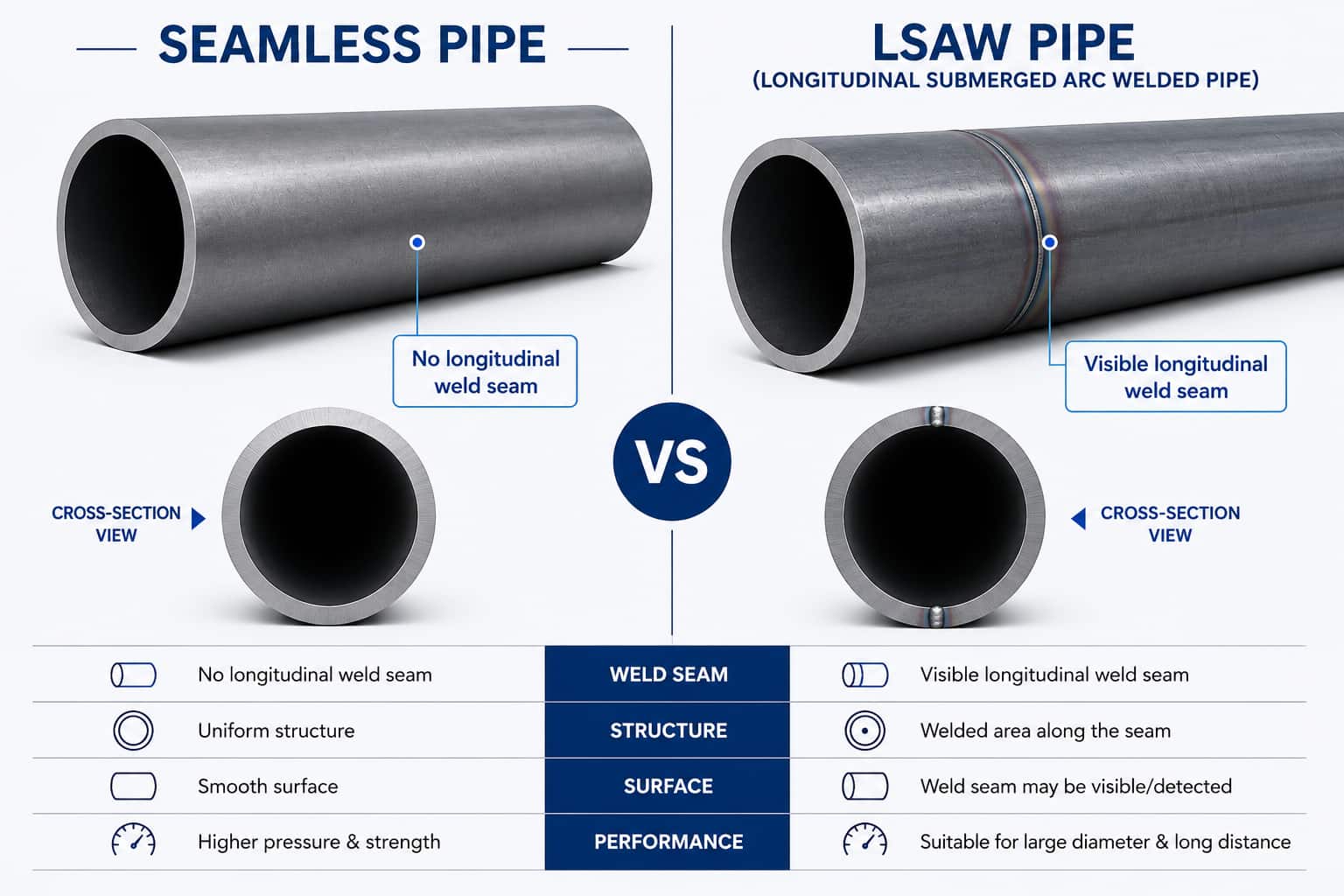
The core distinction starts on the production floor. A seamless pipe is formed from a solid round billet that is pierced and rolled into a hollow tube, so the finished pipe has no weld seam anywhere along its length. This is why seamless pipe is the default choice when a customer specifically wants to eliminate any weld-related risk.
LSAW pipe (Longitudinal Submerged Arc Welded pipe) starts from a flat steel plate. The plate is formed into a cylindrical shape and then joined with a single longitudinal submerged arc weld, followed by full-length UT/RT inspection and hydrostatic testing. For how seamless tube is pierced and rolled, see our seamless pipe manufacturing process page.
In terms of governing standards, seamless pipe is typically specified to ASTM A106 or A53 for standard pressure applications, while LSAW pipe is most often supplied to API 5L or ASTM A672, depending on whether the project is a pipeline or process piping application. Confirming which standard your project calls for is usually the first step in narrowing down pipe type.
Strength comparisons should be read in context of the application, not as a blanket ranking. Seamless pipe has an advantage in high-pressure and high-temperature applications because there is no weld seam to account for in the stress calculation. Under ASTM A106, for example, seamless carbon steel pipe is rated for service roughly from -29°C (-20°F) up to about 427°C (800°F), and standard hydrostatic test pressures run up to 2,500 psi for NPS 3 pipe and 2,800 psi for larger sizes — figures that make it a common choice for boiler tubes and hydraulic lines where pressure cycling and heat are constant factors.
LSAW pipe, on the other hand, provides reliable performance for large-diameter pipeline projects once the weld seam has passed UT, RT, and hydrostatic inspection. Under API 5L, LSAW pipe is available across a wide grade range — from Grade B (35,000 psi / 241 MPa minimum yield) up through X70 and X80 (70,000–80,000+ psi / 483–550+ MPa minimum yield) — which lets engineers dial in the strength needed for a given pressure class without switching to seamless. PSL2-grade LSAW pipe adds Charpy impact testing and tighter chemical composition limits, which is why it's specified on most modern long-distance transmission lines.
Seamless Pipe Applications:
Boiler tubes — codes such as ASME B31.1 and the ASME Boiler and Pressure Vessel Code favor seamless construction for fired equipment, since there's no weld seam to monitor under continuous thermal cycling.
Hydraulic systems — hydraulic lines see frequent pressure pulses; a seamless wall handles that fatigue loading more predictably than a welded one.
High-pressure equipment — wellhead assemblies, high-pressure vessels, and similar equipment where a single point of weld failure isn't an acceptable risk.
LSAW Pipe Applications:
Oil and gas pipelines — long-distance transmission lines commonly specify LSAW in grades from X52 up to X80 under API 5L, balancing strength with manageable wall thickness.
Large diameter transmission pipelines — trunk lines in the 20"–48" range routinely use LSAW because seamless production isn't practical at that bore size.
Structural projects — piling and structural columns benefit from LSAW's ability to combine large diameter with heavy wall thickness at a manageable cost.
Choose seamless pipe when:
Your project has high-pressure requirements
The line operates in high-temperature service
You need smaller diameter pipe
Choose LSAW pipe when:
The project calls for large-diameter pipeline
Heavy wall thickness is required
Cost-effective transportation of large volumes matters
In practice, many pipeline projects don't choose one pipe type exclusively. It's common to specify LSAW pipe for the long-distance transmission mainline, where large diameter and cost efficiency matter most, while reserving seamless pipe for high-pressure connection points, wellhead equipment, or short runs where pressure and temperature exceed what the mainline sees. Structuring the spec this way often gives the best balance of performance and cost across the full project.
Seamless pipe generally costs more per ton, particularly as diameter and wall thickness increase, because piercing and rolling a solid billet becomes less efficient — and yields more scrap — the larger the target diameter gets. LSAW pipe is more economical for large-diameter applications since plate-forming and welding scale more predictably with size, which is why most long-distance, large-bore pipelines specify LSAW rather than seamless. Exact price gaps vary by mill, grade, and market conditions, so it's worth requesting quotes for both pipe types at your specific size and grade rather than assuming a fixed differential.
As a size reference point, a typical long-distance gas transmission project might specify 24" OD, X70-grade LSAW pipe with a 12–15mm wall for the mainline, while using seamless A106-grade pipe in smaller diameters (2"–6") for the high-pressure metering and wellhead connections feeding into it — a combination that matches pipe construction to the actual pressure and diameter each section needs, rather than over-specifying one pipe type across the whole project.
What is the main difference between seamless pipe and LSAW pipe?
Seamless pipe is formed from a solid billet with no weld seam, while LSAW pipe is made from rolled steel plate joined by a longitudinal submerged arc weld. In practical terms, that's also why their size ranges barely overlap: seamless tops out around 24" NPS, while LSAW starts around 16" and runs up to 60" or more.
Is seamless pipe stronger than LSAW pipe?
Not universally. Seamless pipe is rated for pressure and temperature service up to roughly 427°C (800°F) under ASTM A106, which suits high-pressure, high-temperature lines. LSAW pipe, once welded and inspected, is available in grades up to X80 under API 5L — strong enough for the pressure classes used on most large-diameter transmission pipelines.
Is LSAW pipe suitable for oil and gas pipelines?
Yes. LSAW pipe is a standard choice for oil and gas transmission lines, particularly in large diameters, and is commonly supplied to API 5L PSL1 or PSL2 specifications — PSL2 adds Charpy impact testing and tighter chemistry limits for higher-pressure, higher-grade service.
Which is cheaper, seamless pipe or LSAW pipe?
LSAW pipe is generally more cost-effective for large-diameter projects, while seamless pipe costs more due to lower material yield during piercing and rolling at larger sizes. The exact gap depends on grade, size, and current mill pricing, so it's worth quoting both for your specific spec rather than assuming a fixed percentage.
Related articles:
