


Seamless pipe vs SSAW pipe is a common comparison for buyers evaluating steel pipe for pressure, structural, or pipeline projects. The two products come from different manufacturing routes, and that difference shapes weld seam presence, size capability, typical applications, and cost. This article compares seamless pipe and SSAW pipe directly across these factors so you can match the right product to your project's standards, operating conditions, and specification requirements.
|
Factor |
Seamless Pipe |
SSAW Pipe |
|
Manufacturing Method |
Billet piercing and forming |
Spiral submerged arc welding |
|
Weld Seam |
No longitudinal weld seam |
Spiral weld seam |
|
Starting Material |
Round billet |
Steel coil |
|
Production Advantage |
Suitable for seamless construction |
Suitable for large-diameter production |
|
Common Applications |
Pressure and critical service |
Large-diameter pipelines and structural applications |
|
Cost |
Generally higher |
Often more economical for suitable applications |
The manufacturing route is the starting point for every other difference between these two products.
Seamless pipe starts from a solid round billet. The billet is heated and pierced through its center, then formed and drawn or rolled into a hollow tube with the required outside diameter and wall thickness. Because the pipe body is formed from a single piece of steel, no longitudinal weld seam is created during this process. This manufacturing route sets the baseline for seamless pipe's typical role in applications where a continuous, unwelded pipe wall is specified.
SSAW pipe (spiral submerged arc welded pipe) starts from steel coil rather than solid billet. The coil is uncoiled, formed into a spiral or helical shape, and the edges are joined using submerged arc welding, which creates a spiral weld seam running the length of the pipe. This coil-based, spiral-forming approach is commonly suitable for producing pipe efficiently across a wide range of diameters, particularly larger sizes where coil width and spiral geometry work to the manufacturer's advantage.
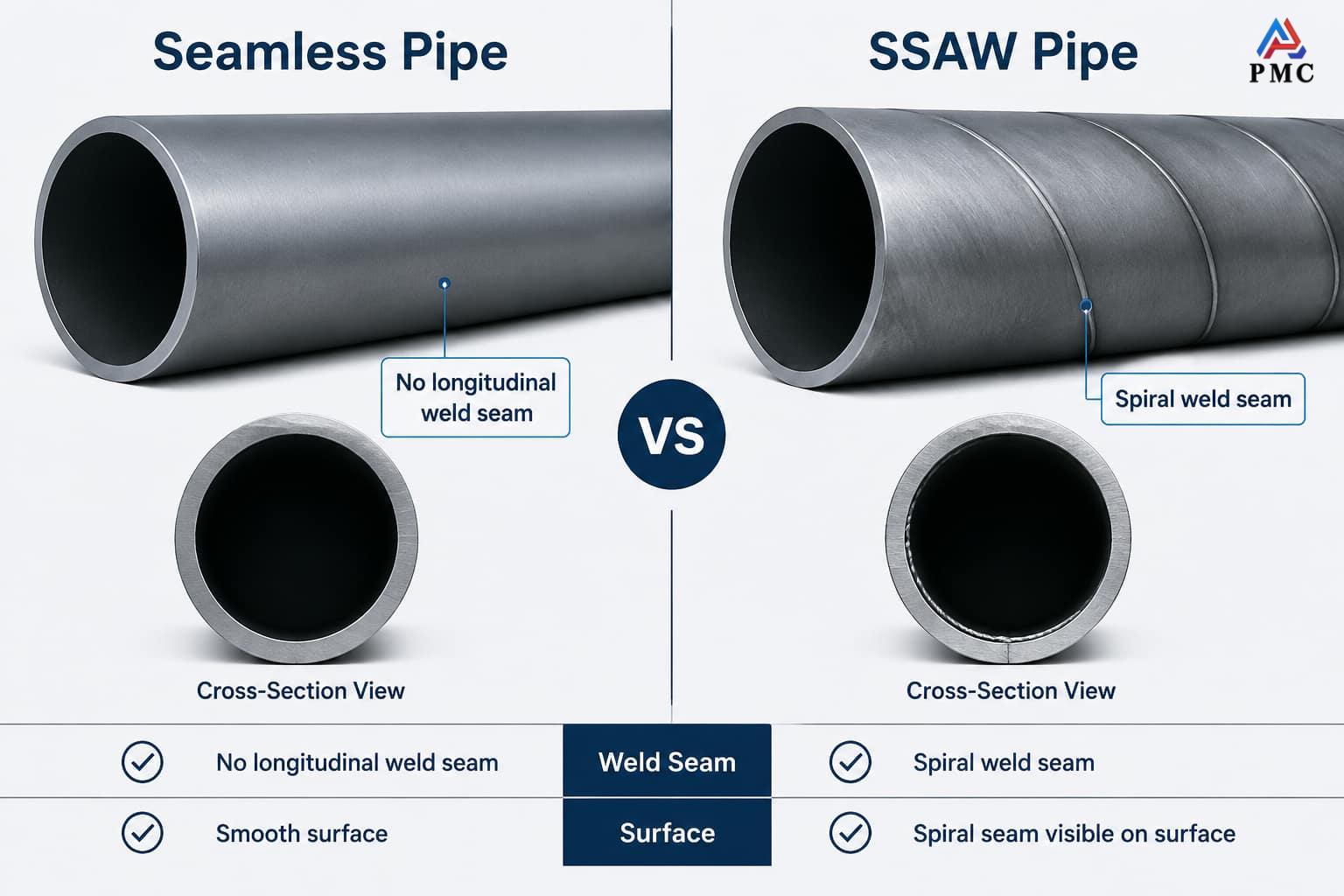
The weld seam is the most visible distinction between the two products. Seamless pipe has no longitudinal weld seam, since the pipe wall is formed from a single billet. SSAW pipe has a spiral weld seam created during the submerged arc welding process.
This structural difference does not by itself determine which pipe performs better in a given application. Pipe performance depends on manufacturing control, the applicable standard, material grade, and inspection requirements such as non-destructive testing and hydrostatic testing. Both seamless and SSAW pipe are manufactured and qualified under recognized industry standards, and a project specification will typically call out which construction type — and which testing regime — is required.
SSAW pipe has a practical advantage in large-diameter production. Because the pipe is formed by spiraling steel coil rather than piercing solid billet, manufacturers can produce large outside diameters from moderate coil widths, which makes the spiral process well suited to large-diameter pipeline and structural projects.
Seamless pipe is also available across a range of sizes, with the specific diameter and wall thickness capability depending on the manufacturer's forming and rolling equipment and the standard being followed. For projects with detailed dimensional requirements, size availability should be confirmed against the applicable standard and the supplier's production range rather than assumed from the manufacturing method alone.
Seamless Pipe Common Applications:
Pressure piping
High-temperature service
Critical industrial applications
Oil and gas applications where seamless construction is specified
SSAW Pipe Common Applications:
Water transmission pipelines
Large-diameter pipelines
Piling
Structural applications
Application suitability is not a simple matter of seamless for high pressure and SSAW for low pressure. What a pipe is qualified for depends on the applicable standard, material grade, wall thickness, design pressure, service temperature, and the specific project requirements set by the engineer or specification. The manufacturing method is one input into that qualification, not the sole determining factor.
Seamless pipe generally involves a more complex manufacturing process, from billet piercing through multiple forming and sizing stages, which typically places it at a higher cost point. SSAW pipe, produced from coil through a spiral forming and welding process, can be more economical for large-diameter applications where it is a suitable and specified option.
Actual pricing for either product depends on diameter, wall thickness, material grade, applicable standard, and order quantity. Buyers comparing costs should request quotations based on their specific project parameters rather than relying on manufacturing method alone as a cost indicator.
The right question is not which pipe is better overall, but which one is suitable for your application.
Choose Seamless Pipe When:
Seamless construction is required by the project or design
Critical service conditions exist, such as high pressure or elevated temperature
The applicable specification calls for seamless pipe
Choose SSAW Pipe When:
Large diameter is required
Welded pipe construction is acceptable under the project specification
The application is a pipeline, piling, or structural project suited to spiral-welded pipe
The correct choice depends on project requirements, applicable standards, and operating conditions. Reviewing the governing specification early helps narrow the decision before comparing suppliers or pricing.
Is SSAW pipe seamless?
No. SSAW pipe is a welded pipe with a spiral weld seam formed by submerged arc welding.
Is seamless pipe stronger than SSAW pipe?
There is no simple yes or no answer. Performance depends on material grade, wall thickness, manufacturing quality, the applicable standard, and testing requirements. Both seamless and SSAW pipe can meet strength and service requirements when produced and qualified correctly under the relevant specification.
Why is SSAW pipe commonly used for large diameters?
The spiral forming process allows large-diameter pipe to be produced efficiently from steel coil, which makes SSAW a common choice for large-diameter pipeline and structural projects.
Seamless pipe and SSAW pipe represent two different manufacturing approaches to steel pipe production. Seamless pipe is formed from billet and has no longitudinal weld seam, while SSAW pipe is formed from coil and has a spiral weld seam. SSAW pipe is often suitable for large-diameter applications, while seamless pipe is selected when seamless construction is required by the project or specification. Final selection should be based on the applicable standard, service conditions, and specific project requirements rather than manufacturing method alone.
Technically reviewed by PMC's quality engineering team for accuracy against seamless and SSAW pipe manufacturing and inspection practice.
PMC manufactures and supplies both seamless steel pipe and SSAW steel pipe, giving project teams a single source for comparing construction types against their specification requirements. Every batch is inspected in-house for dimensional accuracy and weld seam quality before shipment. PMC supplies seamless and SSAW pipe to oil & gas, water transmission, and structural/piling projects worldwide.
Related articles:
