


Unlike carbon steel, stainless steel pipe is dimensioned under a separate standard (ASME B36.19M), and its pressure capacity depends on grade-specific allowable stress values that shift with temperature. This guide lays out the dimensional data you need, explains how pressure rating is actually determined, and shows where 304 and 316 diverge — so you can size a line correctly instead of relying on a schedule number alone.
The stainless steel pipe pressure rating is the maximum internal pressure a pipe of a given size, wall thickness, and material grade can safely withstand at a specified temperature, as determined under a recognized piping code. It's a calculated value, not a fixed property stamped on the pipe.
A few terms get used interchangeably in the field, but they mean slightly different things:
Working pressure — the pressure a piping system actually operates at during normal service. This is usually well below the pipe's maximum allowable rating, leaving margin for surges and upsets.
Design pressure — the pressure used as the basis for sizing the pipe wall, set at or above the maximum expected operating pressure, including a margin for transients.
Pressure rating (or maximum allowable working pressure) — the ceiling the pipe wall can support at the design temperature, calculated from wall thickness, diameter, and the material's allowable stress.
The reason you can't judge stainless steel pipe working pressure from schedule alone is that schedule only tells you wall thickness. Two pipes with identical Schedule 40S dimensions — one in 304, one in a high-nickel alloy — will have different pressure capacities because their allowable stress values differ. Temperature changes the picture further: allowable stress for austenitic stainless steel drops as temperature rises, so the same pipe rated for a given pressure at 100°F carries a lower rating at 500°F. Schedule sets the geometry; grade and temperature set the actual stainless steel pipe pressure capacity.
The table below lists nominal wall thickness by pipe size and schedule for stainless steel pipe manufactured to ASME B36.19M — the dimensional standard behind the "S" schedules (5S, 10S, 40S, 80S). Use this stainless steel pipe pressure chart as your quick-reference lookup before running the full calculation. For full dimensional data across all sizes, see our Stainless Steel Pipe Dimensions and Weight Chart and Stainless Steel Pipe Schedule Chart.
Wall thickness is a fixed, standardized value. Pressure rating is not — it depends on wall thickness combined with the stainless steel grade, the design temperature, and the piping code applied (ASME B31.3, B31.1, or an equivalent EN standard). Most rows below are left as "calculate per code" for that reason. Where we could source a fully-specified, verifiable example (grade + temperature + code + assumptions all stated), we've included the calculated pressure directly in the table — see the note underneath for exactly which conditions those numbers apply to. Note that the figures in the table are the calculated maximum allowable working pressure (MAWP), not a recommended operating pressure — see Pressure Rating vs Working Pressure below for how the two differ.
|
Pipe Size (NPS) |
Schedule |
Nominal Wall Thickness (in / mm) |
Stainless Steel Grade |
Pressure Rating (MAWP) |
|
1/2" |
5S |
0.065" / 1.65 mm |
316/316L (seamless) |
≈ 2,755 psig* |
|
1/2" |
10S |
0.083" / 2.11 mm |
316/316L (seamless) |
≈ 3,584 psig* |
|
1/2" |
40S |
0.109" / 2.77 mm |
316/316L (seamless) |
≈ 4,836 psig* |
|
1/2" |
80S |
0.147" / 3.73 mm |
316/316L (seamless) |
≈ 6,796 psig* |
|
2" |
5S |
0.065" / 1.65 mm |
316/316L (seamless) |
≈ 935 psig* |
|
2" |
10S |
0.109" / 2.77 mm |
316/316L (seamless) |
≈ 1,591 psig* |
|
2" |
40S |
0.154" / 3.91 mm |
316/316L (seamless) |
≈ 2,284 psig* |
|
2" |
80S |
0.218" / 5.54 mm |
316/316L (seamless) |
≈ 3,309 psig* |
|
4" |
5S |
0.083" / 2.11 mm |
316/316L (seamless) |
≈ 625 psig* |
|
4" |
10S |
0.120" / 3.05 mm |
316/316L (seamless) |
≈ 910 psig* |
|
4" |
40S |
0.237" / 6.02 mm |
316/316L (seamless) |
≈ 1,836 psig* |
|
4" |
80S |
0.337" / 8.56 mm |
316/316L (seamless) |
≈ 2,661 psig* |
|
8" |
5S |
0.109" / 2.77 mm |
316/316L (seamless) |
≈ 426 psig* |
|
8" |
10S |
0.148" / 3.76 mm |
316/316L (seamless) |
≈ 581 psig* |
|
8" |
40S |
0.322" / 8.18 mm |
316/316L (seamless) |
≈ 1,285 psig* |
|
8" |
80S |
0.500" / 12.70 mm |
316/316L (seamless) |
≈ 2,030 psig* |
*Every figure above is a worked example, not a universal rating. All apply only to: ASTM A312 TP316/316L seamless pipe, 100°F (38°C) ambient service, allowable stress S = 16,700 psi, quality factor E = 1.0 (standard for seamless pipe — welded pipe uses a lower E depending on the weld's NDE, which lowers the result), and wall-thickness coefficient Y = 0.4, in the ASME B31.3 Barlow-style equation (P = 2×S×E×t / (D − 2×Y×t)), using nominal (not mill-tolerance-reduced) wall thickness. Change the grade (e.g., standard 304/316 non-L, which carries S ≈ 20,000 psi at 100°F and yields a higher number), the temperature, the manufacturing method, the code, or account for mill tolerance and corrosion allowance, and every number here changes — recalculate for your actual project conditions using the method in "How to Calculate" below. For sizes not shown here, or for 304/304L at these same sizes, use the same method — see the full dimensional data linked above for the wall thickness input.
Piping codes such as ASME B31.3 calculate maximum internal pressure using a form of the Barlow equation, adjusted for wall thickness allowances:
P = 2 × S × t / (D − 2 × Y × t)
Where:
Worked example: Take a 4" 40S pipe in ASTM A312 TP316/316L, seamless, at 100°F, per ASME B31.3. OD = 4.500 in, nominal wall thickness t = 0.237 in, allowable stress S = 16,700 psi (ASME B31.3 Table A-1, TP316L at 100°F), quality factor E = 1.0 (seamless), Y = 0.4 (austenitic stainless below the creep range):
P = 2 × 16,700 × 1.0 × 0.237 / (4.500 − 2 × 0.4 × 0.237) ≈ 1,836 psig
Swap in standard (non-L) 316 or 304, which carries a higher allowable stress of about 20,000 psi at the same temperature, and the same pipe works out to roughly 2,199 psig — same dimensions, different grade, different rating. Change the temperature, the manufacturing method (welded pipe uses a lower E), or the code, and the result moves again.
This is why we don't publish a single pressure-per-schedule number as a blanket rule: the correct stainless steel pipe pressure rating for your project depends on the exact grade, temperature, and code you're designing to. In practice, most engineering teams either run this calculation directly from the applicable code tables or use software/vendor tools that reference the current edition of ASME B31.3, B31.1, or the relevant EN standard — always confirm against the current edition, since allowable stress tables are periodically revised.
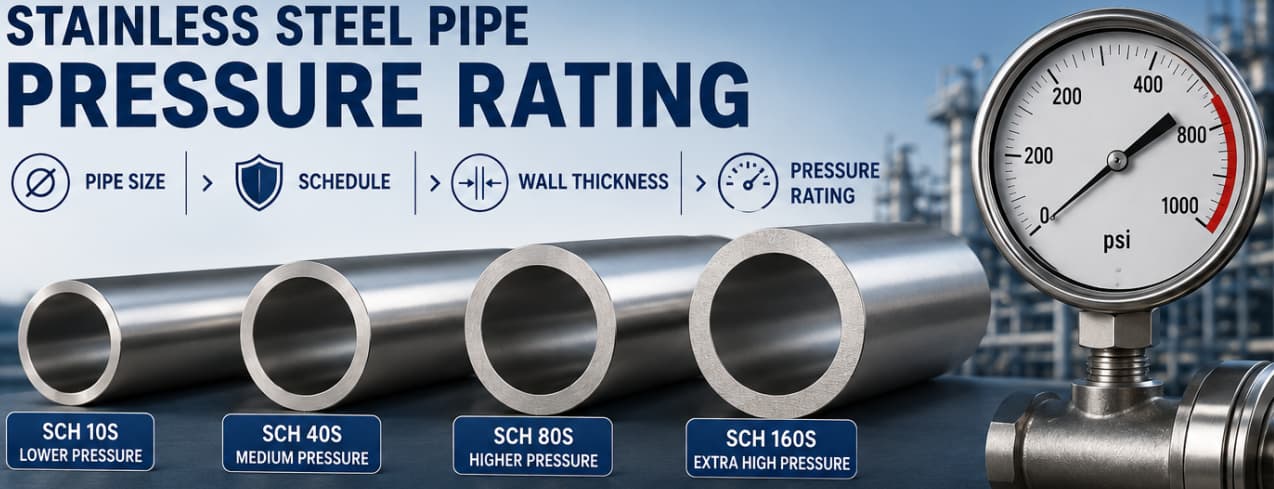
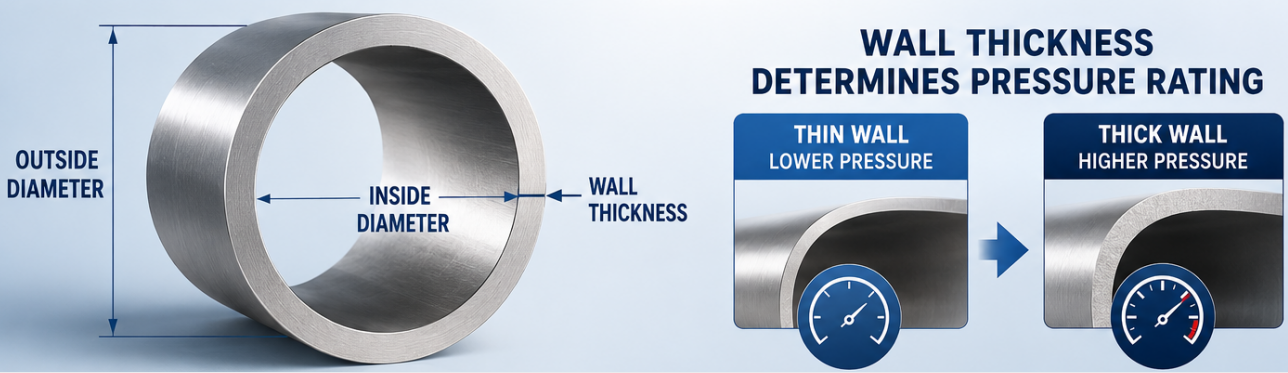
Since wall thickness (t) sits directly in the pressure formula above, schedule selection is the most direct way to change a pipe's pressure capacity without altering its diameter — ASME B36.19M assigns one fixed wall thickness per schedule at each pipe size. Using 4" TP316/316L pipe at 100°F as an example (the same case worked out above), moving from SCH 5S to SCH 80S roughly quadruples the wall thickness — and the calculated pressure rating climbs by nearly the same factor:
SCH 5S → SCH 10S: wall thickness goes from 0.083" to 0.120" (+45%); calculated pressure rating goes from ≈625 psig to ≈910 psig.
SCH 10S → SCH 40S: wall thickness nearly doubles again to 0.237"; pressure rating rises to ≈1,836 psig.
SCH 40S → SCH 80S: wall thickness reaches 0.337"; pressure rating reaches ≈2,661 psig — about 4.3× the SCH 5S figure, at the cost of a smaller bore and more weight per foot.
This stainless steel pipe schedule pressure rating relationship — thicker wall, higher rating — holds within a single grade and temperature, but it isn't perfectly linear, since the formula's denominator also shifts slightly as wall thickness increases. Change the grade or the design temperature and the same jump in schedule produces a different final psi number; see the calculation section for why.
At the same pipe size, schedule, and temperature, 304 stainless steel pipe and 316 stainless steel pipe have comparable — but not identical — allowable stress values, since both are austenitic grades governed by similar tensile and yield strength minimums in ASME B31.3 Table A-1.
In practical terms:
304 stainless steel pipe pressure rating and 316 stainless steel pipe pressure rating are close enough that pressure capacity is rarely the deciding factor between the two grades for a given schedule and temperature.
The real difference between 304 and 316 in most projects is corrosion resistance, not pressure containment — 316's molybdenum content gives it better resistance to chlorides and other aggressive media, which matters far more in marine, chemical, and coastal applications.
Low-carbon variants (304L, 316L) carry slightly lower allowable stress than their standard counterparts, which does translate to a marginally lower pressure rating at a given wall thickness — but the difference is used for weldability and intergranular corrosion resistance, not for gaining pressure margin.
Bottom line: pick 304 vs. 316 based on the service environment and corrosion exposure, then confirm the pressure rating for whichever grade you choose using the design temperature and code that apply to your project.
Six variables determine the actual pressure a given length of stainless steel pipe can handle:
Pipe diameter — For a fixed wall thickness, pressure capacity decreases as diameter increases. Larger-diameter pipe needs a thicker wall to hold the same pressure as a smaller one.
Wall thickness — The dominant variable. Pressure capacity scales roughly with wall thickness for a given diameter, which is why schedule selection is the first lever engineers pull when a line needs more pressure margin.
Stainless steel grade — Allowable stress varies by grade (304 vs. 316 vs. 321 vs. duplex grades, for example), and duplex or super-duplex stainless steels carry meaningfully higher allowable stress than standard austenitic grades, giving them a real pressure-rating advantage at the same wall thickness.
Temperature — Allowable stress for austenitic stainless steel falls as temperature rises, particularly above roughly 300°F (150°C), so the same pipe has a lower pressure rating at elevated temperature than it does at ambient conditions.
Pipe manufacturing method — Seamless and welded pipe are not treated identically under piping codes. Welded pipe carries a weld joint efficiency factor (E) that can reduce the calculated pressure rating relative to seamless pipe of the same dimensions, unless the weld has been fully radiographed.
Applicable design code or standard — ASME B31.3, ASME B31.1, and EN 13480 (among others) each define allowable stress and design factors slightly differently, so the same physical pipe can carry a different calculated pressure rating depending on which code governs the project.
As defined earlier, pressure rating is the calculated ceiling and working pressure is what the system actually runs at — the two are related but shouldn't be treated as the same number when you're specifying a pipe.
A pipe with a calculated pressure rating of, say, several hundred psi at a given temperature is not meant to be operated right at that ceiling continuously. Codes like ASME B31.3 do allow limited, short-duration excursions above the design condition, but routine operation at or near the maximum rating erodes the safety margin the design was built around. Good practice is to select pipe size, schedule, and grade so the calculated rating comfortably exceeds your intended working pressure, not just matches it.
What pressure can a stainless steel pipe handle?
It depends on diameter, wall thickness (schedule), grade, and design temperature — there's no single number across all sizes and grades. That's why a stainless steel pipe pressure rating chart organizes the variables by size and schedule rather than quoting one figure: the actual pressure is calculated from the material's allowable stress at temperature plus the pipe's dimensions, per the applicable code (commonly ASME B31.3).
What is the pressure rating of SCH 40 stainless steel pipe?
It varies by size, grade, and temperature. A 2" SCH 40S pipe and an 8" SCH 40S pipe carry very different ratings despite sharing a schedule, since capacity depends on the diameter-to-wall-thickness ratio, not the schedule number alone. Check the size against the stainless steel pipe pressure rating table above, or calculate the specific case using the formula and allowable stress table in your governing code.
Is 316 stainless steel pipe stronger than 304?
Not meaningfully for pressure containment — their allowable stress values are close. 316's real advantage is corrosion resistance, especially against chlorides, which is why it's specified for marine and aggressive chemical service rather than for extra pressure capacity.
Does a higher Schedule mean a higher pressure rating?
Within the same size, grade, and temperature, yes — thicker wall means higher rating. But schedule can't be compared across different grades or temperatures; a thick-wall pipe in the wrong grade for a hot, corrosive service can still be under-rated.
How do I choose a stainless steel pipe for high pressure?
Start from your design pressure and temperature. Pick a grade with adequate corrosion resistance for the media, then a schedule whose wall thickness meets the required rating at that temperature, and add margin for manufacturing tolerance, corrosion allowance, and pressure transients rather than designing to the calculated limit.
Technically reviewed by PMC's quality engineering team for dimensional accuracy against ASME B36.19M and calculation methodology against ASME B31.3.
PMC is an ISO 9001:2008-certified manufacturer of stainless steel pipe, producing seamless and welded pipe to ASME B36.19M and equivalent international standards across every schedule covered in this chart, from SCH 5S through SCH 80S. Every batch is dimensionally inspected in-house before shipment, with wall thickness and OD checked against the same B36.19M tolerances referenced above. PMC supplies TP304/304L and TP316/316L pipe — the grades used in the worked pressure examples on this page — to petrochemical, water treatment, power generation, and marine & offshore projects worldwide.
Related articles:
304 Stainless Steel Pipe Specifications
316 Stainless Steel Pipe Specifications: Grades, Standards, Sizes
