


That's the core relationship to keep in mind: Schedule and stainless steel pipe wall thickness are linked, but not interchangeable. The same schedule number produces a different wall thickness at every NPS. NPS, meanwhile, is simply the nominal size designation used to identify the pipe — it's tied to a fixed outside diameter, not to wall thickness at all. Confusing the two is one of the most common ordering mistakes in piping procurement, so this guide walks through what stainless steel pipe schedule actually means, gives you a full stainless steel pipe schedule chart to work from, and explains how to choose the right one for your application.
Stainless steel pipe schedules follow ASME B36.19M, which uses an "S" suffix — 5S, 10S, 40S, 80S — to distinguish them from the carbon and alloy steel schedules defined in ASME B36.10M. You'll occasionally see stainless pipe specified without the "S" (just "Sch 40"), but technically that designation belongs to carbon steel; for stainless steel pipe, the S-series is the correct reference.
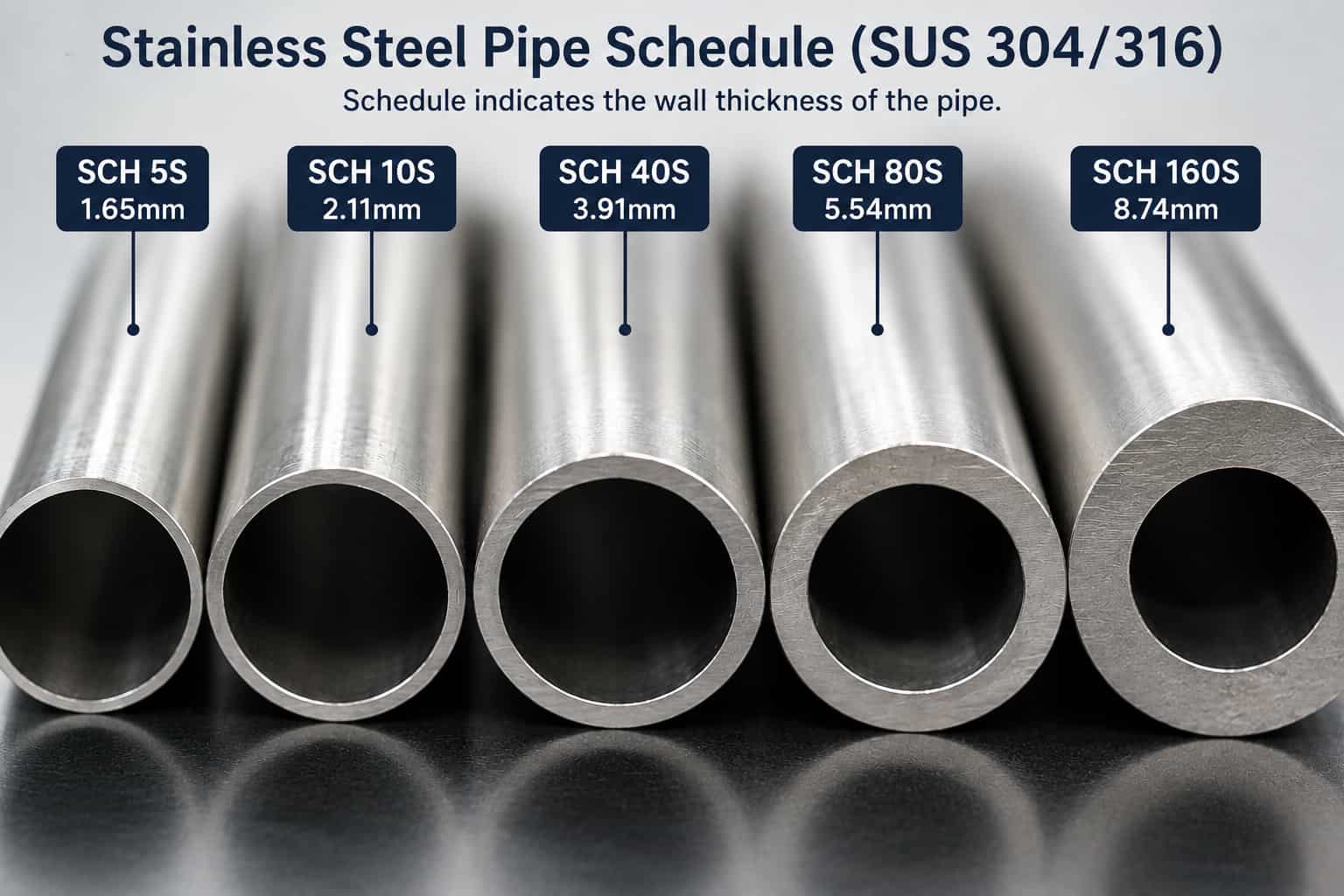
The four schedules you'll encounter most often:
SCH 5S – thinnest wall in the standard S-series, common in low-pressure and sanitary applications where light weight matters more than pressure capacity.
SCH 10S – a step up in wall thickness, widely used for general-purpose stainless piping, especially in welded pipe for process and water systems.
SCH 40S – the most commonly specified schedule for stainless pipe, comparable to "standard weight" and suitable for a broad range of pressure and structural applications.
SCH 80S – heavier wall thickness for higher-pressure service or where extra corrosion allowance is needed over the service life of the pipe.
The key thing to understand is that "SCH 40S" is not a fixed dimension — it's a wall-thickness category that changes with pipe size, covered in more detail below. That's exactly why a chart, rather than a single number, is the only reliable way to look up dimensions.
The table below lists outside diameter (OD) and wall thickness in inches for NPS 1/2" through 12", per ASME B36.19M, covering the four most-used stainless schedules.
|
NPS |
OD (in) |
SCH 5S (in) |
SCH 10S (in) |
SCH 40S (in) |
SCH 80S (in) |
|
1/2" |
0.840 |
0.065 |
0.083 |
0.109 |
0.147 |
|
3/4" |
1.050 |
0.065 |
0.083 |
0.113 |
0.154 |
|
1" |
1.315 |
0.065 |
0.109 |
0.113 |
0.179 |
|
1-1/4" |
1.660 |
0.065 |
0.109 |
0.140 |
0.191 |
|
1-1/2" |
1.900 |
0.065 |
0.109 |
0.145 |
0.200 |
|
2" |
2.375 |
0.065 |
0.109 |
0.154 |
0.218 |
|
2-1/2" |
2.875 |
0.083 |
0.120 |
0.203 |
0.276 |
|
3" |
3.500 |
0.083 |
0.120 |
0.216 |
0.300 |
|
4" |
4.500 |
0.083 |
0.120 |
0.237 |
0.337 |
|
5" |
5.563 |
0.109 |
0.134 |
0.258 |
0.375 |
|
6" |
6.625 |
0.109 |
0.134 |
0.280 |
0.432 |
|
8" |
8.625 |
0.109 |
0.148 |
0.322 |
0.500 |
|
10" |
10.750 |
0.134 |
0.165 |
0.365 |
0.500 |
|
12" |
12.750 |
0.156 |
0.180 |
0.375 |
0.500 |
Each schedule fits a different balance of weight, cost, and mechanical margin. The table below is a general guide to typical use — actual pressure suitability always needs to be verified against the applicable design code.
|
Schedule |
Wall Thickness |
Typical Characteristics |
Common Applications |
|
SCH 5S |
Thinnest |
Lightest weight, lowest material cost, least corrosion/wear allowance |
Sanitary piping, low-pressure fluid transfer, instrumentation lines |
|
SCH 10S |
Light-to-medium |
Good balance of weight and strength for welded construction |
General process piping, water and beverage lines, HVAC |
|
SCH 40S |
Standard |
Most widely stocked and specified; solid general-purpose margin |
Process piping, structural and mechanical piping, general industrial use |
|
SCH 80S |
Heavy |
Extra wall thickness for higher pressure or added corrosion allowance |
High-pressure lines, chemical processing, piping with long service-life requirements |
It's worth repeating this point on its own, because it's the source of most spec-sheet errors: schedule is not a fixed wall thickness — it's a wall-thickness category that scales with pipe size.
Take SCH 40S as an example:
A 2-inch SCH 40S pipe has an OD of 2.375" and a wall thickness of 0.154".
A 4-inch SCH 40S pipe has an OD of 4.500" and a wall thickness of 0.237".
Same schedule, same designation on the drawing — but the actual wall thickness is over 50% greater on the 4-inch pipe. If you're calculating weight, flow area, or pressure capacity, you always need the specific NPS-and-schedule combination, not just the schedule number on its own. This is also why pipe schedule charts exist in table form rather than as a single lookup value — there's no way to shortcut the NPS/schedule pairing.
Selecting a schedule isn't just a matter of picking a number off the chart. A few factors need to be considered together:
Working pressure – higher operating pressures generally call for a heavier schedule, calculated against the applicable design formula rather than assumed from habit.
Temperature – allowable stress for stainless steel drops at elevated temperatures, which can push a design toward a thicker wall even if the pressure itself is moderate.
Pipe size / NPS – because wall thickness scales with size within the same schedule, the right schedule for a 2-inch line won't automatically be right for a 10-inch line carrying the same service.
Material grade – 304/304L and 316/316L have different mechanical and corrosion properties, which affects both the allowable stress calculation and the corrosion allowance you may want to build in.
Applicable design standard – process piping, boiler piping, and structural piping are governed by different codes (ASME B31.3, B31.1, and others), each with its own approach to minimum wall thickness and allowable stress.
The short version: schedule is one input into a pressure-and-service calculation, not the calculation itself. Choosing a schedule based only on "what's usually used" for a given pipe size can leave you either over-specifying (unnecessary cost and weight) or, worse, under-specifying for the actual operating conditions. When in doubt, work from the design pressure and temperature back to the required minimum wall thickness, then select the lowest schedule that meets or exceeds it — for stainless steel seamless pipe in particular, this also needs to account for manufacturing tolerance on wall thickness.
The dimensional framework behind everything above comes from ASME B36.19M, which governs the standardization of dimensions for welded and seamless stainless steel pipe. It defines the S-series schedules (5S, 10S, 40S, 80S, and a few others depending on size) and pairs each with a fixed outside diameter for every NPS.
Two related concepts worth keeping straight when reading any stainless steel pipe dimensions chart:
NPS identifies the nominal size and fixes the outside diameter — it does not change based on wall thickness.
Schedule identifies the wall-thickness series and, combined with NPS, determines the actual wall thickness and resulting inside diameter.
For most sizes, SCH 40S and SCH 80S wall thicknesses line up with the equivalent carbon-steel Sch 40/Sch 80 values under B36.10M — but as noted above, SCH 10S at NPS 14–22, SCH 40S at NPS 12, and SCH 80S at NPS 10 and 12 are exceptions. That's exactly why it's worth checking the S-series chart directly rather than assuming a carbon-steel equivalent applies.
What does Schedule mean in stainless steel pipe?
Schedule is a standardized code (per ASME B36.19M for stainless steel) that indicates a pipe's wall thickness for a given NPS. It doesn't specify a single fixed thickness — the actual wall thickness depends on both the schedule number and the pipe's nominal size.
What's the difference between SCH 5S and SCH 80S wall thickness?
SCH 5S has the thinnest stainless steel pipe wall thickness in the S-series, typically used for low-pressure or sanitary lines, while SCH 80S has the thickest wall of the four common schedules and is used where higher pressure or extra corrosion allowance is needed. The gap between them widens as NPS increases — refer to the schedule chart above for exact values at your pipe size.
Is SCH 40 the same as SCH 40S?
Not officially. SCH 40 belongs to the carbon/alloy steel schedules under ASME B36.10M, while SCH 40S is the corresponding stainless steel schedule under ASME B36.19M. For most sizes up to NPS 12 the wall thicknesses happen to match, but they diverge at some larger and mid-range sizes, so the two shouldn't be treated as automatically interchangeable on a spec sheet.
How do I choose the right stainless steel pipe schedule?
Start from the working pressure, temperature, and applicable design standard, then calculate the minimum required wall thickness for your material grade and pipe size. Select the schedule that meets or exceeds that minimum, rather than choosing a schedule based on size alone.
Technically reviewed by PMC's quality engineering team against ASME B36.19M.
About Permanent Steel Manufacturing Co., Ltd (PMC)
PMC is an ISO 9001:2008-certified manufacturer of stainless steel pipe, producing seamless and welded pipe to ASME B36.19M and equivalent international standards across the schedules covered in this chart. Every batch is dimensionally inspected in-house before shipment, and PMC supplies petrochemical, water treatment, power generation, and marine & offshore projects worldwide.
Related articles:
Stainless Steel Pipe Pressure Rating
316 Stainless Steel Pipe Specifications: Grades, Standards, Sizes
