


To compare steel pipe supplier quotations, first confirm that every quotation matches your required specification and purchasing conditions. Then compare specifications, total cost, delivery, testing, and documentation side by side, using the same price basis and delivery point.
A steel pipe supplier quotation is a supplier's written response to a buyer's inquiry or RFQ. It sets out the pipe offered, the quantity, the price, and the commercial conditions. A complete steel pipe quotation usually contains:
|
Item |
What It Covers |
|
Pipe Specification |
Pipe type, grade, standard, size, length |
|
Quantity |
Tonnage, meters, or pieces quoted |
|
Price |
Unit price, total price, currency, price basis, validity |
|
Delivery |
Lead time, Incoterm, destination port |
|
Testing |
Tests are included in the price |
|
Documents |
Certificates and reports supplied with the shipment |
|
Payment Terms |
Deposit, balance, payment method (T/T, L/C) |
Before looking at price, check each quotation against your requirements:
Pipe type: Seamless pipe and welded pipe differ in production method and price. A quotation for one cannot replace a quotation for the other.
Material / grade: For example, API 5L Grade B and X52 are different grades with different strength and cost.
Standard: Confirm the standard, its edition, and any PSL level or supplementary requirements.
Size / wall thickness: Check OD, wall thickness or schedule, and the tolerance the supplier applies.
Length: Random length and fixed length are priced differently.
Quantity: A price quoted for 20 tons may not hold for 200 tons.
Testing requirements: Confirm that the tests you specified are included.
If the specifications are different, the quoted prices cannot be compared directly. A thinner wall, a lower grade, or a wider tolerance makes a quotation cheaper without making it a better offer. Ask the supplier to re-quote against your original specification, or record the deviation in your comparison.
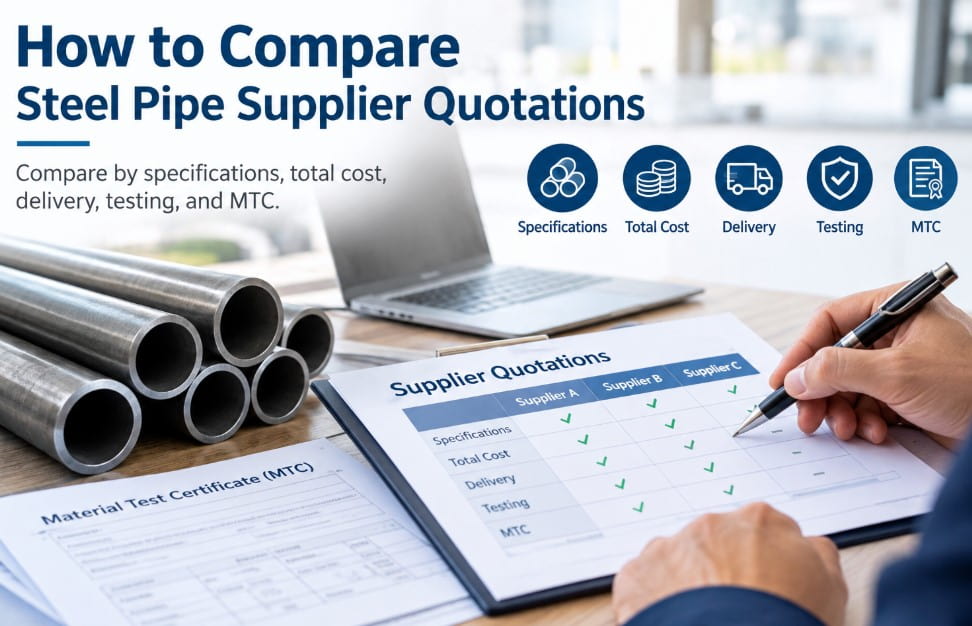
Compare these cost items for each supplier:
Unit price: Confirm the price basis first (per ton, per meter, or per piece). For per-ton prices, check whether the weight is theoretical or actual.
Total price: Multiply out the quantity and check that the supplier's total matches.
Freight / shipping cost: Check whether freight, insurance, and port charges are included or quoted separately.
Testing or inspection fees: Some suppliers include hydrostatic testing, NDT, or third-party inspection in the price. Others charge for them separately.
Other additional costs: These may include packing, bevelling, coating, marking, and cutting to length.
Do not compare unit price alone. Compare the total purchasing cost. Convert every quotation to the same price basis, currency, and delivery point before comparing totals. Also check each validity date, since steel prices move and an expired quotation is not a firm offer.
Lead time: Check whether it counts from order confirmation or from receipt of the deposit, and whether it covers production only or includes inspection and shipping.
Delivery terms / Incoterms: Record the term and named port each supplier quotes, such as FOB or CIF. This determines which freight costs belong in the total.
Payment terms: Compare the deposit percentage, the balance due date, and the payment method (T/T or L/C).
Shipment conditions: Check whether partial shipments are allowed and how the pipes will be packed for transport.
Testing scope and documents commonly differ between quotations. Compare the following:
Hydrostatic testing: Is it done on every pipe, and at what test pressure?
NDT: Check the method (e.g., ultrasonic, eddy current, or radiographic) and the coverage, whether full length or weld seam only.
Chemical and mechanical testing: Confirm which properties are tested, and whether testing is done per heat or per lot.
Third-party inspection: Check whether the supplier accepts your nominated inspector.
MTC: Confirm the certificate type (e.g., EN 10204 3.1 or 3.2) and the standard it follows. See the guide to steel pipe MTC for what a valid certificate should show.
Inspection reports: Check which reports are supplied and in what format. The steel pipe inspection guide explains what each inspection stage covers.
Use this table to compare steel pipe quotations side by side. Enter each detail exactly as written in the quotation.
|
Item |
Supplier A |
Supplier B |
Supplier C |
|
Grade |
|
|
|
|
Standard |
|
|
|
|
Size |
|
|
|
|
Quantity |
|
|
|
|
Unit Price |
|
|
|
|
Price Basis / Validity |
|
|
|
|
Total Cost |
|
|
|
|
Delivery (Lead Time + Incoterm) |
|
|
|
|
Testing |
|
|
|
|
MTC (Type) |
|
|
|
|
Payment Terms |
|
|
|
|
Remarks |
|
|
|
To find the differences between quotations:
1. Compare Grade, Standard, Size, and Quantity first, and flag any mismatch in Remarks.
2. Fill in Total Cost on the same basis, as described in Section 3.
3. Compare Delivery, Testing, MTC, and Payment Terms, and note anything one supplier includes that the others leave out.
4. Record open questions in Remarks and send them back to the supplier for confirmation.
When comparing steel pipe supplier quotations, unit price is only one line in the comparison. Start by confirming that every quotation covers the same grade, standard, size, and quantity. Then bring freight, testing fees, and other extras into a total cost on the same delivery basis, and compare lead time, payment terms, testing scope, and the MTC type each supplier will provide. Any item a quotation leaves unclear should be confirmed in writing before an order is placed, so that the quoted terms match the goods you receive.
If you already have several quotations to review, send us your specification and quantity. We can quote on the same basis, with testing, documents, and delivery terms stated clearly, so the comparison is straightforward.
