


Seamless steel pipe is manufactured from solid round steel billets through a series of forming processes without welding. Unlike welded pipes, seamless pipes do not have a longitudinal weld seam, resulting in a continuous steel structure.
The manufacturing process mainly involves billet preparation, heating, piercing, rolling, sizing, and inspection. Each step affects the final pipe quality, dimensional accuracy, and mechanical performance.
This article explains the basic manufacturing process of seamless steel pipes and how a solid billet is transformed into a finished seamless pipe.
A seamless steel pipe is a pipe produced from a solid steel billet without welding or joining.
During manufacturing, the billet is heated to a suitable temperature and pierced to form a hollow tube shell. The shell is then rolled and sized to achieve the required diameter and wall thickness.
Based on the production method, seamless pipe is generally classified into hot-rolled, cold-rolled, cold-drawn, extruded, and jacking (pushed) pipe.
The basic forming principle is:
Solid Round Billet → Hollow Tube Shell → Finished Seamless Pipe
Because there is no welded joint, seamless steel pipes provide uniform structure and are widely used in applications requiring high pressure resistance and reliability.
The production process starts with high-quality round steel billets.
Before entering production, billets are inspected to ensure they meet requirements for:
Chemical composition
Surface condition
Internal quality
The quality of the billet directly influences the performance of the finished seamless pipe. For a closer look at raw material selection criteria, see Seamless Steel Pipe Raw Material Selection and Production Process.
The round billet is heated in a furnace until it reaches the temperature required for plastic deformation.
Uniform heating is important because uneven temperature distribution may lead to:
Surface defects
Uneven deformation
Internal quality problems
After heating, the billet is ready for the piercing process.
After piercing, the hollow tube shell enters the rolling stage.
Rolling reduces wall thickness and increases pipe length while improving dimensional control.
Depending on production requirements, different rolling equipment may be used, including:
Continuous rolling mills
Mandrel mills
Plug mills
This stage determines the basic size and shape of the seamless pipe. For the full step-by-step equipment sequence, see Production Process Requirements for Seamless Steel Pipes. Material loss also occurs at this and other stages — see Manufacturing Loss Rate of Seamless Steel Pipe for typical loss rates by process step.
After rolling, the pipe passes through sizing equipment to achieve the final outside diameter and dimensional tolerance.
Straightening is performed to improve pipe shape and ensure the finished product meets customer requirements.
Before shipment, seamless steel pipes undergo inspection to confirm product quality.
Common inspection methods include:
Dimensional inspection
Surface inspection
Mechanical testing
Non-destructive testing (NDT)
Inspection requirements depend on the applicable standards and customer specifications.
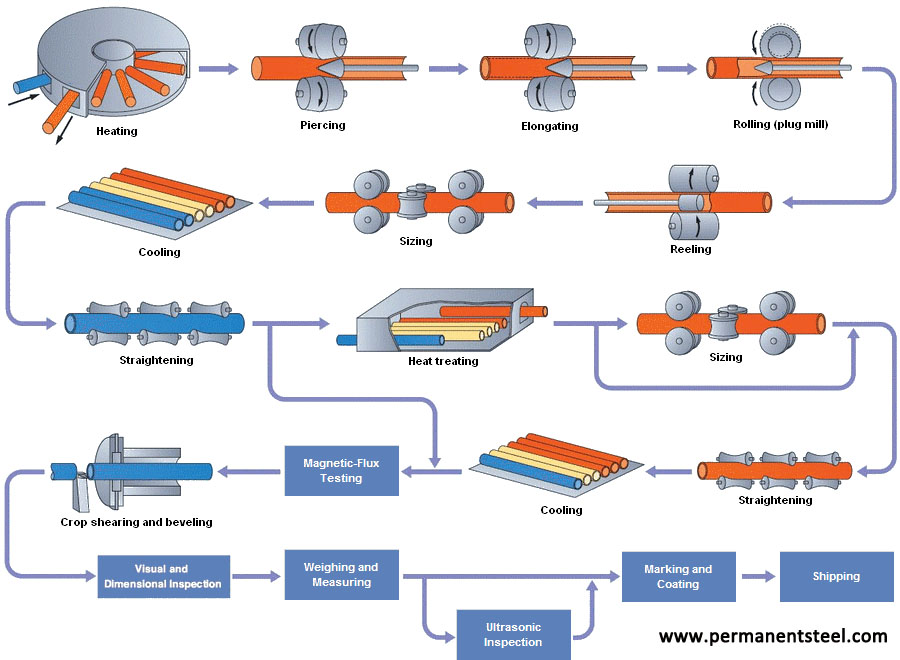
Seamless steel pipes can be produced using different manufacturing methods depending on pipe size, material grade, and application requirements. The main methods include:
|
Manufacturing Method |
Main Features |
|
Hot Rolling |
Common method for producing large-size seamless pipes |
|
Cold Drawing |
Improves dimensional accuracy and surface quality; typically performed on a single- or double-chain drawing machine rated 0.5–100 tons |
|
Cold Rolling |
Suitable for precision seamless tubes; typically carried out on a two-roll mill, where the pipe is formed within an annular cavity between a grooved roll and a stationary tapered mandrel |
|
Extrusion |
Used for special sizes and smaller-diameter pipe; the heated blank is pushed through a closed cylinder and forced out through a smaller die |
The typical manufacturing flow can be summarized as:
Round Billet Preparation → Heating → Piercing → Rolling → Sizing → Straightening → Inspection → Finished Seamless Pipe
Each production stage plays an important role in controlling pipe quality and ensuring the final product meets technical requirements.
The main difference between seamless and welded steel pipes is the forming method.
|
Item |
Seamless Steel Pipe |
Welded Steel Pipe |
|
Raw Material |
Solid round billet |
Steel plate or strip |
|
Forming Method |
Piercing and rolling |
Forming and welding |
|
Weld Seam |
No weld seam |
Contains welded joint |
|
Structure |
Continuous structure |
Welded structure |
Seamless pipes are commonly selected for applications where high pressure resistance and uniform mechanical properties are required. For a full comparison of pros and cons versus welded pipe, see Advantages and Disadvantages of Seamless Pipe.
Seamless pipe is selected across a wide range of industries and specifications. See What are Seamless Steel Pipes Used for? for a full breakdown of applications by industry.
Common carbon steel seamless pipe grades include ASTM A106, ASTM A53, and API 5L. Production is governed by a range of national and international standards (GB, ASTM, EN, JIS, API) — see SMLS Steel Pipe Manufacturing Standards for the full breakdown.
Seamless steel pipes are manufactured by heating solid round billets, piercing them into hollow shells, and processing them through rolling, sizing, straightening, and inspection.
Seamless pipe is most commonly made from carbon steel, but it also covers alloy steel and stainless steel, chosen based on pressure, temperature, and corrosion requirements.
Seamless pipe is widely used in oil and gas, power generation, chemical processing, construction, and machinery manufacturing, among other industries.
Piercing is the process of creating a hollow section inside a heated steel billet before further rolling and sizing.
The common methods include hot rolling, cold drawing, cold rolling, and extrusion.
Seamless pipe is formed from a solid billet by piercing and rolling, with no weld seam, while welded pipe is formed from steel plate or strip that is rolled and welded along a seam.
The seamless steel pipe manufacturing process transforms solid steel billets into finished pipes through controlled heating, piercing, rolling, sizing, and inspection.
A clear understanding of each manufacturing stage helps buyers evaluate pipe quality and select suitable seamless steel pipes based on application requirements.
Related:
