


ASTM A53 Steel Pipe Specifications define the key requirements for carbon steel pipes used in construction, water pipelines, gas distribution, and structural applications. This standard is widely used for both seamless and welded pipes, offering a balance of strength, cost, and versatility.
This page provides a complete overview of ASTM A53 pipe specs, dimensions, and grades, helping engineers, contractors, and buyers understand technical requirements and select the right pipe for different applications.
Whether you are looking for ASTM A53 pipe dimensions, mechanical properties, or grade differences, this guide covers all essential specifications in one place.
|
NPS (inch) |
OD (mm) |
SCH 40 WT (mm) |
SCH 80 WT (mm) |
SCH 40 ID (mm) |
SCH 80 ID (mm) |
|
1/2" |
21.3 |
2.77 |
3.73 |
15.76 |
13.84 |
|
3/4" |
26.7 |
2.87 |
3.91 |
20.96 |
18.88 |
|
1" |
33.4 |
3.38 |
4.55 |
26.64 |
24.30 |
|
1-1/4" |
42.2 |
3.56 |
4.85 |
35.08 |
32.50 |
|
1-1/2" |
48.3 |
3.68 |
5.08 |
40.94 |
38.14 |
|
2" |
60.3 |
3.91 |
5.54 |
52.48 |
49.22 |
|
3" |
88.9 |
5.49 |
7.62 |
77.92 |
73.66 |
|
4" |
114.3 |
6.02 |
8.56 |
102.26 |
97.18 |
|
6" |
168.3 |
7.11 |
10.97 |
154.08 |
146.36 |
|
8" |
219.1 |
8.18 |
12.70 |
202.74 |
193.70 |
|
10" |
273.0 |
9.27 |
15.09 |
254.46 |
242.82 |
|
12" |
323.8 |
10.31 |
17.48 |
303.18 |
288.84 |
OD (Outside Diameter) is fixed for each NPS size.
Wall Thickness (WT) increases with schedule number.
ID (Inside Diameter) decreases as wall thickness increases.
SCH 40 = standard thickness, widely used
SCH 80 = thicker wall, higher pressure capacity
Related: ASTM A53 Pipe Size Chart
ASTM A53 pipes are classified into two main grades: Grade A and Grade B, which are often searched under the keyword ASTM A53 Grade A vs Grade B Pipes for comparison and selection purposes.
Grade A – Lower strength, suitable for basic applicationsIn practice, ASTM A53 Grade B is the dominant choice due to its better mechanical performance.
3.1 A53 vs ASTM A106
|
Feature |
ASTM A53 |
|
|
Application |
General purpose |
High temperature & pressure |
|
Pipe Type |
Seamless & welded |
Seamless only |
|
Cost |
Lower |
Higher |
ASTM A106 is preferred for high-temperature services, while A53 is more economical.
|
Feature |
ASTM A53 |
API 5L |
|
Application |
General piping |
Oil & gas pipelines |
|
Standard Level |
Moderate |
Strict |
|
Strength Grades |
Limited |
Wide range (X42–X70) |
American Petroleum Institute API 5L pipes are designed for pipeline transportation, with stricter requirements.
Related: ASTM A53 vs ASTM A500 Steel Pipe
Chemical Properties %
|
/ |
Grade |
C,
max
|
Mn,
max
|
P,
max
|
S,
max
|
Cu*,
max
|
Ni*,
max
|
Cr*,
max
|
Mo*,
max
|
V*,
max
|
|
Type S (Seamless) |
A | 0.25 | 0.95 |
0.05 |
0.05 |
0.4 |
0.4 |
0.4 |
0.15 | 0.08 |
| B | 0.3 | 1.2 |
0.05 |
0.05 |
0.4 |
0.4 |
0.4 |
0.15 |
0.08 |
|
|
Type E (Electric-resistance Welded) |
A | 0.25 |
0.95 |
0.05 |
0.05 |
0.4 |
0.4 |
0.4 |
0.15 |
0.08 |
| B | 0.3 | 1.2 |
0.05 |
0.05 |
0.4 |
0.4 |
0.4 |
0.15 |
0.08 |
|
|
Type F (Furnace-welded) |
A | 0.3 | 1.2 |
0.05 |
0.05 |
0.4 |
0.4 |
0.4 |
0.15 |
0.08 |
*The total composition for these five elements shall not exceed 1.00%
Grade A
Grade B
Tensile Strength, min., psi, (MPa)
48,000 (330)
60,000 (415)
Yield Strength, min., psi, (MPa)
30,000 (205)
35,000 (240)
(Note: This is summarized information from ASME Specification A53. Please refer to the specific Standard or Specification or contact us for more details.)
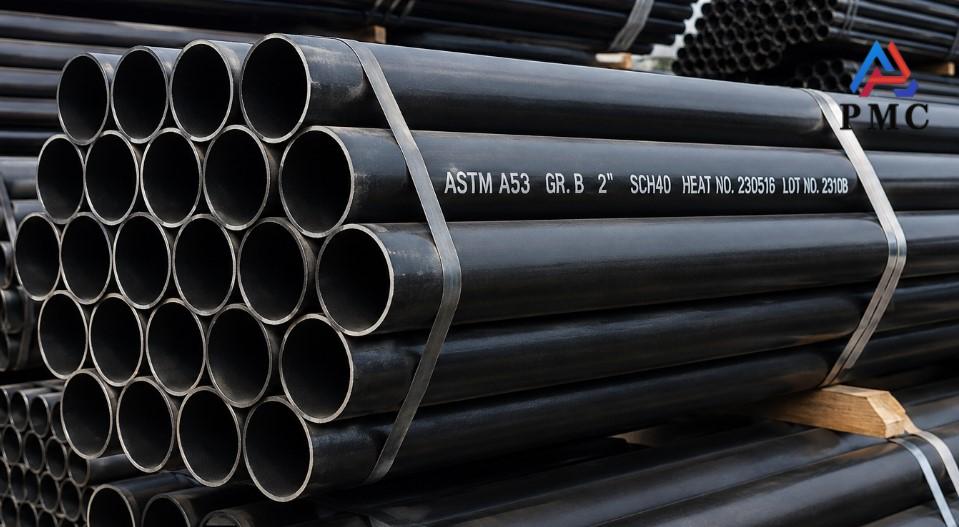
ASTM A53 steel pipes are produced using seamless and welded (ERW) manufacturing methods, each offering different advantages in strength, cost, and application.
They are widely used in construction, water pipelines, and structural applications.
ASTM A53 steel pipe is a versatile and cost-effective solution for general-purpose piping and structural applications, widely used in construction, water distribution, mechanical systems, and low-pressure pipelines. With multiple types (seamless and welded) and grades (Grade A and Grade B), it provides flexibility to meet different engineering and budget requirements.
For projects requiring higher pressure, elevated temperature resistance, or stricter technical standards, alternatives such as ASTM International ASTM A106 or American Petroleum Institute API 5L steel pipes should be considered for improved performance and compliance with demanding industrial conditions.
Q1: What is ASTM A53 pipe used for?
ASTM A53 pipe is used for structural applications, water transport, and low-pressure systems such as air and steam pipelines.
Q2: What is the difference between Grade A and Grade B?
Grade B has higher tensile and yield strength, making it more suitable for structural and pressure applications.
Q3: Is ASTM A53 seamless or welded?
It can be both. ASTM A53 includes seamless (Type S) and welded (Type E and F) pipes.
Q4: Can ASTM A53 be used for high-pressure applications?
It is generally used for low to moderate pressure. For high pressure, ASTM A106 or API 5L is preferred.
To better understand ASTM A53 pipe and related standards, you may also find these guides useful:
ASTM A53 Pipe Weight Chart and Formula
ASTM A53 Pipe Price: ERW vs Seamless & Cost Factors
How to Choose ASTM A53 Pipe: Size & Grade Guide
ASTM A53 Grade B ERW Pipe: Specifications, Size Chart & Properties
