


When comparing ASTM A53 vs API 5L seamless pipe, understanding their differences in specifications, performance, and applications is essential for selecting the right material.
ASTM A53 seamless pipe is an American standard seamless steel pipe formulated by the American Society for Testing and Materials (ASTM). It corresponds to domestic low-carbon steel materials (such as Q235 grade). It is made of high-quality carbon structural steel and is produced through hot rolling or cold drawing. It has no welds and uniform overall performance.
API 5L seamless pipe is a special seamless steel pipe for pipelines with standards set by the American Petroleum Institute (API). It is mainly used in long-distance transportation pipeline systems for energy such as oil and natural gas, and has extremely high requirements for safety and environmental resistance. Its materials cover multiple steel grades from low carbon steel to high-strength alloy structural steel, such as L245 (B grade), L360, L485, and even high-strength X80, X100, etc.
The main difference between ASTM A53 and API 5L seamless pipe lies in their application focus, strength requirements, and quality standards.
|
Feature |
ASTM A53 Seamless Pipe |
API 5L Seamless Pipe |
|
Standard |
ASTM |
API (American Petroleum Institute) |
|
Application |
General industrial use |
Oil & gas pipelines |
|
Strength Level |
Lower |
Higher (X Grades) |
|
Pressure Capability |
Medium |
High |
|
Testing Requirements |
Basic |
Strict (especially PSL2) |
|
Grades |
A, B |
B, X42–X70 |
|
Cost |
Lower |
Higher |
ASTM A53 is the American national standard for general seamless steel pipes. It provides specifications for seamless steel pipes for general purposes, covering requirements from materials, dimensions to test methods, etc., to ensure the quality of steel pipes in general use scenarios. API 5L is the American Petroleum Institute standard, which is specifically for pipeline pipes and makes detailed provisions for the key properties of steel pipes such as strength, toughness, and corrosion resistance required under oil and gas transportation conditions.
ASTM A53 seamless pipes are widely used in general pressure piping, such as building water supply and drainage pipe systems, to stably transport water; in mechanical manufacturing, mechanical parts, such as some shaft parts, are made, using their comprehensive performance to meet structural support and transmission requirements. API 5L seamless pipe is mainly used for professional pipelines such as oil and natural gas transportation. For example, in deep-sea oil extraction, the oil pipeline from the seabed oil platform to the land has harsh working conditions that place extremely high demands on the performance of steel pipes.
ASTM A53 seamless pipe focuses on comprehensive performance. On the basis of meeting certain strength and toughness, it also has good processing performance and welding performance, making it widely used in conventional scenarios. API 5L seamless pipe emphasizes high strength to withstand high-pressure transportation; high toughness to prevent rupture due to stress concentration under complex geological conditions; corrosion resistance, and can work stably for a long time in oil and gas environments containing corrosive media such as hydrogen sulfide and carbon dioxide.
ASTM A53: The strength grade is relatively basic, including only two steel grades, A and B.
Grade A: tensile strength ≥330MPa, yield strength ≥205MPa;
Grade B: tensile strength ≥415MPa, yield strength ≥240MPa;
The overall strength meets the low-pressure working condition, and there is no extension to higher strength grades.
API 5L: The strength coverage is extremely wide, ranging from basic steel grades to high-strength steel grades.
Basic steel grade (such as L245/B grade): tensile strength ≥415MPa, yield strength ≥245MPa (close to A53 B grade);
High-strength steel grade (such as X80): tensile strength reaches 555-705MPa, yield strength ≥555MPa, far exceeding the performance upper limit of A53, and can meet the needs of high-pressure transportation.
When comparing ASTM A53 vs API 5L seamless pipe price, API 5L pipe is generally more expensive than ASTM A53 pipe due to differences in strength, standards, and applications.
One key reason is the use of higher strength grades (X42, X52, X65, X70) in API 5L pipes, which provide better performance and increase production costs compared to ASTM A53 Grade A and Grade B.
Another factor is the stricter PSL2 requirements, including tighter chemical control, more testing, and additional inspections, all of which raise the API 5L seamless pipe cost.
In addition, API 5L pipe is designed for oil and gas pipelines, requiring higher safety standards and certifications, which further increases the price compared to ASTM A53 used in general applications.
The higher API 5L pipe price vs ASTM A53 pipe is mainly due to stronger grades, stricter PSL2 standards, and oil & gas application requirements.
Related: ASTM A53 Pipe Price: ERW vs Seamless & Cost Factors
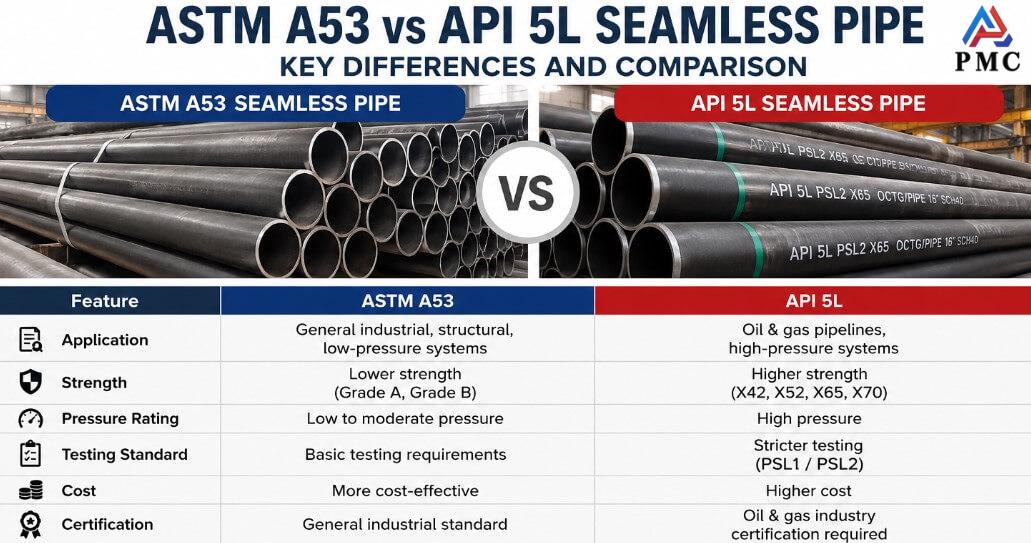
When deciding between ASTM A53 vs API 5L pipe, the right choice depends on your application, pressure requirements, and performance expectations. While both are widely used carbon steel pipes, they are designed for different purposes.
Choose ASTM A53 pipe if your project requires a cost-effective solution for general applications. It is suitable for systems operating under low to moderate pressure, such as water, air, and steam pipelines. ASTM A53 is also commonly used in structural and mechanical applications, where extreme strength and strict testing standards are not necessary.
Choose API 5L pipe if your project demands higher strength, durability, and reliability. API 5L is specifically designed for oil and gas transportation, making it ideal for pipelines that operate under high pressure or critical safety conditions. It also meets stricter standards, ensuring better performance in demanding environments.
For general-purpose and low-pressure applications, ASTM A53 pipe is usually sufficient, while API 5L pipe is the better choice for high-pressure oil and gas pipeline systems.
Related: How to Choose ASTM A53 Pipe: Size & Grade Guide
Q1:What is the main difference between ASTM A53 and API 5L seamless pipe?
The main difference between ASTM A53 vs API 5L seamless pipe is their application and strength level. ASTM A53 is used for general-purpose and low-pressure systems, while API 5L is designed for oil and gas pipelines with higher strength and stricter quality standards.
Q2: Which is better, ASTM A53 or API 5L pipe?
API 5L pipe is better for high-pressure, high-strength, and oil & gas applications. ASTM A53 is more suitable for cost-effective and general industrial uses such as water, air, and structural systems.
Q3:Why is API 5L pipe more expensive than ASTM A53?
The API 5L pipe price is higher than ASTM A53 because it includes higher strength grades (X42–X70), stricter PSL2 testing requirements, and oil & gas industry certifications.
ASTM A53 vs API 5L seamless pipe mainly differs in application and performance. ASTM A53 is ideal for general construction and low-pressure systems, while API 5L is designed for high-pressure oil and gas pipelines with superior strength and corrosion resistance.
Choosing the right pipe depends on your project requirements.
To better understand ASTM A53 pipe and related standards, you may also find these guides useful:
ASTM A53 Pipe Weight Chart and Formula
