


API 5L, a standard established by the American Petroleum Institute (API), is widely recognized in the pipeline industry for the transportation of oil, natural gas, and other fluids. It applies to both seamless pipes and welded pipes, setting clear requirements for manufacturing processes, chemical composition, mechanical properties, dimensions, and heat treatment. By defining these specifications, API 5L ensures the safe, reliable, and efficient operation of pipeline systems.
API 5L carbon steel pipe is manufactured according to this standard. Carbon steel offers excellent overall performance, is relatively affordable, and utilizes mature manufacturing processes. It meets the needs of most pipeline transportation scenarios and holds an irreplaceable position in the energy transportation sector.
API 5L carbon steel pipe adheres to strict standards for both chemical composition and mechanical properties. For example, the common X52 steel grade generally requires carbon content to be controlled within 0.22%, manganese content to be within 1.40%, and impurity elements such as phosphorus and sulfur to be strictly limited to no more than 0.025% and 0.015%, respectively, to ensure the purity and stability of the steel and reduce the risk of brittleness and cracking.
In terms of mechanical properties, X52 steel grade must achieve a minimum yield strength of 359 MPa and a minimum tensile strength of 455 MPa, ensuring that the pipe will not easily deform or rupture when subjected to internal pressure and external loads. Furthermore, specifications for elongation and other indicators are also specified to ensure that the steel pipe has a certain level of toughness to adapt to complex geological conditions and construction requirements.
To ensure that every steel pipe meets standards, the production process undergoes multiple inspection steps. From incoming raw material inspection to in-process testing during production, to comprehensive inspection of finished products, including non-destructive testing and hydrostatic testing, problems at any stage prevent the pipe from entering the market, fully guaranteeing product quality.
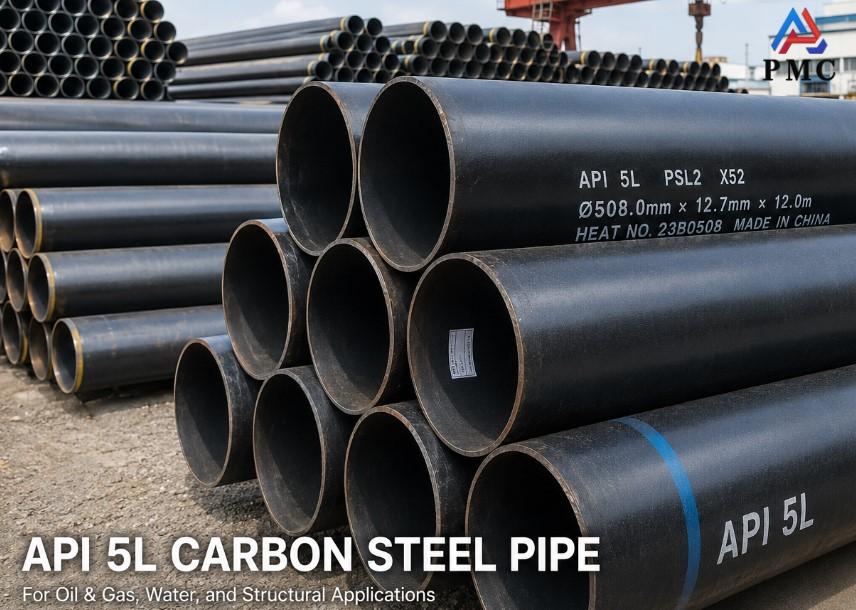
API 5L carbon steel pipe boasts a range of significant advantages, making it highly sought after in various engineering projects. Its outstanding high strength allows it to withstand significant internal pressure and external loads. For example, in the construction of long-distance oil and gas pipelines, even in complex terrain such as mountains and rivers, API 5L carbon steel pipe, with its X70 steel grade, ensures stable operation thanks to its high strength, effectively preventing problems such as rupture and deformation caused by excessive pressure.
Its excellent welding performance is also a major highlight. In actual construction, different pipe sections must be connected by welding. API 5L carbon steel pipe is well-suited to various welding processes and materials, and its welded joints are strong and leak-tight. This makes the construction process more efficient, reduces the occurrence of welding defects, and ensures the integrity and reliability of the entire pipeline system.
Corrosion resistance is also remarkable. Carbon steel inherently possesses a certain degree of corrosion resistance, and through special surface treatments such as coating and galvanizing, API 5L carbon steel pipe remains stable in harsh environments. Pipelines laid in coastal areas or high-humidity environments are less susceptible to corrosion, even under long-term exposure to seawater and moisture, extending the pipeline's service life and reducing maintenance costs.
|
Product |
API 5L Carbon Steel Pipes/Black Steel Pipe |
|
Standard |
API 5L |
|
Outer Diameter |
21.3mm - 914mm |
|
Wall Thickness |
2.11mm — 59.54mm |
|
Length |
4m-12m |
|
Material |
Gr.B, X42, X46, X52, X56, X60, PSL1, PSL2 |
|
PSL1 API 5L Grade B Pipe Chemical Composition |
PSL2 |
|||||||
|
Grade |
C (Max.) |
Mn (Max.) |
P (Max.) |
S (Max.) |
C (Max.) |
Mn (Max.) |
P (Max.) |
S (Max.) |
|
A |
0.22 |
0.90 |
0.03 |
0.03 |
0.22 |
1.20 |
0.025 |
0.015 |
|
B |
0.26 |
1.20 |
0.03 |
0.03 |
0.22 |
1.30 |
0.025 |
0.015 |
|
X42 |
0.26 |
1.30 |
0.03 |
0.03 |
0.22 |
1.40 |
0.025 |
0.015 |
|
X46 |
0.26 |
1.40 |
0.03 |
0.03 |
0.22 |
1.40 |
0.025 |
0.015 |
|
X52 |
0.26 |
1.40 |
0.03 |
0.03 |
0.22 |
1.40 |
0.025 |
0.015 |
|
X56 |
0.26 |
1.40 |
0.03 |
0.03 |
0.22 |
1.40 |
0.025 |
0.015 |
|
X60 |
0.26 |
1.40 |
0.03 |
0.03 |
0.22 |
1.45 |
0.025 |
0.015 |
|
X65 |
0.26 |
1.45 |
0.03 |
0.03 |
0.22 |
1.65 |
0.025 |
0.015 |
|
X70 |
0.26 |
1.65 |
0.03 |
0.03 |
0.22 |
1.85 |
0.025 |
0.015 |
|
Pipe Grade |
Tensile Properties - Grade B Pipe Body of SMLS and Welded Pipes PSL 1 |
Seam of Welded Pipe |
||
|
Yield Strength a |
Tensile Strength a |
Elongation |
Tensile Strength b |
|
|
Grade A |
30,500 |
48,600 |
c |
48,600 |
|
Grade B |
35,500 |
60,200 |
c |
60,200 |
|
Grade X42 |
42,100 |
60,200 |
c |
60,200 |
|
Grade X46 |
46,400 |
63,100 |
c |
63,100 |
|
Grade X52 |
52,200 |
66,700 |
c |
66,700 |
|
Grade X56 |
56,600 |
71,100 |
c |
71,100 |
|
Grade X60 |
60,200 |
75,400 |
c |
75,400 |
|
Grade X65 |
65,300 |
77,500 |
c |
77,500 |
|
Grade X70 |
70,300 |
82,700 |
c |
82,700 |
API 5L carbon steel pipes are mainly used for pipeline transportation, while ASTM standards such as ASTM A53 and ASTM A106 are widely applied in structural and pressure systems. Understanding their differences helps in selecting the right pipe for specific applications.
ASTM A53 vs API 5L: Both standards are used for general-purpose piping, but their focus differs.
API 5L is designed for oil and gas pipeline transportation, with stricter requirements for strength and testing.
ASTM A53 is commonly used for structural, mechanical, and low-pressure applications such as water, steam, and air lines.
Key Differences:
API 5L has higher strength grades (e.g., X42–X70)
ASTM A53 is more versatile for general construction use
API 5L includes PSL1 and PSL2 with stricter quality control
API 5L and ASTM A106 are both used in pressure applications, but they serve different environments.
API 5L: Suitable for long-distance pipeline systems, especially oil and gas transmission.
ASTM A106: Specifically designed for high-temperature and high-pressure service, such as boilers and refineries.
Key Differences:
ASTM A106 is seamless only; API 5L can be seamless or welded
ASTM A106 performs better in high-temperature environments
API 5L is optimized for pipeline transport rather than heat service
1. Oil and gas transportation: As a major force in long-distance transportation, it is widely used in projects such as the West-East Gas Pipeline Project, enabling cross-regional oil and gas resource transportation.
2. Submarine pipeline construction: Specially treated for corrosion resistance, it resists seawater erosion and seabed water pressure, ensuring safe transportation during offshore oil and gas field operations.
3. City gas pipelines: Widely distributed in underground networks, they provide a stable gas source for residents and are a key component of urban energy supply.
4. Chemical pipelines: They adapt to the corrosion, temperature, and pressure requirements of various chemical media, supporting the production and transportation processes of petrochemical companies.
API 5L carbon steel pipe is a widely recognized standard for pipeline transportation systems in the oil and gas industry. Defined by the American Petroleum Institute (API), it ensures high quality, strength, and reliability for conveying oil, gas, and water under various pressure and environmental conditions. Compared with other standards such as ASTM A53 and ASTM A106, API 5L pipes are specifically designed for line pipe applications, offering stricter requirements on mechanical properties, chemical composition, and testing. With a wide range of grades and sizes available, API 5L pipes deliver excellent durability, corrosion resistance, and adaptability, making them a preferred choice for both onshore and offshore pipeline projects.
Q1. What is API 5L carbon steel pipe used for?
API 5L carbon steel pipe is mainly used for transporting oil, natural gas, and water in pipeline systems, especially in the petroleum and energy industries.
Q2. What are the main grades of API 5L pipe?
Common grades include Grade A, Grade B, and higher strength grades such as X42, X52, X60, X65, and X70.
Q3. What is the difference between API 5L and ASTM A53?
API 5L is specifically designed for pipeline transportation, while ASTM A53 is more general-purpose for structural and low-pressure applications.
Q4. How does API 5L differ from ASTM A106?
ASTM A106 is primarily used for high-temperature service, whereas API 5L focuses on pipeline transport under various pressure conditions.
Q5. What types of API 5L pipes are available?
API 5L pipes are available in seamless and welded types, including ERW, LSAW, and SSAW.
If you want to explore more detailed comparisons, check out these related articles:
