


ASTM A53 pipe weight is the theoretical mass of carbon steel pipe per unit length, calculated based on outside diameter, wall thickness, and steel density (7.85 g/cm³). It is used in engineering design, transportation planning, and cost estimation.
It is commonly obtained using a standard pipe weight chart or pipe weight formula. Below is the ASTM A53 pipe weight chart and calculation method.
The table below shows the theoretical weight of ASTM A53 steel pipes (SCH 40 / SCH 80):
|
NPS |
OD (mm) |
SCH 40 WT |
SCH 40 Wt (kg/m) |
SCH 80 WT |
SCH 80 Wt (kg/m) |
|
1/2" |
21.3 |
2.77 |
1.27 |
3.73 |
1.62 |
|
3/4" |
26.7 |
2.87 |
1.69 |
3.91 |
2.13 |
|
1" |
33.4 |
3.38 |
2.50 |
4.55 |
3.24 |
|
1 1/2" |
48.3 |
3.68 |
4.05 |
5.08 |
5.41 |
|
2" |
60.3 |
3.91 |
5.43 |
5.54 |
7.48 |
|
3" |
88.9 |
5.49 |
11.29 |
7.62 |
14.90 |
|
4" |
114.3 |
6.02 |
16.07 |
8.56 |
21.27 |
|
6" |
168.3 |
7.11 |
24.40 |
10.97 |
36.12 |
|
8" |
219.1 |
8.18 |
36.06 |
12.70 |
53.29 |
|
10" |
273.0 |
9.27 |
49.56 |
12.70 |
64.64 |
|
12" |
323.8 |
9.53 |
64.41 |
12.70 |
76.81 |
Important Notes:
Values are theoretical weight per meter.
Based on steel density = 7.85 g/cm³
SCH 80 is heavier due to thicker wall.
Actual weight may vary due to manufacturing tolerance.
The standard formula used to calculate ASTM A53 pipe weight is:
W=0.02466×(D−t)×tW = 0.02466 \times (D - t) \times tW=0.02466×(D−t)×t
Where:
W = weight (kg/m)
D = outside diameter (mm)
t = wall thickness (mm)
Example: NPS 2 SCH 40
OD = 60.3 mm
WT = 3.91 mm
Step 1: Apply formula
W = 0.02466 × (60.3 − 3.91) × 3.91
Step 2: Result
W ≈ 5.43 kg/m
The difference between SCH 40 and SCH 80 pipe weight is primarily due to wall thickness. Although both have the same outside diameter (OD) for each NPS size, SCH 80 pipes use thicker walls, resulting in higher weight and pressure capacity.
|
Feature |
SCH 40 Pipe |
SCH 80 Pipe |
|
Wall Thickness |
Standard |
Thicker |
|
Weight |
Lighter |
Heavier |
|
Strength |
Moderate |
Higher |
|
Pressure Capacity |
Lower |
Higher |
|
Typical Applications |
Water, air, low-pressure systems |
High-pressure,industrial systems |
Key Insights
SCH 80 pipes are typically 30–60% heavier than SCH 40 pipes depending on size
Increased wall thickness directly increases both pipe weight and pressure rating
SCH 40 is more cost-effective for general use, while SCH 80 is preferred for demanding applications
Choosing between SCH 40 and SCH 80 depends on pressure requirements, budget, and installation conditions.
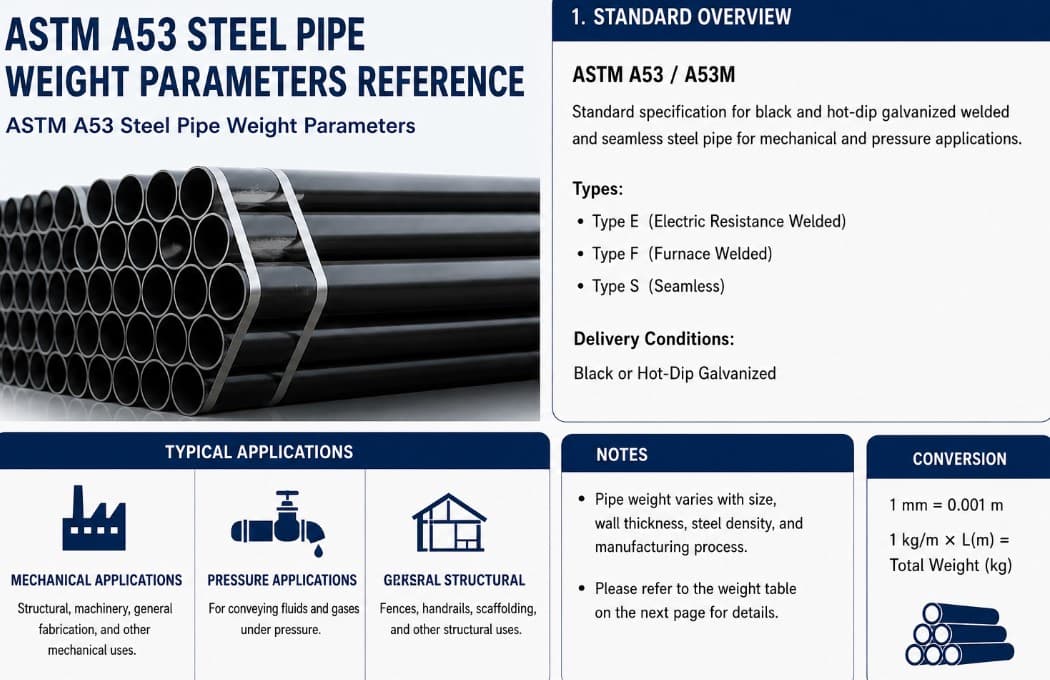
Understanding ASTM A53 pipe weight is essential for accurate engineering design, cost control, and efficient project execution. In real-world projects, even small miscalculations in pipe weight can lead to significant cost overruns or safety risks.
ASTM A53 pipe weight is critical for:
Weight errors can increase total project cost by 10–30%.
Heavier schedules (SCH 80) can add 30–60% more weight than SCH 40.
Transportation and lifting costs scale directly with pipe weight.
1. How is ASTM A53 pipe weight calculated?
It is calculated using a standard formula based on OD, wall thickness, and steel density or by using a pipe weight chart.
2. Is pipe weight theoretical or actual?
Pipe weight is theoretical and may slightly differ from actual measured weight.
3. Why is SCH 80 heavier than SCH 40?
Because SCH 80 has a thicker wall, requiring more material per unit length.
4. What density is used for steel pipe weight calculation?
Standard carbon steel density of 7.85 g/cm³ is used.
To better understand ASTM A53 pipe and related standards, you may also find these guides useful:
ASTM A53 Grade A vs Grade B Pipes
Differences between ASTM A53 and ASTM A106 Steel Pipe
ATSM A53 Pipe vs API 5L Pipe: Key Differences & Applications
