


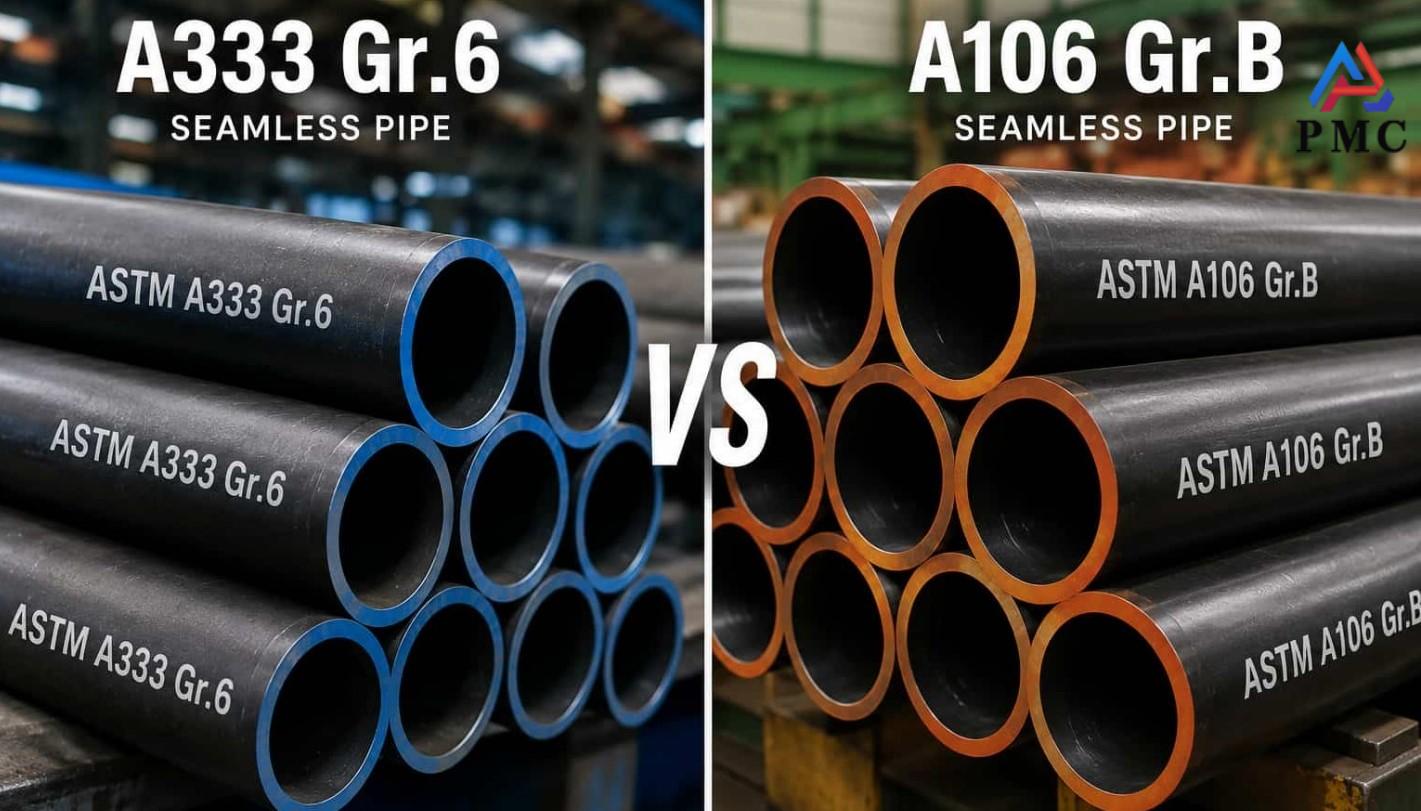
In industrial piping selection, the correct choice of materials directly affects the system's safety, stability, and overall cost control. ASTM A333 Gr.6 and ASTM A106 Gr.B are two widely used seamless steel pipe standards, commonly used in the energy, petrochemical, and power industries. Although they are similar in strength specifications, their design applications differ fundamentally: A333 Gr.6 is primarily designed for low-temperature environments, emphasizing the material's impact toughness; while A106 Gr.B is suitable for high-temperature and high-pressure conditions, focusing on heat resistance. Understanding these differences is crucial for avoiding selection errors and reducing engineering risks.
ASTM A333 Gr.6 is a seamless carbon steel pipe specifically designed for cryogenic environments. It is widely used in applications requiring the resistance to cryogenic impact loads, such as LNG projects and cryogenic storage and transportation systems.
The core advantage of this material lies in its excellent low-temperature impact toughness, which enables it to maintain good plasticity and resistance to brittle fracture under extreme low-temperature conditions, thereby ensuring the safe operation of the pipeline system.
In contrast, ASTM A106 Gr.B is a typical high-temperatureseamless carbon steel pipe, mainly used in high-temperature and high-pressure environments, such as boiler systems, steam pipelines, and oil refining plants. Its design focuses on the material's high temperature strength and long-term stability, enabling it to withstand continuous thermal stress and pressure loads under high-temperature conditions.
Overall, although these two materials both belong to the category of carbon steel seamless pipes, they have significant differences in performance focus and application scenarios: A333 Gr.6 focuses on low-temperature safety, while A106 Gr.B is oriented towards high-temperature performance.
|
Element |
ASTM A333 Gr.6 |
ASTM A106 Gr.B |
Key Insight |
|
Carbon (C) |
≤ 0.30 |
≤ 0.30 |
Similar levels |
|
Manganese (Mn) |
0.29 – 1.06 |
0.29 – 1.06 |
Same strength range |
|
Phosphorus (P) |
≤ 0.025 |
≤ 0.035 |
A333 has stricter impurity control |
|
Sulfur (S) |
≤ 0.025 |
≤ 0.035 |
Lower in A333 for better toughness |
|
Property |
ASTM A333 Gr.6 |
ASTM A106 Gr.B |
|
Tensile Strength |
≥ 415 MPa |
≥ 415 MPa |
|
Yield Strength |
≥ 240 MPa |
≥ 240 MPa |
|
Impact Test |
Required |
Not Required |
The primary difference between ASTM A333 Gr.6 and ASTM A106 Gr.B lies in their service temperature range and application scenarios.
ASTM A333 Gr.6 is specifically designed for low-temperature service, where resistance to brittle fracture is critical. It is widely used in applications such as LNG projects, low-temperature storage tanks, cold chain systems, and pipelines in extremely cold regions. Its ability to maintain toughness under sub-zero conditions makes it a reliable choice for cryogenic environments.
On the other hand, ASTM A106 Gr.B is engineered for high-temperature and high-pressure applications. It is commonly used in boiler systems, high-temperature steam pipelines, petroleum refining, and power plants, where materials must withstand continuous heat and pressure. Its strength and stability at elevated temperatures make it ideal for thermal and energy-related systems.
When comparing costs, ASTM A333 Gr.6 is generally more expensive than ASTM A106 Gr.B. The higher price is mainly due to its mandatory low-temperature impact testing and stricter quality control requirements, which increase both production complexity and inspection costs.
In contrast, ASTM A106 Gr.B offers a more cost-effective solution for most standard applications. Since it does not require impact testing and is primarily used in conventional high-temperature environments, the overall manufacturing and testing costs are lower.
In practical terms, if your project does not involve low-temperature conditions, choosing A106 Gr.B can help reduce procurement costs without compromising performance. However, for critical low-temperature applications, the additional cost of A333 Gr.6 is justified by its enhanced safety and reliability.
When comparing costs, ASTM A333 Gr.6 is generally more expensive than ASTM A106 Gr.B. The higher price is mainly due to its mandatory low-temperature impact testing and stricter quality control requirements, which increase both production complexity and inspection costs.
In contrast, ASTM A106 Gr.B offers a more cost-effective solution for most standard applications. Since it does not require impact testing and is primarily used in conventional high-temperature environments, the overall manufacturing and testing costs are lower.
In practical terms, if your project does not involve low-temperature conditions, choosing A106 Gr.B can help reduce procurement costs without compromising performance. However, for critical low-temperature applications, the additional cost of A333 Gr.6 is justified by its enhanced safety and reliability.
In real-world procurement, selecting between ASTM A333 Gr.6 and ASTM A106 Gr.B should be based on a combination of temperature conditions, application scenarios, safety requirements, budget considerations, and project specifications.
First, consider the service temperature. For low-temperature environments (≤ -20°C), especially where impact resistance is critical, A333 Gr.6 is the appropriate choice. For high-temperature conditions (≥ 400°C), A106 Gr.B is more suitable due to its thermal strength and stability.
Second, evaluate the application type. Projects involving LNG or cryogenic systems require A333 Gr.6, while boilers, refineries, and high-temperature pipelines are better served by A106 Gr.B.
Third, assess safety requirements. If the system must withstand impact or operate in harsh low-temperature conditions, A333 Gr.6 provides higher reliability. For general structural or standard industrial use, A106 Gr.B is typically sufficient.
Fourth, take budget constraints into account. If cost control is a priority and the application does not involve low temperatures, A106 Gr.B offers a more economical solution. However, for projects with strict safety demands, investing in A333 Gr.6 is often necessary.
Finally, always follow project standards and specifications. Engineering requirements and client specifications should take precedence over general selection rules.
ASTM A333 Gr.6 and ASTM A106 Gr.B are common seamless carbon steel pipes for energy, petrochemical and power industries, with identical basic mechanical strength and similar chemical composition. Their core difference lies in service design: A333 Gr.6 features stricter sulfur and phosphorus control and mandatory low-temperature impact tests, delivering excellent low-temperature toughness and anti-brittle fracture performance for cryogenic services such as LNG systems. In contrast, A106 Gr.B has looser impurity limits and no impact test requirements, offering superior thermal stability for high-temperature and high-pressure scenarios including boilers, steam pipelines and refining equipment. A106 Gr.B is more cost-effective for regular high-temperature projects, while the higher-priced A333 Gr.6 ensures reliable safety in critical low-temperature conditions. Proper material selection depends on operating temperature, application needs, safety standards and budget, helping avoid misselection, mitigate engineering risks and balance project quality and cost.
Q1: What is the core difference between A333 Gr.6 and A106 Gr.B?
A1: The two grades differ fundamentally in operating temperature and performance focus. A333 Gr.6 is a cryogenic pipe with strict impurity control and mandatory low-temperature impact tests, preventing brittle fracture at low temperatures. A106 Gr.B is a high-temperature pipe optimized for thermal stability under high heat and pressure, with no impact test requirement.
Q2: Can A106 Gr.B be used for low-temperature piping systems?
A2: No. A106 Gr.B has higher impurity content and no low-temperature impact qualification, leading to poor low-temperature toughness. It risks brittle fracture below -20°C and cannot be used for cryogenic services such as LNG pipelines.
Q3: Why is A333 Gr.6 more expensive than A106 Gr.B?
A3: A333 Gr.6 is more costly due to stricter production control and mandatory low-temperature impact testing (typically -45°C). A106 Gr.B requires fewer inspection procedures, offering lower cost and better economy for standard industrial applications.
Q4: Are the mechanical strength properties of the two pipes different?
A4:Both pipes feature identical tensile and yield strength. The major distinction is low-temperature impact toughness, which only A333 Gr.6 possesses, defining their different service suitability.
Q5: What typical scenarios are suitable for each pipe grade?
A5: A333 Gr.6 is used for low-temperature services, including LNG systems, cryogenic pipelines and cold-region piping. A106 Gr.B applies to high-temperature high-pressure facilities such as boilers, steam pipelines and refinery piping.
Q6: How to quickly select the right pipe for engineering projects?
A6: Select A333 Gr.6 for working temperatures below -20°C to ensure low-temperature toughness and safety. Select A106 Gr.B for high-temperature conditions above 400°C for stable thermal performance. A106 Gr.B provides cost advantages for conventional high-temperature projects, while A333 Gr.6 is essential for all critical cryogenic applications.
