


Seamless steel pipes are widely used in industrial production, infrastructure and other fields. From high-pressure boilers to precision machinery, their wall thicknesses are different. This difference is not a random operation in production, but a comprehensive consideration of working condition requirements, manufacturing processes, economy and other factors. The following is a detailed explanation of the core reasons for the wall thickness difference of seamless steel pipes, carefully summarized by Permanent Steel Manufacturing Co.,Ltd (PMC).
Working Condition Requirements and Wall Thickness Corresponding Relationship
The wall thickness of seamless steel pipes is first determined by the actual working conditions. Different application scenarios have different requirements for pressure bearing, load capacity and corrosion resistance, which directly determine the minimum wall thickness of the pipe. The specific corresponding relationship is shown in Table 1:
|
Application Scenario (Industry) |
Working Condition Characteristics |
Wall Thickness Characteristics (Standard Specification Range) |
|
High-pressure boilers (power industry) |
High working pressure, high temperature, long-term operation |
Thick-walled pipe, SCH80 and above (wall thickness ≥10mm) |
|
Fluid transportation (petrochemical industry) |
Medium pressure, corrosive medium |
Medium-thin wall pipe, SCH40-SCH80 (wall thickness 3-10mm) |
|
Mechanical structure (machinery industry) |
Mainly bear load, low pressure |
Medium-thin wall pipe, SCH20-SCH40 (wall thickness 2-8mm) |
|
Precision machinery (automotive industry) |
High precision requirements, light weight |
Thin-walled precision pipe (wall thickness 0.5-3mm) |
|
Geological drilling (mining industry) |
High load, harsh working environment |
Extra-thick wall pipe (wall thickness ≥20mm) |
Table 1 Corresponding Relationship Between Different Application Scenarios and Wall Thickness
The minimum wall thickness required for seamless steel pipes can be calculated by the thin-walled cylinder theory formula, which provides a theoretical basis for wall thickness selection. The specific formula is as follows:
Formula: t = P * D / (2 *[σ] * ϕ + P)
Note: This formula is applicable to seamless steel pipe wall thickness calculation, where the weld coefficient ϕ is 1.0; each parameter unit is: P = working pressure (unit: MPa); D = outer diameter (unit: mm); [σ] = allowable stress (unit: MPa); t = minimum required wall thickness (unit: mm).
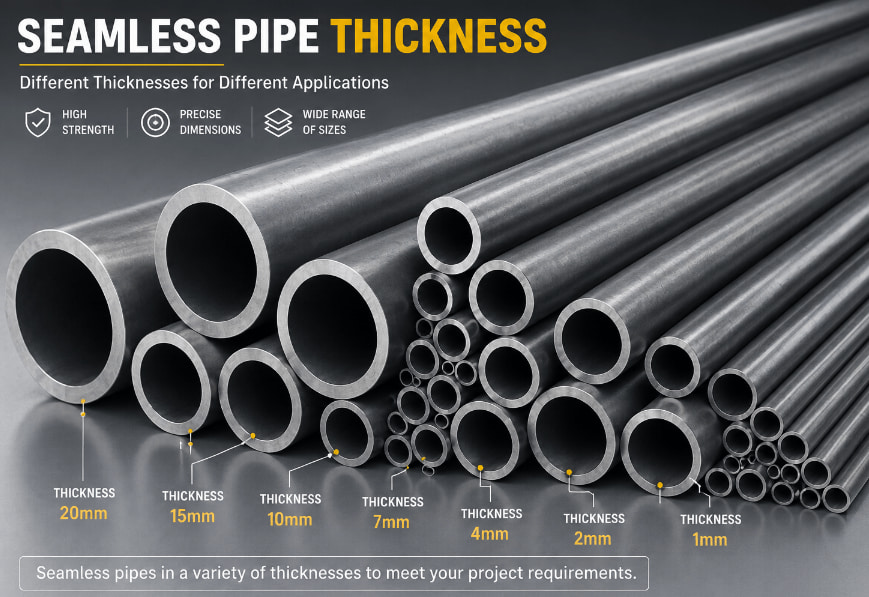
In addition to working condition requirements, the natural limitations of manufacturing processes also determine the wall thickness range and precision of seamless steel pipes. Different production processes have different applicable wall thickness ranges and precision levels, which are specifically reflected in the following three aspects:
This is the most common production process for seamless steel pipes, mainly applicable to large-diameter fluid pipes and structural pipes. The wall thickness range of hot-rolled seamless steel pipes is usually ≥2.5mm, and the tolerance range is usually ±12.5%. The process principle is to heat the steel billet to a high temperature above the recrystallization temperature, then pierce and roll it into a pipe. Its advantage is high production efficiency and low cost, but the precision is relatively low, which is suitable for scenarios with low precision requirements.
This process is mainly used for the production of precision seamless steel pipes, which are widely used in precision machinery, auto parts and other fields. The wall thickness range of cold-drawn/cold-rolled seamless steel pipes is 0.5-20mm, and the tolerance range can be controlled at ±0.05mm-±0.2mm, with high precision. The process principle is to process the pipe blank at room temperature, which can effectively ensure the dimensional accuracy and surface quality of the pipe, but the production efficiency is low and the cost is relatively high.
This process is mainly used for the production of special-shaped seamless steel pipes and thick-walled pipes, with typical application cases such as rocket engine casings and high-end aerospace equipment. The wall thickness range of spinning seamless steel pipes is 3-50mm, which can realize the processing of variable wall thickness pipes. Its advantage is strong flexibility, which can meet the customized needs of special scenarios, but the production cycle is long and the cost is high.
On the premise of the same outer diameter, the change of seamless steel pipe wall thickness will directly affect its performance and cost, which is specifically reflected in the following aspects:
1. Pressure-bearing capacity: The pressure-bearing capacity of seamless steel pipes is positively correlated with the wall thickness. The thicker the wall thickness, the stronger the pressure-bearing capacity, which can effectively avoid pipe burst and leakage under high pressure.
2. Bending stiffness: The bending stiffness of seamless steel pipes is greatly improved with the increase of wall thickness (its moment of inertia is proportional to the cube of the wall thickness), which can better resist deformation under load.
3. Weight and cost: The weight and material cost of seamless steel pipes increase with the increase of wall thickness. Excessively thick wall thickness will lead to waste of materials and increase the cost of transportation and installation.
On the basis of meeting working condition requirements and manufacturing processes, the selection of wall thickness also needs to take into account economy to achieve a balance between cost and safety. The specific trade-off relationship is shown in Table 2:
|
Wall Thickness Selection |
Advantages |
Disadvantages |
Specific Practices |
|
Too thin |
Low material cost, light weight, low transportation cost |
Insufficient strength, easy to burst and fail, short service life |
Not recommended, which does not meet the safety requirements |
|
Too thick |
High strength, strong pressure-bearing capacity, long service life |
Waste of materials, high cost, easy to have cold cracks and excessive residual stress |
Avoid blind thickening, and select according to the calculation formula |
|
Optimal |
Balance of safety and economy, high material utilization rate |
Need to comprehensively consider multiple factors |
Combine formula calculation, reserve corrosion allowance, and round to standard specifications |
Table 2 Cost and Risk Trade-off in Wall Thickness Selection
In engineering practice, the determination of wall thickness needs to follow the principle of "calculated wall thickness + corrosion allowance (usually 1-3mm, note: corrosion allowance refers to the additional wall thickness reserved to cope with medium corrosion) + manufacturing negative deviation compensation", and finally rounded to the industry standard series value to ensure the balance between safety and economy.
The essence of the wall thickness difference of seamless steel pipes is the result of the triangular balance of "functional demand, manufacturing capacity and cost control": on the demand side, the minimum wall thickness is determined by the working pressure, load and corrosion environment; on the manufacturing side, the achievable wall thickness range and precision are determined by the production process capacity; on the standard side, the customization cost is reduced and the versatility is improved through serialized specifications; on the economic side, the material utilization rate is maximized and the comprehensive cost is controlled on the premise of meeting the safety standards. Only by comprehensively considering these factors can we select the most suitable seamless steel pipe wall thickness for the actual application scenario.
Q1: What are the main factors determining the wall thickness difference of seamless steel pipes?
A1: It is mainly determined by four core factors: working condition requirements (pressure, load, etc.), manufacturing process limitations, economic trade-off, and standard serialization requirements.
Q2: What are the differences in wall thickness of seamless steel pipes in different application scenarios?
A2: Thick-walled pipes (SCH80 and above) are used for high-pressure scenarios (such as high-pressure boilers); medium-thin wall pipes (SCH40-SCH80) are used for conventional fluid transportation and structural support; thin-walled high-precision pipes are used for precision machinery; extra-thick wall pipes are used for geological drilling.
Q3: What is the wall thickness calculation formula of seamless steel pipes? What do each parameter represent?
A3: Common thin-walled cylinder theory formula: t = P * D / (2 *[σ] * ϕ + P); P = working pressure, D = outer diameter, [σ] = allowable stress, ϕ = weld coefficient (1.0 for seamless pipes).
Q4: What are the different requirements for wall thickness between hot rolling and cold drawing/cold rolling processes?
A4: Hot rolling wall thickness ≥2.5mm, with large tolerance (±12.5%); cold drawing/cold rolling wall thickness 0.5-20mm, with extremely small tolerance (±0.05-±0.2mm) and higher precision.
Q5: What impact will the increase of wall thickness bring under the same outer diameter?
A5: The pressure-bearing capacity and bending stiffness are greatly improved, but the weight and material cost also increase accordingly.
Q6: How to balance economy and safety when selecting the wall thickness of seamless steel pipes?
A6: Take the calculated wall thickness + corrosion allowance (1-3mm) + manufacturing negative deviation compensation, then round to the standard series value to maximize the material utilization rate under the premise of safety.
Q7: What risks will there be if the wall thickness of seamless steel pipes is too thin or too thick?
A7: Too thin is prone to insufficient strength and burst failure; too thick will waste materials, increase welding and transportation costs, and may also have problems such as cold cracks and excessive residual stress.
