


Seamless steel pipes are widely used in various fields such as industrial transportation, machinery manufacturing, and energy chemical industry, and are core basic components in industrial production. As a key parameter of seamless steel pipes, wall thickness directly determines their pressure-bearing capacity, deformation resistance and service life. Reasonably controlling the wall thickness parameters of seamless steel pipes is crucial for the safe operation of equipment and cost control. This article will focus on the core points of the wall thickness of seamless steel pipes and provide references for the selection and use of seamless steel pipes.
The wall thickness of a seamless steel pipe refers to half the difference between the outer diameter and the inner diameter of the seamless steel pipe, and is a core indicator for measuring the strength of the seamless steel pipe. In daily marking, SCH series and nominal wall thickness are commonly used to standardize the expression of the wall thickness of seamless steel pipes, and there are clear standards for allowable deviation of wall thickness to ensure the unity of the production and use of seamless steel pipes. The core function of the wall thickness of seamless steel pipes is to bear working pressure, resist external deformation, extend the service life of seamless steel pipes under complex working conditions, and is the basic guarantee for the safe operation of seamless steel pipes.
Note: The following are the core international parameters for the wall thickness of seamless steel pipes commonly used worldwide, covering mainstream standards, adapting to common application scenarios of seamless steel pipes, and the parameters refer to international general specifications and practical industry standards for seamless steel pipes.
|
Standard Type |
Standard Number |
Nominal Outer Diameter (mm) |
Common Wall Thickness Range (mm) |
Allowable Deviation of Wall Thickness |
Application Scenarios |
|
National Standard (China) |
GB/T 17395-2008 |
12-530 |
0.25-75 |
±12.5% (General), ±0.05-±0.2mm (Precision) |
Seamless steel pipes are used for general fluid transportation, mechanical structures, and boiler equipment |
|
American Standard (USA) |
10-610 |
1.0-50 |
±10% (Hot-rolled), ±5% (Cold-rolled) |
Seamless steel pipes are used for oil and gas, low-pressure fluid transportation, and high-temperature working conditions |
|
|
American Standard (USA) |
API 5L |
114-1220 |
3.0-40 |
±7.5% (SCH40), ±10% (SCH80) |
Seamless steel pipes are used for oil and gas long-distance pipelines |
|
International Standard |
ISO 3304 |
10-1016 |
0.5-60 |
±8% (Ordinary Grade), ±3% (Precision Grade) |
Seamless steel pipes are used for general industry and transnational project adaptation |
Supplementary Notes:
Working condition requirements are the core factor determining the wall thickness of seamless steel pipes. The higher the working pressure, the stronger the medium corrosion, and the higher the working temperature, the thicker the required wall thickness of seamless steel pipes; the manufacturing process will also limit the wall thickness of seamless steel pipes. Hot-rolled seamless steel pipes have a wider wall thickness range but lower precision, while cold-drawn and cold-spun seamless steel pipes have high precision but a limited wall thickness range; in terms of economy, it is necessary to balance the wall thickness of seamless steel pipes with material, transportation and processing costs to avoid waste caused by excessive thickness; at the same time, industry standards such as GB, ASTM and API have clear regulations on the wall thickness of seamless steel pipes in different scenarios, which must be strictly followed.
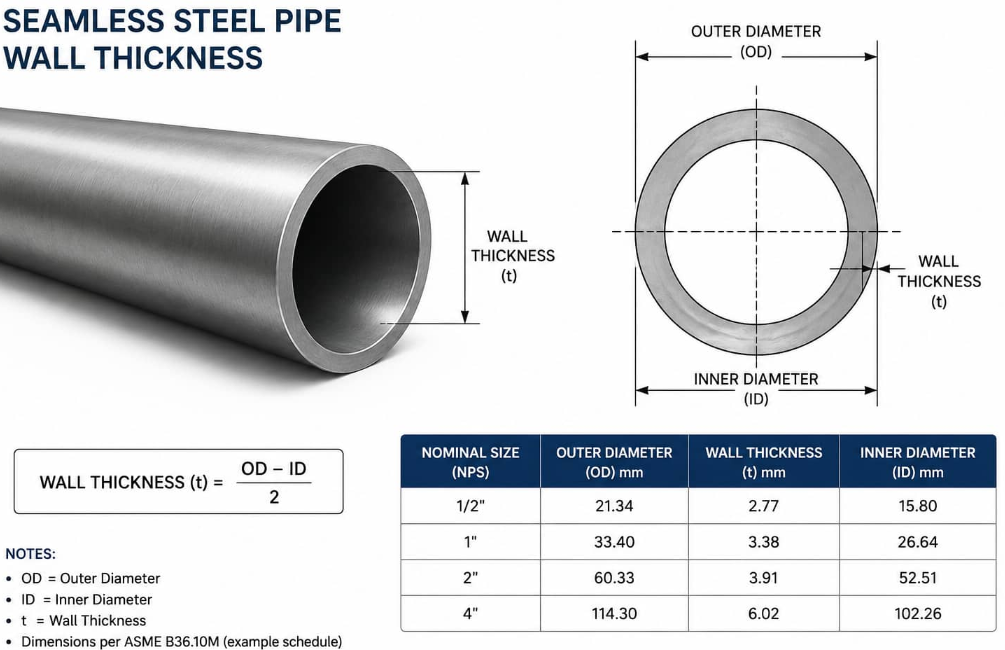
The selection of the wall thickness of seamless steel pipes shall follow the principles of "adapting to working conditions, complying with standards, and balancing economy": thick-walled seamless steel pipes shall be selected for high-pressure scenarios (such as boilers and high-pressure transportation) to ensure pressure-bearing safety and meet the requirements of high temperature, corrosion and other working conditions; medium and thin-walled seamless steel pipes are sufficient for conventional scenarios (such as ordinary fluid transportation and mechanical structures), balancing practicality and economy; for special scenarios (such as precision machinery and geological drilling), seamless steel pipes with appropriate wall thickness shall be customized according to specific needs to ensure adaptability and precision.
Excessive deviation of the wall thickness of seamless steel pipes will affect the pressure-bearing capacity of seamless steel pipes and lead to inconvenient installation; too thin wall thickness of seamless steel pipes is prone to safety hazards such as blasting and leakage, while too thick wall thickness will cause waste of materials and costs; daily inspection of whether the wall thickness of seamless steel pipes meets the standards can be carried out through spectral detection, ultrasonic detection and other methods to timely eliminate hidden dangers.
During selection, the wall thickness of seamless steel pipes shall be accurately matched according to the working conditions to avoid blind thickening or thinning; in the manufacturing link, the process can be optimized to improve the precision of the wall thickness of seamless steel pipes and control deviations; during use, good maintenance shall be done to reduce medium corrosion and external force loss and extend the service life of seamless steel pipes.
Q1: What is the wall thickness of seamless steel pipes and how to mark it?
A1: It is half the difference between the outer diameter and inner diameter of seamless steel pipes, usually marked with SCH series or nominal wall thickness.
Q2: What is the core function of seamless steel pipe wall thickness?
A2: It bears working pressure, resists deformation, and ensures the safe operation and service life of seamless steel pipes.
Q3: What factors affect the wall thickness of seamless steel pipes?
A3: Mainly working conditions, manufacturing processes, economy and industry standards.
Q4: What principles should be followed to select seamless steel pipe wall thickness?
A4: Follow the principles of adapting to working conditions, complying with standards and balancing economy, and select according to different scenarios.
Q5: What hidden dangers exist in improper wall thickness of seamless steel pipes?
A5: Too thin may cause blasting and leakage; too thick will waste materials and increase costs.
Q6: How to inspect the wall thickness of seamless steel pipes daily?
A6: Use spectral detection, ultrasonic detection and other methods to check thickness deviation and uniformity.
Q7: What are the optimization suggestions for seamless steel pipe wall thickness?
A7: Accurately match the wall thickness, optimize the manufacturing process and do a good job in daily maintenance.
Q8: What affects the allowable deviation of seamless steel pipe wall thickness?
A8: It is affected by manufacturing processes, product precision levels and different industry standards.
The selection and control of the wall thickness of seamless steel pipes is mainly to balance working condition requirements, manufacturing capacity, standard specifications and economy. A reasonable wall thickness of seamless steel pipes can not only ensure the safe operation of equipment, but also effectively control costs. The basic cognition, influencing factors, selection principles and common problems of the wall thickness of seamless steel pipes sorted out in this article can provide references for the selection, use and maintenance of seamless steel pipes in industrial production. With the upgrading of manufacturing technology, the precision and adaptability of the wall thickness of seamless steel pipes will be further improved, better meeting the diversified needs of various industries for seamless steel pipes.
Permanent Steel Manufacturing Co.,Ltd (PMC) is a professional and experienced supplier of seamless steel pipes with rich industry experience, strict quality control and complete international certifications. We provide high-quality products and professional services for global customers. For any inquiries or cooperation, please feel free to contact us.
