


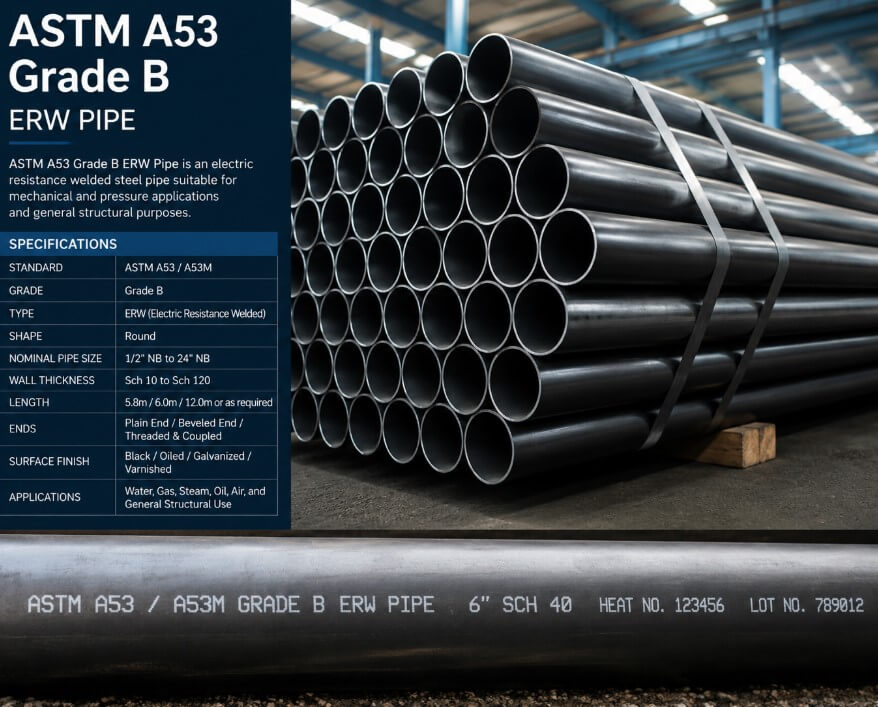
ASTM A53 Grade B ERW pipe is one of the most widely used carbon steel pipes for general-purpose and structural applications. Known for its cost-effectiveness, durability, and versatility, it is commonly applied in water pipelines, gas lines, and construction projects.
This guide provides a complete overview of ASTM A53 Grade B ERW pipe, including specifications, size chart, mechanical properties, and key differences compared to seamless pipes. It is one of the most commonly specified ERW pipes in global pipeline and construction projects.
ASTM A53 is a standard specification for carbon steel pipes used in mechanical and pressure applications, as well as for general structural use. Among its grades, Grade B offers higher strength compared to Grade A, making it more suitable for load-bearing and medium-pressure systems.
(ASTM A53 Grade A vs Grade B Pipes)
ASTM A53 Grade B ERW pipe is widely recognized as a reliable carbon steel pipe solution for general-purpose and structural applications. It is manufactured using the ERW (Electric Resistance Welded) process, where steel is formed into a cylindrical shape and welded longitudinally to ensure consistent quality and dimensional accuracy.
Due to its stable performance, cost-effectiveness, and wide size availability, ERW pipes are extensively used in construction, water transmission, and industrial piping systems.
ASTM A53 Grade B ERW pipe specifications define the standard requirements for dimensions, materials, manufacturing process, and testing.
These pipes are widely used in structural, mechanical, and pressure applications due to their reliable strength and cost-effective performance.
|
Category |
Specification |
|
Standard |
ASTM A53 |
|
Grade |
Grade B |
|
Pipe Type |
Type E (Electric Resistance Welded - ERW) |
|
Manufacturing Process |
Electric Resistance Welding |
|
Outside Diameter (OD) |
1/2" – 24" (21.3 mm – 610 mm) |
|
Wall Thickness |
SCH 10 – SCH 16 |
|
Length |
6 m, 12 m, or customized |
|
End Type |
Plain End (PE), Beveled End (BE), Threaded |
|
Surface Finish |
Black, Galvanized, Painted |
|
Coating Options |
Varnish, Anti-corrosion oil, 3PE, Epoxy coating |
|
Heat Treatment |
As required (normalized or stress relieved) |
|
Testing |
Hydrostatic Test, NDT, Flattening Test |
|
Applicable Fluids |
Water, Gas, Steam, Oil |
|
Application |
Structural, mechanical, low-pressure piping |
ASTM A53 Grade B ERW pipe specifications cover key aspects such as size range, wall thickness, manufacturing process, and testing requirements.
Among these, Grade B is the most commonly used due to its higher strength and versatility in both structural and pressure applications.
The ERW manufacturing process ensures uniform wall thickness and consistent quality, making these pipes a cost-effective solution for construction, pipeline systems, and industrial use.
Selecting the appropriate diameter, schedule, and coating helps optimize performance, durability, and project cost.
The following ASTM A53 Grade B ERW pipe size chart shows standard dimensions, wall thickness, and weight for SCH 40 and SCH 80 pipes.
|
NPS (Inch) |
OD (mm) |
SCH 40 Thickness (mm) |
SCH 80 Thickness (mm) |
SCH 40 Weight (kg/m) |
SCH 80 Weight (kg/m) |
|
1/2 |
21.3 |
2.77 |
3.73 |
1.27 |
1.62 |
|
3/4 |
26.7 |
2.87 |
3.91 |
1.69 |
2.20 |
|
1 |
33.4 |
3.38 |
4.55 |
2.50 |
3.24 |
|
1-1/2 |
48.3 |
3.68 |
5.08 |
4.05 |
5.41 |
|
2 |
60.3 |
3.91 |
5.54 |
5.44 |
7.48 |
|
3 |
88.9 |
5.49 |
7.62 |
11.29 |
15.27 |
|
4 |
114.3 |
6.02 |
8.56 |
16.07 |
22.32 |
|
6 |
168.3 |
7.11 |
10.97 |
28.26 |
42.56 |
|
8 |
219.1 |
8.18 |
12.70 |
42.55 |
63.74 |
NPS (Nominal Pipe Size): Standard pipe designation
OD (Outside Diameter): Actual outer diameter
Schedule (SCH 40 / SCH 80): Indicates wall thickness
Weight: Mass per meter, important for transport and design
Increasing wall thickness (SCH 80 vs SCH 40) significantly improves pressure capacity but also increases pipe weight and cost.
4.1 Grade and Chemical Composition (%) Of ASTM A53 Grade B ERW Steel Pipe
|
Type
|
Grade | C≤ | M≤ | P≤ | S≤ | Cu≥ | Ni≤ |
Mo≤ |
|
Type E
(electric-resistance welded)
|
A | 0.25 | 0.95 | 0.05 | 0.045 | 0.4 | 0.4 | 0.08 |
| B | 0.3 | 1.2 | 0.05 | 0.045 | 0.4 | 0.4 | 0.08 |
4.2 Mechanical Properties Of ASTM A53 Grade B ERW Steel Pipe
|
Grade
|
Rm Mpa Tensile Strength | Mpa Yield Point | Elongation | Delivery Condition |
|
A |
≥330 | ≥205 | 20 | Annealed |
|
B |
≥415 | ≥240 | 20 | Annealed |
Architecture: maximum pipeline under more groundwater extraction when towers, boilers, hot water conveyance and so on.
Machining, bearing sets, processing machinery and other accessories.
Electrical class: gas distribution, water power fluid conduit.
Anti-static tubes wind power plants.
|
Feature |
ERW Pipe |
Seamless Pipe |
|
Manufacturing |
Welded |
No weld seam |
|
Strength |
Good |
Higher |
|
Cost |
Lower |
Higher |
|
Applications |
General use |
High pressure / temperature |
ERW pipes are sufficient for most applications, while seamless pipes are preferred for critical environments.
ASTM A53 Grade B ERW pipe is used for water pipelines, gas lines, structural applications, and general mechanical systems due to its strength and affordability.
ERW pipe is strong enough for most applications, but seamless pipe offers higher reliability for high-pressure and high-temperature conditions.
Yes, ASTM A53 pipes can be galvanized to improve corrosion resistance, making them suitable for outdoor and water-related applications.
ASTM A53 Grade B ERW pipe is a reliable and cost-effective solution for a wide range of applications. With its standardized specifications, versatile size options, and solid mechanical properties, it remains a preferred choice in construction and industrial piping systems.
Choosing the right schedule and pipe type ensures optimal performance, safety, and cost efficiency for your project.
To better understand ASTM A53 pipe and related standards, you may also find these guides useful:
ASTM A53 Pipe Weight Chart and Formula
