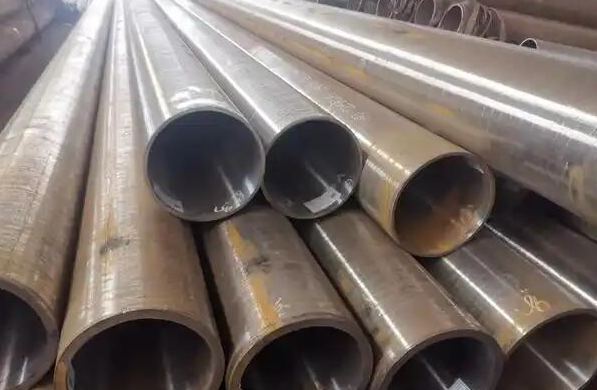
What is high-carbon steel seamless pipe?
High-carbon steel seamless pipe is a
seamless pipe made from high-carbon steel. Its carbon content is typically between 0.60% and 1.4%, making it a special type of carbon steel seamless pipe.
Production process of high-carbon steel seamless pipe:
The production process of high-carbon steel seamless pipe is similar to that of ordinary seamless steel pipe, but the process needs to be adjusted to suit the characteristics of high-carbon steel. It mainly includes billet heating, pressure piercing, rolling and extrusion, sizing and cooling, etc., and finally, it undergoes rigorous mechanical property testing and surface quality inspection. Due to the high hardness and low plasticity of high-carbon steel, the requirements for equipment and process control are higher during processing, and it is often formed using hot rolling or cold rolling methods.
Characteristics of high-carbon steel seamless pipes:
The core characteristics of high-carbon steel seamless pipes are high hardness and high strength, but poor plasticity. This makes them suitable for applications requiring high wear resistance and deformation resistance, such as special mechanical parts, tools, or structural components subjected to high stress. In machining, their machinability is difficult to manage, requiring specialized tools and process parameters.
Compared to low-carbon or medium-carbon steel seamless pipes, high-carbon steel seamless pipes have significantly higher strength and hardness, but poorer weldability and plastic deformation capacity. Therefore, their applications are more focused on high-strength, high-wear-resistant specialized fields rather than general-purpose structural components.
Typical Application Areas:
1. Tools and Molds: Rock drill rods, chisels, tool blanks, ejector pins, mandrels.
2. Machinery and Automotive: High-load mechanical springs (such as heavy-duty vehicle suspension springs, clutch springs), piston rods, hydraulic cylinder barrels (requiring wear-resistant inner walls).
3. Bearings and Wear-Resistant Parts: Bearing rings, rollers, guide rails, bushings. 4. Military and Special Applications: Gun barrels, cannon barrel liners (certain types), special structural components.
Selection Considerations:
1. Non-weldable: Welded connections should be avoided in the design; mechanical connections (threaded, flanged, expansion joints) should be preferred.
2. Heat treatment required: Most applications require quenching and tempering to achieve the required hardness, strength, and elasticity. The heat treatment condition must be specified during procurement.
3. Prevention of brittle fracture: In low-temperature environments or environments with notches or impact loads, the risk of brittle fracture must be considered.
4. Alternative materials: In many applications requiring wear resistance while maintaining toughness, alloy steel (such as chromium-molybdenum steel) or surface-hardened low- to medium-carbon steel pipes may be a better choice.
5. Difficult to machine: High hardness makes machining difficult and causes significant tool wear.
Read more: Types of Seamless Carbon Steel Pipes