The working pressure or pressure-bearing capacity of
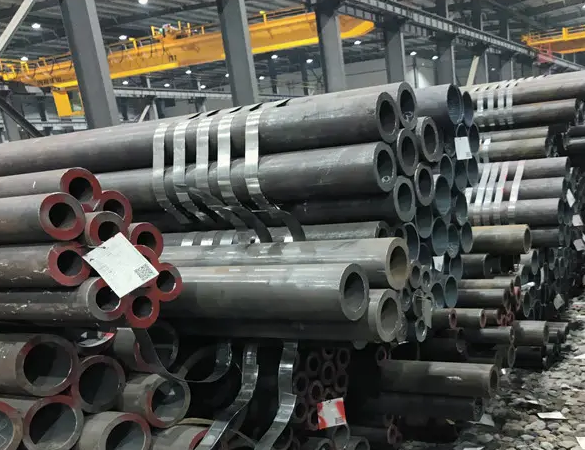
seamless steel pipes (SMLS) is not a fixed value, but a result calculated based on specific conditions. The pressure that seamless steel pipes can withstand depends on factors such as their material, specifications, and manufacturing process.
Factors Affecting the Working Pressure of Seamless Steel Pipes:
1. Material Properties
Material Grade and Strength: For example, the allowable stress of
A53 and A106 steels is much lower than that of P91 alloy steel. This is the material basis for determining pressure-bearing capacity.
Allowable Stress: The maximum stress value that the material can withstand at the design temperature. Obtained from tables in standards (such as ASME B31.1).
2. Dimensions and Specifications
Wall Thickness: The most direct variable; the thicker the wall, the higher the pressure resistance. Calculations must use the minimum measured wall thickness.
Outer Diameter: Under the same wall thickness and material, the smaller the outer diameter, the higher the pressure resistance.
3. Manufacturing Quality
Manufacturing Process:
Hot-rolled pipes and cold-drawn pipes have different performance characteristics.
Quality Factor: For seamless steel pipes, due to their seamless integrity, the quality factor is taken as 1.0 in standard calculations. This is one of their core advantages over welded pipes (whose factor is often less than 1.0).
Defect Control: Internal inclusions, cracks, and other defects significantly reduce actual pressure-bearing capacity.
4. Safety Specifications and Design Guidelines
Design Standards: Such as ASME B31.3 and GB/T 20801, which specify calculation formulas and safety factors.
Service Environment: Corrosive environments, high temperatures, low temperatures, cyclic loads, etc., require measures such as increasing corrosion allowances and selecting heat-resistant materials.
Pressure-Bearing Capacity of Seamless Steel Pipes:
Seamless steel pipes are formed by pressing molten steel through an annular slit and then performing stretching and other processes. Therefore, there are no welds, which significantly improves their pressure-bearing capacity compared to welded steel pipes.
Generally, seamless steel pipes for ordinary fluid transportation can withstand pressures of approximately 1.0 MPa to 10.0 MPa. In certain high-pressure applications, such as piping connections in hydraulic equipment, the selected seamless steel pipes can even withstand pressures ranging from 15 MPa to 30 MPa.
Furthermore, according to national standards such as GB/T8163 "Seamless Steel Pipes for Fluid Transportation," these seamless steel pipes can be used for pipelines with a design pressure not exceeding 1.6 MPa. GB3087 "Seamless Steel Pipes for Low and Medium Pressure Boilers" and GB5310 "Seamless Steel Pipes for High Pressure Boilers" specify seamless steel pipe standards for pipelines with design pressures not exceeding 5.3 MPa and exceeding 5.3 MPa, respectively.
Read more: Seamless Pipe Pressure Calculation