


In industrial piping systems, selecting the right pipe specification is essential to ensure safety, performance, and cost efficiency. Among the various standards available, SCH 40 and SCH 80 pipes are the most widely used in a range of applications.
However, many buyers and engineers still find it challenging to clearly understand the differences between these two options and determine which one best suits their specific project requirements.
In this article, we provide a clear and practical comparison of SCH 40 and SCH 80 pipes, covering their wall thickness, pressure capacity, typical applications, and selection guidelines to help you make an informed decision.
Schedule 40 (SCH 40) pipe is a widely used pipe specification that defines the wall thickness of a pipe based on its nominal size (NPS). It is part of the standardized pipe sizing system established by ASME B36.10M.
Unlike common misconceptions, the schedule number (such as “40”) does not represent a fixed wall thickness. Instead, it corresponds to a series of standardized wall thickness values that vary depending on the pipe diameter.
1. Medium wall thickness, suitable for general-purpose applications
2. Balanced strength and cost, making it a popular choice across industries
3. Available in a wide range of sizes, typically from 1/8 inch to 30 inches
4. Suitable for low to moderate pressure systems, depending on material and operating conditions
SCH 40 pipes are commonly used in applications such as water supply systems, construction, HVAC, and general industrial piping.
Schedule 80 (SCH 80) pipe is a widely used pipe specification that defines the wall thickness of a pipe based on its nominal size (NPS). It is part of the standardized pipe sizing system established by ASME B36.10M.
Unlike common misconceptions, the schedule number (such as “80”) does not represent a fixed wall thickness. Instead, it corresponds to a series of standardized wall thickness values that vary depending on the pipe diameter. Compared to SCH 40, SCH 80 pipes have thicker walls, resulting in higher strength and improved pressure resistance.
1. Thicker wall thickness, suitable for high-pressure applications
2. Higher strength and durability for demanding environments
3. Available in a wide range of sizes, typically from 1/8 inch to 30 inches
4. Suitable for medium to high pressure systems, depending on material and operating conditions
SCH 80 pipes are commonly used in applications such as oil and gas, chemical processing, high-pressure steam systems, and power generation.
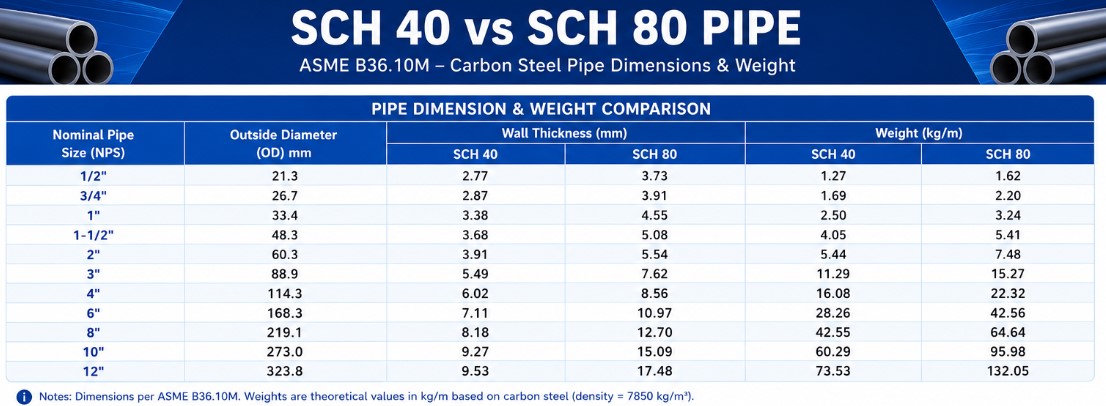
When comparing SCH 40 and SCH 80 pipes, the key distinctions cover wall thickness, pressure rating, overall weight, and service adaptability. Though both pipe grades comply with the ASME B36.10M standard and maintain identical outer diameters for the same nominal pipe size (NPS), they deliver vastly different mechanical performance and engineering applicability.
1. Wall Thickness
For any given nominal pipe size, SCH 80 pipes feature thicker walls than SCH 40 pipes. The increased wall thickness delivers higher structural rigidity and greater safety redundancy, enabling SCH 80 pipes to withstand more rigorous and demanding operating conditions.
2. Pressure Capacity
Benefiting from its thick-wall structure, SCH 80 provides superior pressure resistance compared with SCH 40. It is the ideal option for high-pressure industrial systems, whereas SCH 40 is designed and rated for low-to-medium pressure conventional applications.
3. Weight and Installation
SCH 80 pipes weigh more due to extra raw material consumption, which naturally raises logistics and on-site installation costs and construction difficulty. In comparison, SCH 40 pipes are lightweight and easy to handle, ensuring higher installation efficiency for standard pipeline projects.
4. Cost Considerations
SCH 80 pipes come with higher manufacturing and material costs because of their thicker walls. For conventional projects with budget limitations, SCH 40 serves as a more practical and cost-effective solution without sacrificing basic performance.
5. Applications
SCH 40 pipes are widely adopted for water supply systems, building construction, HVAC systems, and general industrial piping.
SCH 80 pipes are preferred for harsh and high-demand scenarios, including oil and gas transmission, chemical processing, high-pressure steam systems, and critical industrial process piping.
Selecting the appropriate pipe schedule between SCH 40 and SCH 80 depends on comprehensive engineering conditions and budget planning. A reasonable selection directly determines the pipeline system’s operational performance, long-term safety, and overall project economy.
Based on Pressure Requirements
SCH 80 pipes feature thicker wall structures and higher pressure tolerance, making them ideal for high-pressure and demanding industrial systems. In contrast, SCH 40 pipes fully meet the operational demands of low-to-medium pressure scenarios, including conventional plumbing, HVAC systems, and general water transportation.
Based on Application Type
For heavy-duty industrial scenarios such as oil and gas transmission, chemical processing, and high-temperature operating environments, SCH 80 is the preferred option due to its enhanced mechanical strength and structural durability. SCH 40 pipes are widely applied in residential construction, commercial buildings, and light industrial systems without extreme operating conditions.
Based on Budget Considerations
SCH 40 pipes deliver outstanding cost performance, benefiting from thinner walls and lower raw material consumption. Although SCH 80 pipes require higher upfront investment, they provide higher structural safety and longer service life, effectively lowering long-term maintenance and replacement costs for critical pipeline systems.
Based on Flow Requirements
Under the same nominal pipe size, SCH 40 pipes offer a larger internal diameter than SCH 80 pipes. This feature ensures better fluid flow efficiency and minimizes pressure loss during transmission, making SCH 40 more suitable for projects that prioritize maximum flow capacity.
Based on Safety Margin
For projects that require extreme system reliability and operational stability, SCH 80 provides a much higher safety margin. Its thicker wall offers stronger resistance to mechanical stress, reserved corrosion allowance, and effective protection against sudden pressure spikes, avoiding potential pipeline failure risks.
When selecting SCH 40 or SCH 80 pipes, understanding the applicable material standards is essential to ensure performance, safety, and compliance with project requirements. Different ASTM specifications define the mechanical properties, manufacturing processes, and suitable applications of carbon steel pipes.
1. ASTM A53 (General Use)
ASTM A53 is one of the most widely used specifications for carbon steel pipes in general industrial applications. It is suitable for low to medium pressure systems such as water distribution, structural use, and utility piping. ASTM A53 pipes can be either seamless or welded, making them a flexible and cost-effective choice for many standard projects where extreme temperature or pressure conditions are not required.
2. ASTM A106 (High Temperature)
ASTM A106 is designed specifically for high-temperature service applications. It is commonly used in industries such as oil and gas, power generation, and refineries where pipes are exposed to elevated temperatures and higher pressure conditions. Unlike A53, ASTM A106 is typically supplied in seamless form, offering better strength and reliability under demanding operating environments.
3. Seamless vs Welded Pipe Considerations
In addition to material grades, the manufacturing method also plays a critical role in pipe performance. Seamless pipes are produced without a welded seam, providing higher strength, better pressure resistance, and improved performance in critical applications. They are generally preferred for high-pressure and high-temperature systems.
Welded pipes, on the other hand, are manufactured by rolling and welding steel plates or coils. They are more economical and widely used in general applications where pressure requirements are moderate. However, welded pipes may have slightly lower strength compared to seamless pipes, making material selection dependent on the specific engineering requirements of the project.
Choosing the correct combination of material standard and pipe type ensures optimal system performance, safety, and long-term reliability.
SCH 40 and SCH 80 are mainstream wall thickness grades under the ASME B36.10M standard. They share the same outer diameter at equal nominal pipe sizes but differ significantly in wall thickness, pressure resistance and application scenarios. SCH 40 features moderate wall thickness, light weight, low cost and high flow efficiency, ideal for low-to-medium pressure scenarios such as water supply, HVAC, building construction and general industrial piping. SCH 80 has thicker walls, higher structural rigidity and a larger safety margin, suitable for high-pressure, high-temperature and harsh working conditions in oil and gas, chemical and power industries. Proper pipe selection requires comprehensive consideration of system pressure, flow demand, operating environment and budget. Matching qualified materials (ASTM A53/A106) and appropriate pipe types (seamless/welded) ensures safe, stable and cost-effective pipeline operation.
Q1: What is the core difference between SCH 40 and SCH 80 pipe?
A1: The key difference is wall thickness and pressure resistance. SCH 80 has thicker walls and higher pressure tolerance with a larger safety margin, while SCH 40 is lighter, has a larger inner diameter and delivers better fluid flow efficiency.
Q2: Do SCH 40 and SCH 80 pipes have different outer diameters?
A2: No. Per ASME B36.10M, both pipes have identical outer diameters at the same NPS. Only the wall thickness varies, leading to different inner diameters and pressure performance.
Q3: Which pipe is suitable for high-pressure projects?
A3: SCH 80 pipe is the best choice. Its thick-wall structure provides high mechanical stability and pressure resistance, adapting to high-pressure, high-temperature and fluctuating working conditions in heavy-duty industrial projects.
Q4: Why is SCH 40 more cost-effective?
A4: SCH 40 adopts a thinner wall design with less material consumption, cutting manufacturing, transportation and installation costs. It fully meets the needs of conventional low-to-medium pressure projects with no redundant investment.
Q5: Which pipe has better fluid flow performance?
A5: SCH 40 pipe performs better. With the same NPS, its thinner wall creates a larger inner diameter, reducing fluid resistance and pressure loss for higher transmission efficiency.
Q6: What are the common material standards for these pipes?
A6: ASTM A53 and ASTM A106 are widely used. ASTM A53 applies to general low-to-medium pressure piping, while ASTM A106 is dedicated to high-temperature and high-pressure industrial pipelines.
