


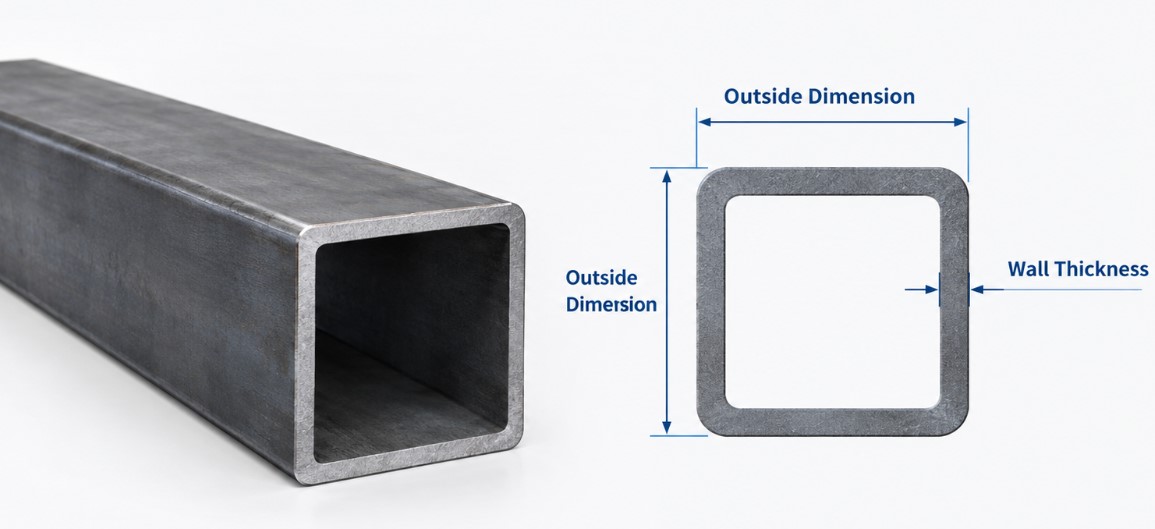
ASTM A500 square tube is square hollow structural section (HSS) made to the cold-formed carbon steel tubing standard most commonly specified in the United States for HSS. This guide covers what the standard includes, how Grade B and Grade C differ, which sizes and tolerances to expect, how to estimate weight, and what to confirm before you request a quotation.
ASTM A500/A500M is a standard specification for cold-formed welded and seamless carbon steel structural tubing in rounds and shapes. It is written for welded, riveted or bolted construction and for general structural purposes. The standard is not limited to square sections: it also covers round and rectangular tubing, and other shapes within its scope. Square tube is one product form under that specification, usually called square hollow sections or square HSS. Both welded and seamless production are permitted (see Manufacturing and Surface Finish below). For a general overview of the standard itself, see our guide to ASTM A500 cold-formed welded and seamless structural tube.
What separates A500 from general commercial square tube is that A500 defines minimum mechanical properties, chemical limits, tolerances and testing. Commercial or mechanical tubing is often supplied under other specifications (ASTM A513, for example) or without defined structural strength. If your design assumes a specific yield strength, the purchase order should name the standard and grade.
A500 defines four grades: A, B, C and D. Grade D must be heat treated. Grades B and C are the ones most commonly supplied for structural use, and many producers certify tube to both.
The table below gives minimum strength for square and rectangular (shaped) tubing. Requirements for round tubing are different and should not be applied to square tube.
|
Grade |
Minimum Yield Strength (shaped) |
Minimum Tensile Strength |
Selection Considerations |
|
Grade A |
39 ksi |
45 ksi |
Lowest strength of the four grades; confirm availability before specifying |
|
Grade B |
46 ksi |
58 ksi |
General structural grade; check whether the design requires higher yield |
|
Grade C |
50 ksi |
62 ksi |
Higher yield and tensile strength; widely specified for structural HSS |
|
Grade D |
36 ksi |
58 ksi |
Heat-treated grade; confirm availability before specifying |
For round tubing, the minimum yield strengths are lower (Grade B 42 ksi, Grade C 46 ksi), while the tensile requirements are the same. Values are minimums from the standard. They are not typical supplier values, and the edition named on your order governs. SI equivalents vary slightly between editions, so check them against the edition you specify.
Grade C offers higher minimum yield and tensile strength, but a higher grade is not automatically the better choice. The decision usually rests on four points:
Design requirements: Start from the strength your engineer specifies. If the design uses a yield strength that only Grade C meets, Grade B is not an option.
Section size and wall thickness: Where a member is governed by stiffness or local buckling rather than yield strength, a higher grade may add little.
Member length and support conditions: Long, slender members are often controlled by buckling, which depends mainly on geometry and stiffness. For calculation methods, see our article on square tube load capacity and strength calculation.
Project specification and documents: Some projects name a grade, require dual certification, or ask for specific material test reports.
Much HSS is dual-graded, so tube certified to both B and C can often satisfy a Grade B requirement; confirm this with the supplier. Whichever grade you choose, ask for it to be confirmed in writing, not assumed from the size or appearance.
A500 covers tube up to a maximum total perimeter of 88 in, which corresponds to a 22 × 22 in square, and a maximum nominal wall thickness of 1 in. Within that range the standard does not fix a short list of sizes, and what is available depends on the producer. The table shows representative sizes only. It does not represent every size covered by the standard or every size a given supplier offers. Weights are calculated theoretical values for carbon steel at 7.85 g/cm³, using nominal dimensions and sharp corners.
|
Outside Dimensions (in / mm) |
Wall Thickness (in / mm) |
Weight (lb/ft) |
Weight (kg/m) |
|
2 × 2 / 50.8 × 50.8 |
1/8 / 3.18 |
3.19 |
4.75 |
|
2 × 2 / 50.8 × 50.8 |
3/16 / 4.76 |
4.63 |
6.88 |
|
3 × 3 / 76.2 × 76.2 |
3/16 / 4.76 |
7.18 |
10.68 |
|
3 × 3 / 76.2 × 76.2 |
1/4 / 6.35 |
9.36 |
13.93 |
|
4 × 4 / 101.6 × 101.6 |
1/4 / 6.35 |
12.76 |
18.99 |
|
4 × 4 / 101.6 × 101.6 |
3/8 / 9.53 |
18.51 |
27.54 |
|
6 × 6 / 152.4 × 152.4 |
1/4 / 6.35 |
19.57 |
29.12 |
|
6 × 6 / 152.4 × 152.4 |
3/8 / 9.53 |
28.72 |
42.73 |
The main A500 requirements for square tube are summarized below. The standard sets limits, and a supplier’s actual production practice may be tighter, but you should not assume that without confirmation. For worked tolerance and wall thickness guidance, see our square tube thickness and tolerance guide.
|
Item |
A500 Requirement |
|
Outside dimensions |
Plus or minus 0.020 in for sizes up to 2½ in; plus or minus 0.025 in over 2½ to 3½ in. Larger sizes have wider limits per the standard. |
|
Wall thickness |
Plus or minus 10% of the specified wall, measured at the center of the flats, excluding the weld area |
|
Length |
Normally supplied in random lengths; specified lengths carry tolerances listed in the standard |
|
Straightness |
1/8 in × total length in feet ÷ 5 |
|
Squareness of sides |
Adjacent sides within 2° of 90° |
|
Outside corner radius |
Not more than 3 × the specified wall thickness |
Theoretical weight depends on three inputs: outside dimension, wall thickness and steel density. For a square tube, with B and t in mm:
Weight (kg/m) ≈ [B² − (B − 2t)²] × 0.00785
Example for a 4 × 4 × 1/4 in tube (101.6 × 101.6 × 6.35 mm): the inner dimension is 101.6 − 12.7 = 88.9 mm, the area difference is 10,322.56 − 7,903.21 = 2,419.35 mm², and 2,419.35 × 0.00785 ≈ 18.99 kg/m. Multiply by 0.672 for lb/ft, which gives about 12.76 lb/ft, matching the table above.
This is a theoretical estimate for carbon steel. A500 does not list a mass tolerance, so scale weights can differ from calculated weights. For more sizes in kg/m and lb/ft, use our square tube weight chart.
Cold-formed square tube starts as flat-rolled steel strip. The strip is formed into a tube, welded along the seam, and sized into a square section. Seamless tube is produced without a weld seam. Both are covered by A500, and the order should state which one you need if it matters for your application.
Surface condition is a separate question from the standard. Tube is commonly supplied black, meaning as produced without a coating. Oiling, painting, galvanizing or other treatment should be specified separately on the purchase order. If you need a coating, confirm which coating standard or process applies, and whether the supplier performs it in-house or through a third party.
Building frames and structural supports: Columns, posts, bracing and secondary framing members. Square sections suit layouts where connections and load paths are symmetrical.
Industrial equipment frames: Machine bases, skids and support structures, where the flat faces make welding and bolting straightforward.
Platforms and storage racks: Legs, rails and cross members for walkways, mezzanines and racking.
Fabricated structural components: Trusses, brackets and welded assemblies cut from standard lengths.
In all of these, final selection depends on the structural design, loading and service conditions, and the applicable code. A grade or size that suits one project may not suit another.
|
|
Square Tube |
Rectangular Tube |
|
Cross-section |
Equal sides |
Unequal sides, with a long and a short dimension |
|
Typical Selection Factors |
Equal-direction connections, symmetrical layouts, columns |
Space limits, members loaded mainly in one direction, beams |
|
Design Considerations |
Same section properties about both axes |
Different properties about each axis; orientation matters |
Give the supplier the following information in the inquiry:
Specification and grade: ASTM A500/A500M, the edition if your project requires it, and the required grade (B, C or dual-certified).
Outside dimensions and wall thickness: State the unit (in or mm) and the nominal wall.
Length and quantity: Random or specified lengths, and the number of pieces or total tonnage.
Surface finish and special processing: Black, oiled, painted or galvanized, and any cutting, drilling or end preparation.
Inspection, testing and documents: Required test reports, third-party inspection or marking requirements.
Delivery requirements: Destination, packaging and required schedule.
Price depends mainly on size, wall thickness, grade, order quantity, surface treatment and delivery conditions. Steel market conditions also affect it, so request a current quotation rather than relying on a fixed rate.
To discuss sizes, grades and availability for your project, contact PermanentSteel with your specification.
It is used for structural applications such as building frames, supports, industrial equipment frames, platforms and racks, and fabricated components. A500 is written for welded, riveted or bolted construction and general structural purposes. The right size and grade depend on your design and the governing code.
Grade C has higher minimum strength. For square and rectangular tube, Grade B requires 46 ksi minimum yield and 58 ksi minimum tensile, while Grade C requires 50 ksi and 62 ksi. Choose based on the design requirement and project specification, not on grade alone.
A500 covers square tube up to 22 × 22 in (88 in total perimeter) with a maximum nominal wall of 1 in. Actual availability depends on the producer, so confirm outside size, wall thickness and length with the supplier. The table above lists representative sizes from 2 × 2 in to 6 × 6 in.
The standard permits both. Welded tube is formed from flat-rolled steel and welded along the seam, and seamless tube is made without a seam. If you need a specific type, state it in the order, because it affects availability and documentation.
Provide the standard and grade, outside dimensions, wall thickness, length, quantity, surface finish, any special processing, required inspection and documents, and delivery destination and timing. Clear specifications let the supplier confirm availability and quote accurately.
