


Square tube strength and load capacity are calculated from the section properties of the tube (area A, moment of inertia I, section modulus S) and checked against the actual load case: yielding under axial load (N_y = A × f_y), bending stress (σ = M / S), buckling for compression members, and deflection. The lowest result governs, and a safety factor is applied. Square tubing strength therefore depends on size, wall thickness, material grade, length, supports and load type, not on any single value. The formulas below are for preliminary estimation; structural designs must be verified against the applicable design code.
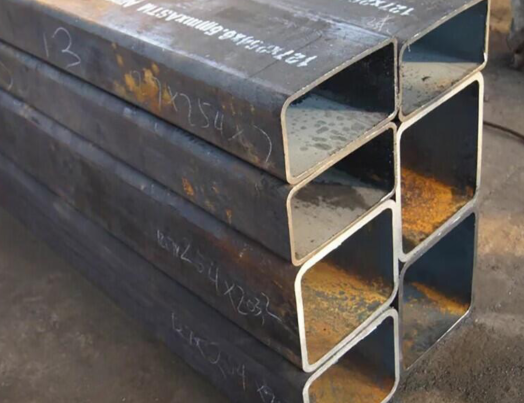
Square tube (SHS tube) is widely used in construction, machinery manufacturing, bridges, highways and transportation. When using square tubes, its strength needs to be calculated to ensure that it can withstand the corresponding load.
Section properties. For a hollow square section with outer width B and wall thickness t (sharp-corner approximation):
Area: A = B² − (B − 2t)² = 4t(B − t)
Moment of inertia: I = [B⁴ − (B − 2t)⁴] / 12
Elastic section modulus: S = 2I / B
Radius of gyration: r = √(I / A)
Units: B and t in mm; A in mm²; I in mm⁴; S in mm³; r in mm. Real tubes have rounded corners, so for design use the section properties tabulated in the product standard.
When the square tube is subjected to bending, the stress generated will cause its bending deformation, thereby affecting its strength. The bending stress is calculated as follows:
σ = M / S ≤ f_y / n
Among them, σ is the bending stress (MPa), M is the maximum bending moment (N·mm), S is the section modulus (mm³), f_y is the yield strength (MPa), and n is the safety factor. The yield moment is M_y = S × f_y.
The maximum moment M and deflection δ depend on the loading and support conditions (elastic, constant section):
|
Beam case |
Maximum moment M |
Maximum deflection δ |
|
Simply supported, central point load P |
P × L / 4 |
P × L³ / (48 × E × I) |
|
Simply supported, uniform load w (N/mm) |
w × L² / 8 |
5 × w × L⁴ / (384 × E × I) |
|
Cantilever, end-point load P |
P × L |
P × L³ / (3 × E × I) |
|
Cantilever, uniform load w (N/mm) |
w × L² / 2 |
w × L⁴ / (8 × E × I) |
P in N, L (span) in mm, E in MPa, I in mm⁴. A square section has the same I about both axes; for rectangular tube, use the axis that matches the load direction.
When a square tube is subjected to an axial load (along the tube axis), the stress generated will affect its bearing capacity. For tension, or a short compression member, the yield capacity is:
N_y = A × f_y
Among them, N_y is the axial yield capacity (N), A is the effective cross-sectional area (mm²), and f_y is the yield strength (MPa = N/mm²). The allowable load is N_y / n, where n (greater than 1) is the safety factor set by the design code or project specification. A is the effective area at the critical section: the full area less holes and cut-outs. Welded connections are checked separately (see Calculation elements, item 3). For bending and buckling, use sections 1 and 3.
Longer compression members buckle before the material yields. The Euler critical load, an upper bound for an ideal straight column, is:
P_cr = π² × E × I / (K × L)²
K is the effective length factor (theoretical values: 1.0 pinned–pinned, 2.0 fixed–free, 0.7 fixed–pinned, 0.5 fixed–fixed; design codes recommend larger values where end fixity is not ideal) and L is the member length. The slenderness ratio is λ = K × L / r. Euler’s formula applies only to slender members, λ ≥ π√(E / f_y) (about 93 for f_y = 235 MPa and E = 206,000 MPa).
Real members have initial imperfections, so the Euler value can overestimate capacity, especially near this limit. For shorter members, inelastic buckling lowers the capacity below N_y. In design, take the compression capacity from the column buckling curves of the applicable code (for example GB 50017, AISC 360 or EN 1993-1-1; confirm which applies to your market). Where axial load and bending act together, use the combined-action equations of that code.
Square tube strength calculations are used mainly in construction (structural supports and component connections) and machinery manufacturing (machine tools, light vehicles, agricultural machinery). First identify whether the member sees axial load, bending or both, then apply the matching method above.
1. Material properties: The strength and yield strength of the square tube material are an important basis for calculating the load-bearing capacity. Commonly used materials for square tubes include Q235, Q355, etc., with yield strengths of 235MPa and 355MPa respectively (thickness up to 16 mm). Yield strength can be lower for thicker material, so take the values from the product standard and the mill test certificate. The elastic modulus E (about 206,000 MPa for carbon steel) is also needed for deflection and buckling calculations. Aluminum has an elastic modulus of roughly one-third of steel, so deflection often governs. Stainless steel and aluminum are covered by their own design codes, so take f_y and E from the applicable standard.
2. Square tube size: The size of the square tube body is also an important factor in calculating load-bearing capacity. Generally, the larger the cross-sectional area of a square tube, the greater its bearing capacity. What needs to be noted here is that the cross-sectional shape of the square tube is different, and its area will also be different. The calculation needs to be based on the specific situation. Outer width and wall thickness determine A, I and S, and for bending and buckling the moment of inertia matters more than area alone. For standard wall thickness options and tolerances, see Square Tube Thickness.
3. Welds: The size, shape and position of the weld, together with the welding materials and process, determine the capacity of welded connections. It is generally confirmed by welding tests and must meet the applicable welding standard.
4. Member length and support conditions: Length, span and end conditions (simply supported, cantilever, fixed) determine the bending moment, deflection and effective length K.
5. Load type: Axial, bending or combined; point or distributed; static or dynamic.
Given (assumed for illustration): 100 × 100 × 5 mm square tube, Q235 with f_y = 235 MPa, E = 206,000 MPa. It is checked as (a) a simply supported beam with L = 2,000 mm and a central point load P, and (b) a pinned column of the same length (K = 1.0). Sharp-corner properties are used and self-weight is ignored.
Step 1: Section properties
Step 2: Axial yield capacity
N_y = 1,900 × 235 = 446,500 N ≈ 446.5 kN (tension or a very short column only)
Step 3: Bending
Step 4: Deflection
Step 5: Compression
λ = 1.0 × 2,000 / 38.8 ≈ 51.5, below 93, so Euler’s formula does not apply. It would give about 1,457 kN, higher than N_y, and must not be used. The column capacity must be taken from the buckling curves of the design code.
Result: these are limit values, not safe working loads. A real design must also apply the code’s safety or resistance factors, include self-weight and load combinations, and check local buckling and connections.
Confirm that the delivery condition and mechanical properties of the square tube (especially yield strength) meet the product standard and design requirements.
Square tubing load capacity can also be limited by deflection, overall buckling and local buckling of thin walls, which must be checked in addition to strength. Check wall thickness tolerance and corrosion allowance as well, and use additional checks for dynamic, impact or fatigue loads.
Permanent Steel Manufacturing Co.,Ltd (PMC) is a professional and experienced supplier of square tubes with rich industry experience, strict quality control and complete international certifications.
We provide high-quality products and professional services for global customers. For any inquiries or cooperation, please feel free to contact us.
