


A square tube has equal width and height, while a rectangular tube has two different side lengths. Which one fits depends on the application, load direction, wall thickness, material and available space.
As a general rule, square tube suits columns, posts and frames where loads or connections come from several directions. Rectangular tube suits beams, rails and bracing where the load acts mainly in one direction. Neither shape is stronger in every case, so confirm the final size against your load, span and support conditions.
|
Factor |
Square Tube |
Rectangular Tube |
|
Cross-section |
Equal width and height |
Different width and height |
|
Behavior in bending |
Same section stiffness about both axes |
Stiffness differs about each axis, so orientation matters |
|
Typical use |
Columns, posts, frames, supports and general fabrication where load or connections come from several directions |
Beams, rails, bracing and frames where the load acts mainly in one direction, with the long side aligned to the load direction |
|
Connections and layout |
Same dimension on all faces, which simplifies joint layout |
Long and short faces differ, so joint details depend on which face is used |
|
How it is specified |
Side length × wall thickness (e.g. 50 × 50 × 3 mm) |
Width × height × wall thickness (e.g. 100 × 50 × 3 mm) |
|
Key selection criterion |
Section size and wall thickness |
Section size, wall thickness and orientation |
Choose square tube when loads or connections come from more than one direction, as in columns, posts and general frames. Choose rectangular tube when the load acts mainly in one direction, as in beams, rails and bracing, or when the available space is wider than it is tall. Neither shape is stronger in every case: a rectangular section can be stiffer in one direction and less stiff in the other, so orientation and size matter more than shape alone.
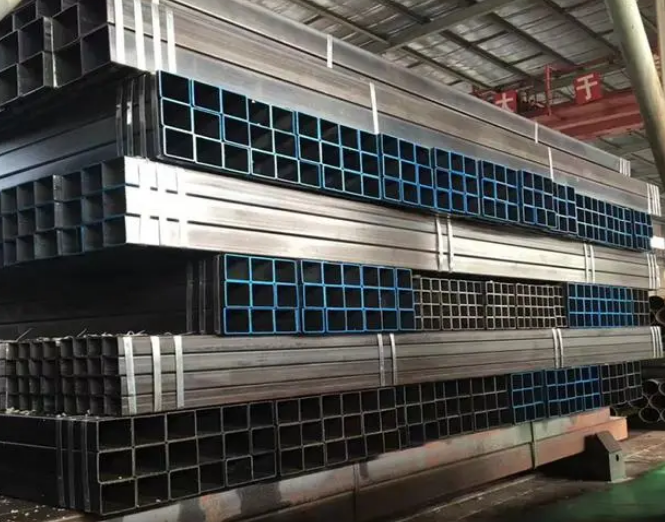
Select the material according to the service environment, then confirm the standard required by the project.
Carbon steel: the usual choice for structural and general fabrication. It normally needs coating or galvanizing where corrosion is a concern.
Stainless steel: chosen mainly for corrosion resistance and appearance. The grade should match the environment.
Alloy steel: specified when the design calls for particular mechanical properties.
Aluminum: lighter and easy to process, but its strength and stiffness differ from steel, so it should not be swapped for steel at the same size.
Standards commonly referenced for steel hollow sections include EN 10210 (hot finished structural hollow sections), EN 10219 (cold formed welded structural hollow sections), ASTM A500 (cold-formed welded and seamless carbon steel structural tubing) and ASTM A513 (electric-resistance-welded carbon and alloy steel mechanical tubing). Confirm the grade and standard in your drawing or purchase specification. For grade and size details, see our ASTM A500 square tube guide.
Square tube is specified by side length and wall thickness. Rectangular tube is specified by width, height and wall thickness. Typical examples include 25 × 25 mm, 50 × 50 mm and 100 × 100 mm for square tube, and 50 × 25 mm and 100 × 50 mm for rectangular tube; available sizes depend on the standard and the manufacturer.
When sizing, consider the space limits, the connection details and the direction of the load. For rectangular tube, state which dimension is the depth in the loaded direction, so the section is installed with the correct orientation.
Common wall thicknesses such as 1.5 mm, 2.0 mm and 3.0 mm are examples only; available thicknesses depend on the standard and size.
Surface treatment depends on the environment and on how the tube will be fabricated and finished. Common options include black (as produced), painted or primed, pre-galvanized and hot-dip galvanized for carbon steel. Stainless steel may be supplied with a pickled or polished finish, depending on the grade and process. Confirm the finish together with the required corrosion protection and any welding or coating work after delivery.
Request the mill test certificate (MTC) and confirm that the grade and standard match your order. On delivery, check:
Compare quotations on the same basis: standard, grade, dimensions, wall thickness, length tolerance and surface treatment. Where tube is priced by weight, the weight per meter affects the total cost. You can check this with our square tube weight chart; rectangular tube weight depends on its own width, height and wall thickness.
Load capacity cannot be judged from wall thickness or cross-sectional shape alone. Before you finalize a size, check the following:
Not in every case. A rectangular section can be stiffer in one direction than a square section, but it is less stiff in the other direction, so orientation matters. Capacity also depends on wall thickness, material grade, span, load type and support conditions. To compare two sections, check them under the same load and support conditions.
Not automatically. Changing the shape changes the section dimensions, the stiffness in each direction, the weight and the fit. Equal wall thickness or equal weight does not mean equal capacity, so check the replacement against the load, span and deflection requirements before substituting.
Provide the shape, outside dimensions, wall thickness, length, material grade and standard, surface treatment and quantity. A typical format is: rectangular tube, 100 × 50 × 3.0 mm, ASTM A500 Grade B, 6 m, black finish. This is a format example only, not a recommended specification. Add any inspection or certificate requirements at the same time.
Read more:
Square Tube vs. Round Tube: Which One is Better? How to Choose?
