
Permanent Steel Manufacturing Co.,Ltd

Home  >  Hot News  >  Current News

Manufacturing Process of Cold Drawn Steel Tube

Date:2026-07-13    keywords: cold drawn steel tube manufacturing process, cold drawn seamless tube

Cold drawn steel tube — also known as cold drawn seamless tube — is  produced by pulling an already-formed seamless steel tube (the mother tube) through a die at room temperature. This cold working process improves dimensional accuracy, surface finish, and mechanical strength compared with the hot-finished tube it starts from. Below is a  detailed look at each step involved.


1. Manufacturing Process of Cold Drawn Steel Tube


Step 1: Mother Tube Preparation


The starting material is a hot-finished seamless tube produced by piercing and rolling a steel billet. Before drawing, the mother tube is inspected for size and surface defects, then cut into workable lengths.


Step 2: Pickling and Surface Cleaning


The mother tube is pickled in acid to remove mill scale, oxides, and surface impurities left from hot rolling. Thorough cleaning is essential — any scale left on the surface can damage the die or cause surface defects on the finished tube. The tube is then rinsed and dried.
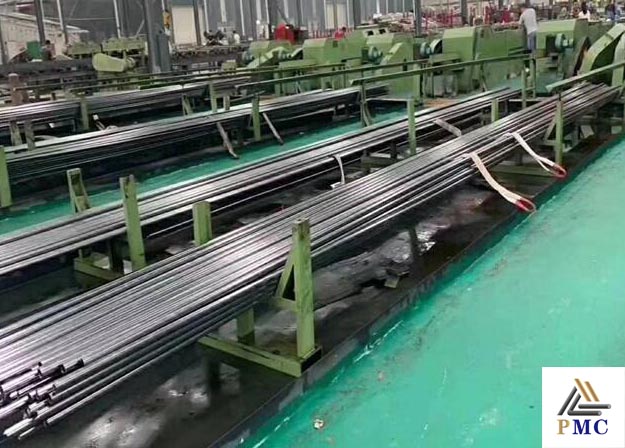

cold drawn seamless tube


Step 3: Lubrication


A lubricant coating (lime, phosphate, or oil-based) is applied to the tube surface. This reduces friction against the die during drawing, protects the die from wear, and helps produce a smooth, defect-free surface.

Step 4: Pointing


One end of the tube is reduced ("pointed") so it can be fed through the die and gripped by the draw bench — a necessary preparation before drawing.


Step 5: Cold Drawing


The tube is pulled through a die — with or without an internal mandrel or plug, depending on the required inside diameter — at room temperature. This reduces the outside diameter and/or wall thickness while significantly improving dimensional accuracy and surface finish. Depending on the target size and grade, the tube may pass through the die multiple times (multi-pass drawing) to reach final dimensions without over-straining the material.


Step 6: Intermediate Annealing (if required)


Cold drawing work-hardens the steel and reduces ductility. When more than one drawing pass is needed, the tube is annealed between passes to relieve internal stress and restore ductility, allowing further drawing without cracking.


Step 7: Straightening


After the final drawing pass, the tube is straightened — typically with a roller straightener — to correct any bow or curvature introduced during drawing.


Step 8: Cutting to Length


The straightened tube is cut to the required standard or customer-specified length.


Step 9: Final Heat Treatment (if specified)


Depending on the required mechanical properties, the finished tube may undergo stress relieving, normalizing, or annealing to meet the specified standard (e.g. ASTM A519). This step is essential for relieving the residual stress introduced during cold drawing — see why cold drawn seamless tubes need heat treatment for a detailed look at the underlying thermal and structural stress mechanisms.


Step 10: Inspection and Testing


Every batch is checked for dimensional accuracy (OD, wall thickness, length), surface quality, and mechanical properties. Common tests include chemical analysis, tensile testing, hardness testing, ultrasonic testing (UT), and eddy current testing (ET), as applicable.
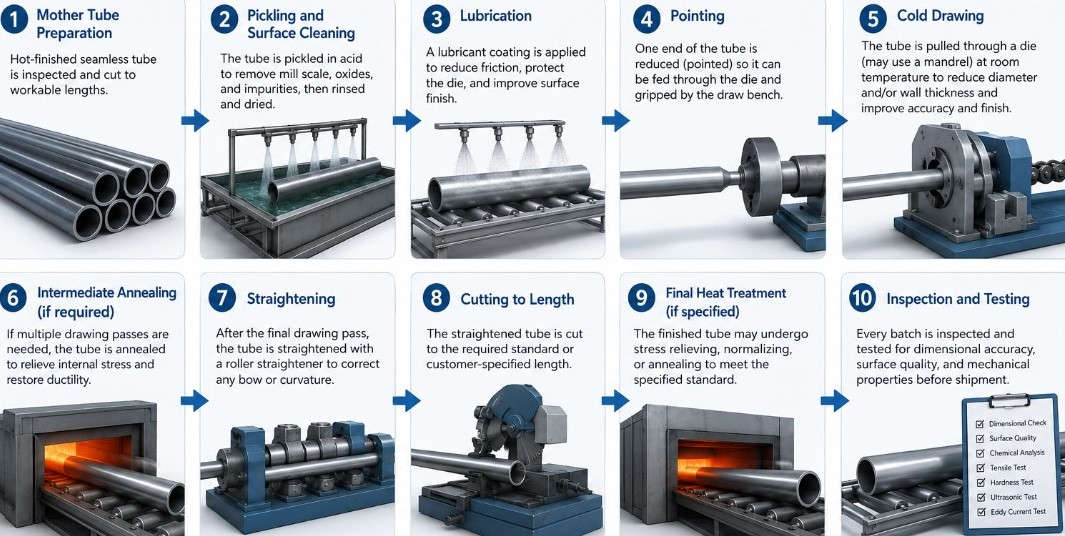

manufacturing process of cold drawn steel tube


2. FAQs

 
Q: How many times does a tube need to be drawn?
This depends on the reduction needed and the grade — light reductions may need only one pass, while larger size changes require multiple passes with annealing in between.
 
Q: Why is annealing needed between drawing passes?
Cold drawing work-hardens the steel; annealing restores ductility so the tube can be drawn further without cracking.
 
Q: What's the difference between cold drawn tube and the seamless tube it starts from?
The mother tube is hot-finished with looser tolerances; cold drawing tightens the OD/ID and wall thickness, smooths the surface, and increases strength.


3. Conclusion


From mother tube preparation and pickling, through lubrication, pointing, and cold drawing (with intermediate annealing where needed), to straightening, cutting, final heat treatment, and inspection — each step in this process is controlled to turn a hot-finished seamless tube into a precision cold drawn product. The result is a tube with tighter dimensional tolerances, a smoother surface, and higher strength than the hot-finished tube it started from, making it well suited for hydraulic cylinders, automotive components, and other applications that demand tight tolerances
and consistent performance.


Related articles:

Applications of Cold Drawn Seamless Tubes

Quality Control Points in Cold Drawn Seamless Tube Production

What Causes Cold Drawn Seamless Tubes to Crack?

©2017 Permanent Steel Manufacturing Co.,Ltd  https://www.permanentsteel.com  All Rights Reserved.  Terms of Sale|Privacy Policy

We use cookies to offer a better browsing experience, analyze site traffic, and personalize content. By using this site, you agree to our use of cookies.