
Permanent Steel Manufacturing Co.,Ltd

Home  >  Hot News  >  Current News

Quality Control Points in Cold Drawn Seamless Tube Production

Date:2026-07-16    keywords: cold drawn seamless tube quality control, pickling process design

Cold drawing turns a hot-finished seamless tube into a precision product with tighter tolerances and a smoother surface — but only if a handful of process steps are tightly controlled. This article focuses on the quality control points within cold drawn seamless tube production: where defects typically originate and how mills prevent them. For the full step-by-step production sequence, see our guide on the manufacturing process of cold drawn steel tube.


Quality Control Points Within Cold Drawn Seamless Tube Production


1.1 Mother Tube (Capillary Tube) Inspection

The starting material — the hot-finished "capillary" or mother tube — is inspected before it ever reaches the die. Wall thickness must be uniform along the length, and inner and outer surface defects need to be minimal, since any flaw present at this stage will only be drawn deeper into the finished tube rather than removed. Mills typically arrange dedicated outer-surface polishing and inner-bore defect-cleaning equipment at this step to catch problems early.


1.2 Pickling Process Control

Before drawing, the tube is pickled in acid to strip mill scale and oxide left over from hot rolling. This scale is mainly a mix of iron oxides — Fe2O3 and Fe3O4 — and if it isn't fully dissolved, residue can redeposit on the surface as a dark "sludge," which shows up as black spots on the finished tube. Fe3O4 (magnetite) in particular resists plain hydrochloric acid more than Fe2O3 does, so pickling baths commonly add 5–10 g/L of NaCl; the added chloride helps break down this more stubborn oxide and reduces the chance of black-spot residue. Getting this step wrong is one of the most common causes of surface rejects downstream, so bath concentration and dwell time are worth checking on any mill's process sheet.


1.3 Drawing Tools and Dies

Die and plug quality has a direct, visible effect on the finished surface. As a general benchmark, drawing tools should have a surface roughness of Ra 0.4 μm or finer, dimensional accuracy within a tight tolerance grade (commonly IT5 or better), and hardness of HRC 70 or above. Tooling below this standard is prone to sticking or tip-galling during the draw, which telegraphs scratches and drag marks straight onto the tube surface.

1.4 Annealing Control

Cold drawing work-hardens the steel, so annealing between passes is what restores ductility and allows further drawing without cracking. It also affects how cleanly oxide scale releases in later processing. Precision cold drawn tube generally calls for a non-oxidizing bright annealing furnace — annealing in an uncontrolled atmosphere can reintroduce the same scale problems the earlier pickling step was meant to solve.


1.5 Lubrication Control

Resin-based lubricant is preferred over phosphate/saponification coatings for precision cold drawn tube. The difference shows up on the finished surface: phosphate or saponification lubrication leaves a dull gray coating that has to be stripped afterward, while resin lubrication draws cleanly off the bare metal, leaving the tube with the natural bright finish of the iron matrix — closer in appearance to a cold rolled tube — without an extra post-draw cleaning step.

1.6 Final Reinspection

After drawing, tubes go through a final reinspection distinct from the initial mother-tube check. This step screens specifically for folding and cracking on the outer surface, and for folding, severe scribing, and pockmarks on the inner surface — defects that can be introduced during drawing itself rather than inherited from the starting material.
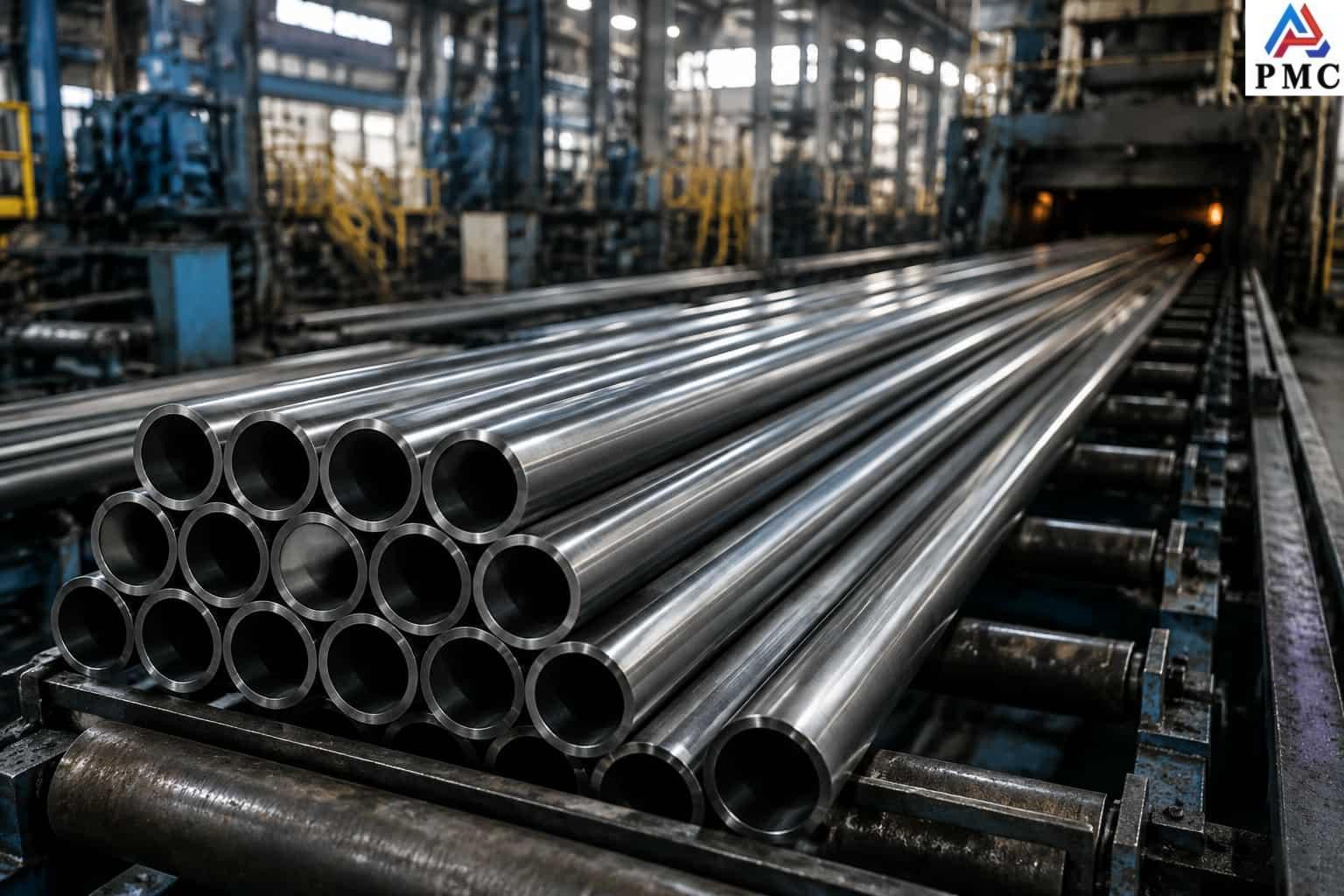

cold drawn seamless tube production


3. FAQs


Q: How often should pickling bath concentration be checked?

Most mills check acid concentration and dwell time at least once per shift, since HCl strength drops as it reacts with scale. A drifting, under-strength bath is exactly what allows iron oxide residue to redeposit instead of fully dissolving, so this is a routine check rather than a one-time setup step.

Q: How often do drawing dies need to be reconditioned or replaced?

Dies and plugs are typically inspected every shift and re-polished or swapped out once roughness or bore size drifts outside the controlled range described above — waiting until scratches show up on finished tube means the tooling was already out of spec for a while.


4. Conclusion


Surface and dimensional defects in cold drawn seamless tube almost always trace back to one of these control points — mother tube condition, pickling chemistry, tooling quality, annealing atmosphere, lubrication type, or final inspection. Buyers evaluating a cold drawn precision seamless steel tube supplier can use these same checkpoints as a quick way to gauge process discipline. 


Related articles: 

Why do Cold Drawn Seamless Tubes need Heat Treatment? 

How to Identify the Quality of Cold Drawn Seamless Steel Tubes?

Common Defects and Causes of Cold Drawn Seamless Steel Tubes

What Causes Cold Drawn Seamless Tubes to Crack?

Cold Drawn Seamless Steel Tube Defects: Repair or Reject?


©2017 Permanent Steel Manufacturing Co.,Ltd  https://www.permanentsteel.com  All Rights Reserved.  Terms of Sale|Privacy Policy

We use cookies to offer a better browsing experience, analyze site traffic, and personalize content. By using this site, you agree to our use of cookies.