


Cold Drawn Seamless Steel Tubing is a precision steel tube produced by drawing a seamless tube through a die at room temperature. This process improves dimensional accuracy, surface finish, and mechanical properties compared with standard hot finished tubing.
Cold drawn seamless steel tubing is widely used in hydraulic systems, automotive components, precision machinery, and other applications that require tight tolerances and consistent performance. Its main advantages include higher strength, smoother surfaces, better concentricity, and more accurate wall thickness control. Below, we'll explain its specifications, manufacturing process, properties, applications, and how to choose the right tubing.
In short, cold drawn seamless steel tubing starts from an existing seamless steel tube (the "mother tube"), which is pickled and lubricated, then pulled through a die at room temperature to reduce its diameter and wall thickness with tight dimensional control. Depending on the grade and target properties, one or more drawing passes may be used, with intermediate annealing in between. The tube is then straightened, cut to length, surface-finished, and inspected before shipment. For the full step-by-step process — including mother tube preparation, pickling, lubrication, die drawing, intermediate annealing, straightening, and inspection — see our detailed guide: Manufacturing Process of Cold Drawn Steel Tube & Why do Cold Drawn Seamless Tubes need Heat Treatment?
Cold drawn seamless steel tubing is manufactured through a cold drawing process that enhances dimensional accuracy and mechanical properties beyond those of hot-finished seamless tubing. These characteristics make it suitable for applications where precision, consistent quality, and reliable performance are essential.
The controlled manufacturing process delivers consistent dimensions, mechanical properties, and surface quality from batch to batch. Depending on the application, cold drawn seamless steel tubing is commonly produced to standards such as ASTM A519, ASTM A179, and EN 10305-1, ensuring compliance with industry requirements.
Cold drawn seamless steel tubing is supplied in different dimensions, grades, and standards to meet specific industrial requirements.
The main specifications include tube size, wall thickness, material grade, manufacturing standard, tolerance, and surface condition.
|
Specification |
Details |
|
Outside Diameter (OD) |
6 mm–325 mm (1/4 in–12 in) |
|
Wall Thickness (WT) |
0.8 mm–25 mm |
|
Length |
4–12 m or customized |
|
Material |
Carbon Steel, Alloy Steel, Stainless Steel |
|
Common Grades |
SAE 1010, SAE 1020, SAE 1026, ST35, ST45, ST52, 4130, 4140 |
|
Standards |
ASTM A519, ASTM A179, ASTM A213, EN 10305, DIN 2391 |
|
Tolerance |
Tight dimensional tolerance for precision applications |
|
Surface Finish |
Smooth, bright surface finish suitable for precision applications |
|
Heat Treatment |
Annealed, Normalized, Stress Relieved, or customized |
|
Testing |
Chemical analysis, Mechanical testing, Dimensional inspection, Eddy current testing, Ultrasonic testing |
Choosing the right cold drawn seamless steel tubing comes down to matching these specifications to your application — size requirements, mechanical properties, operating conditions, and industry standards all play a part.
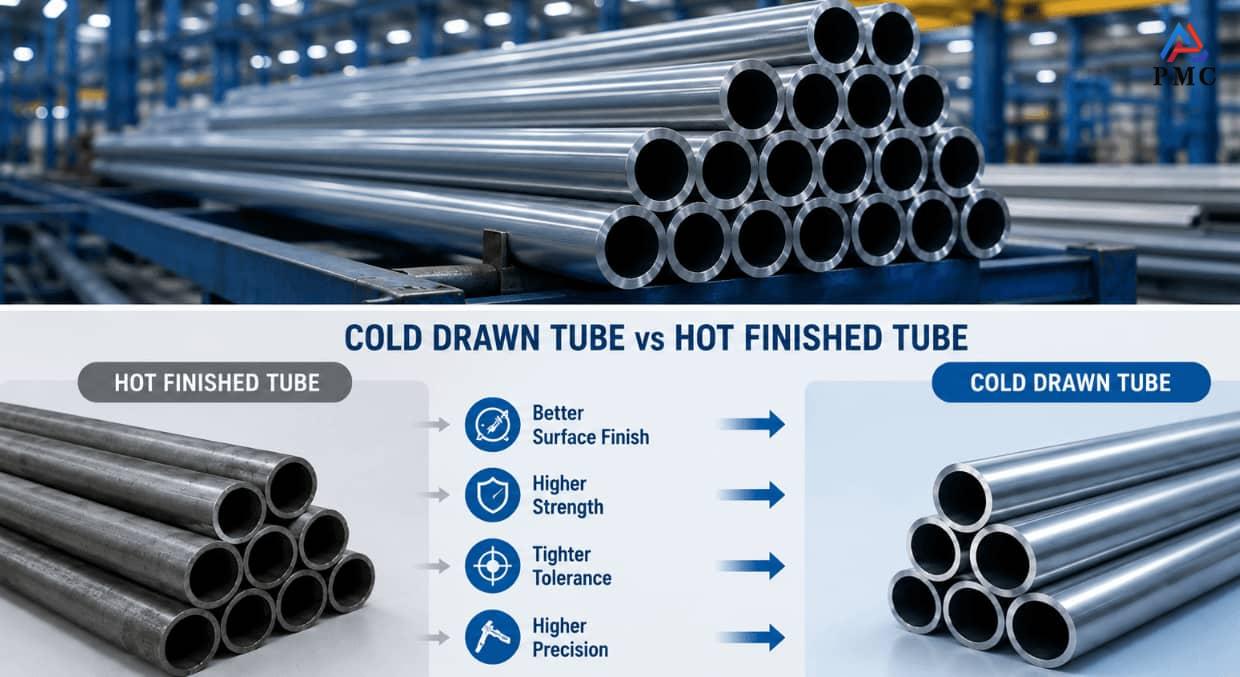
Although both cold drawn and hot finished seamless tubing are from seamless steel tubes, their final processing methods are different. This results in distinct performance characteristics, making each type suitable for different manufactured industrial applications.
|
Feature |
Cold Drawn Seamless Tubing |
Hot Finished Seamless Tubing |
|
Final Processing |
Cold drawing |
Hot finishing |
|
Dimensional Tolerance |
Tight |
Moderate |
|
Surface Finish |
Smooth and uniform |
Mill finish with slight surface scale |
|
Mechanical Properties |
Higher yield strength and hardness |
Better ductility and formability |
|
Machinability |
Excellent for precision machining |
Suitable for general machining |
|
Available Sizes |
Best suited for smaller diameters and precision tubing |
Available in a wider range of diameters and wall thicknesses |
|
Production Cost |
Higher (extra processing step) |
Lower |
|
Typical use case |
Precision shafts, hydraulic cylinders, bushings |
Structural tube, larger-diameter piping |
The right choice depends on the performance requirements of your project. Cold drawn seamless tubing is ideal for applications that require tight tolerances, high machining accuracy, and consistent dimensions. Hot finished seamless tubing is a cost-effective solution for general engineering, structural, and pressure applications where standard tolerances are sufficient.
Building on the tight tolerances and smooth surface finish covered above, cold drawn seamless tubing is commonly used in:
Hydraulic and pneumatic cylinders — precise inner diameter for reliable sealing and pressure control
Automotive parts and bearings — shafts, bushings, and bearing races requiring tight roundness and a smooth finish
Aerospace and medical components — where strength and dimensional consistency matter more than material cost
Instrumentation and fluid control parts — gauges, sensors, and valves needing consistent wall thickness
Related articles: Applications of Cold Drawn Seamless Tubes
When deciding whether cold drawn seamless tubing is right for your order, check these four points:
Tolerance — Need tighter tolerances than standard hot finished tube can offer? Cold drawn is usually the right starting point.
Strength requirement — Choose cold drawn for higher yield strength and hardness; choose hot finished if you need better ductility and formability instead.
Size range — Confirm your required diameter and wall thickness are available in cold drawn — very large sizes may need hot finished or welded tube instead.
Standard — Specify the exact standard you need (e.g., ASTM A519 for mechanical tubing, ASTM A213 for boiler and heat exchanger tube) when placing your order.
Not sure which applies to your project? Share your pressure rating, operating environment, and required tolerance with your supplier, and they can confirm whether cold drawn or hot finished tubing is the better fit for your order.
Q: What's the difference between cold drawn and cold rolled seamless tube?
The terms are often used interchangeably, but "cold drawn" is the more accurate term for seamless tube — it's pulled through a die, not rolled.
Q: Can cold drawn seamless tube be customized to non-standard sizes?
Yes, custom dimensions and tolerances are usually available — confirm with your supplier before ordering.
Q: What surface treatments are available?
Common options include mill finish, oiled, black phosphate, and chrome plating, depending on the supplier.
Q: How long does an order typically take?
Standard sizes ship faster; custom sizes or specific standards (e.g., ASTM A519) may need extra production time.
Cold drawn seamless steel tubing delivers the tight tolerances, smooth surface, and higher strength that hot finished tubing can't match — but that precision comes at a higher cost, so it's worth confirming your tolerance, strength, size, and standard requirements before choosing between the two. If you're ready to move forward, share your specifications with your supplier to get an accurate quote and confirm availability for your required size and standard.
Related articles:
Quality Control Points in Cold Drawn Seamless Tube Production
What Causes Cold Drawn Seamless Tubes to Crack?
