


Cold drawn seamless steel tubes are manufactured through a cold drawing process to achieve tighter dimensional tolerances, improved surface finish, and consistent mechanical properties. Compared with standard seamless tubes, they provide better precision and surface quality, making them suitable for demanding applications such as hydraulic equipment, automotive components, and precision machinery.
Cold drawn seamless steel tubes are widely selected for applications requiring higher precision, better surface quality, and consistent performance. Compared with standard seamless tubes, the cold drawing process allows closer dimensional control and improves the surface condition of the tubes.
The main advantages include:
Tighter dimensional tolerances: typically held to H8-H9 (e.g., per DIN 2391), suitable for applications where accurate fitting and assembly are required.
Better surface finish: Inner-bore roughness is generally Ra 0.8-3.2 um, which helps performance in machining, sealing, and fluid-related applications.
Stable mechanical properties: Provides reliable strength and performance during service.
Consistent quality: Supports precision manufacturing and repeatable production requirements.
Because of these advantages, cold drawn seamless tubes are commonly used in industries that require higher accuracy and reliability than conventional hot-finished tubes can provide, which is why buyers often choose a specialized cold drawn seamless tube manufacturer over a general steel pipe supplier for these applications.
Because seal life depends on bore roundness and surface finish, cylinder tube specifications commonly call for an ID tolerance of H8-H9 and Ra of 1.6 um or better, figures worth confirming on the mill certificate when sourcing.
Cold drawn seamless tubes are widely used in precision machinery and mechanical equipment where accurate dimensions and good machinability are required.
Common applications include:
Machine components
Mechanical shafts
Equipment parts
Precision engineering components
Since this tube is often machined further (bored, honed, or turned), starting from a tighter as-drawn tolerance reduces stock removal and machining time.
Cold drawn seamless tubes are also used in heat exchangers and industrial equipment that require controlled dimensions and reliable material performance.
Typical applications include:
Heat exchanger components
Industrial processing equipment
Pressure-related equipment
Consistent wall thickness matters most here, since it directly affects the pressure rating used in ASME or PED design calculations.
Large-diameter pipeline transport is typically served by welded or hot-finished line pipe (e.g., API 5L), while cold drawn seamless tube is commonly specified for smaller, precision-critical components within oil and gas equipment.
Typical applications include:
Instrumentation tubing
Equipment components
Precision mechanical parts
These smaller-diameter, precision-critical components are exactly where the tight tolerances of cold drawing provide the most benefit.
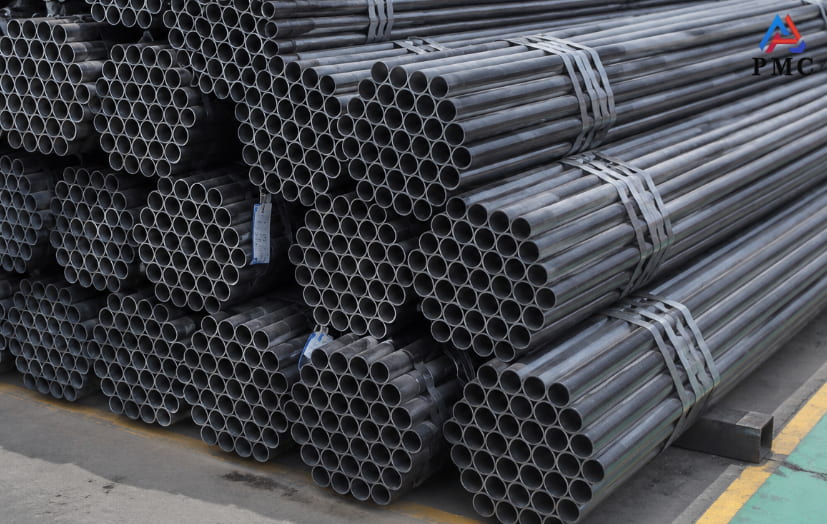
The selection between cold drawn tubes and standard seamless tubes should be based on operating conditions, dimensional requirements, and the specific application environment.
Q: What are cold drawn seamless tubes mainly used for?
Cold drawn seamless tubes are mainly used in applications that require high dimensional accuracy, smooth surface finish, and reliable mechanical performance. Common applications include hydraulic cylinders, automotive components, precision machinery, bearing parts, instrumentation, and other industrial equipment where tight tolerances and consistent quality are required.
Q: Why are cold drawn seamless tubes used in hydraulic cylinders and precision machinery?
Cold drawn seamless tubes are widely used in hydraulic cylinders and precision machinery because they offer excellent dimensional accuracy, improved surface quality, and stable mechanical properties. These advantages help ensure better sealing performance, reduce friction and wear, and support reliable operation in equipment requiring precise fitting and long service life.
Q: What is the difference between cold drawn and hot-finished seamless tubes?
The main difference is the manufacturing process and performance characteristics. Cold drawn seamless tubes are further processed through a drawing process after hot rolling, which improves dimensional tolerance, surface finish, and mechanical properties. Hot-finished seamless tubes are generally more economical and suitable for standard industrial applications where extremely tight tolerances are not required.
Q: What standards are commonly used for cold drawn seamless tubes?
Cold drawn seamless tubes are commonly manufactured according to international standards such as DIN 2391, EN 10305-1, and ASTM A519. The selected standard depends on the application requirements, material grade, dimensional tolerance, and industry specifications.
Q: How do I choose a reliable cold drawn seamless tube supplier?
When selecting a cold drawn seamless tube supplier, buyers should consider manufacturing capability, product standards, material traceability, quality control systems, and inspection documents. A reliable supplier (Permanent Steel Manufacturing Co.,Ltd)should be able to provide mill test certificates (MTC), consistent product quality, and technical support for different application requirements.
Selecting the right tube type based on operating conditions and application requirements - and confirming the governing standard, tolerance class, and material grade with your cold drawn seamless tube manufacturer or supplier - helps ensure better performance and long-term reliability.
Related articles:
Why do Cold Drawn Seamless Tubes need Heat Treatment?
Quality Control Points in Cold Drawn Seamless Tube Production
