Seamless pipes are generally more expensive than welded pipes because the manufacturing process is more complex, they are produced from solid steel billets, they require additional processing steps, and certain specifications call for strict quality control and inspection. A higher price, however, does not automatically mean that seamless pipe is the better choice for every application — welded pipe can be a more economical solution when it fully meets the required specifications.
1. What is a Seamless Pipe?
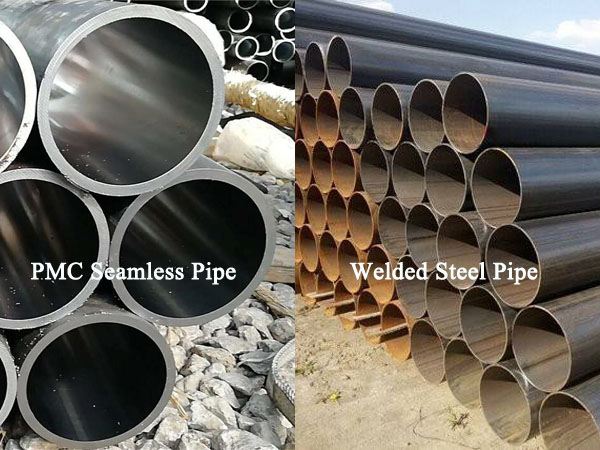
Seamless pipe (SMLS) is a length of steel pipe with a hollow section and no weld seam. It is produced by hot rolling, cold rolling, or cold drawing, starting from a solid steel billet rather than flat strip or plate. Because this route involves more processing steps than welded pipe production, seamless pipe generally carries a higher manufacturing cost.
2. What is a Welded Pipe?
Welded pipe is produced by forming steel strip, coil, or plate into a round or other shape and then welding the seam. Because the production route generally involves fewer processing steps than
seamless pipe manufacturing, welded pipe is usually the more economical option. Welded pipes are commonly divided into straight-seam (LSAW/ERW) and spiral-seam (SSAW) types, based on the weld configuration.
3. Why are Seamless Pipes more Expensive than Welded Pipes?
Generally speaking, the price of seamless pipe is higher than that of welded pipe. The main cost drivers behind this price difference are as follows.
3.1 More Complex Manufacturing Process
Seamless pipe manufacturing starts from a solid steel billet rather than flat steel. The billet is heated, pierced to form a hollow shell, then rolled and sized to the required diameter and wall thickness, followed by heat treatment when required and further inspection. Each additional step — piercing, rolling, sizing, heat treatment, and inspection — adds energy, equipment, and labor cost to the final price. Welded pipe, by contrast, is formed and welded from strip or plate in a comparatively shorter production route, which keeps its manufacturing cost lower. For a broader look at how the two production methods differ beyond price, see our article on
the differences between seamless and welded pipes.
3.2 Higher Material and Processing Costs
Seamless pipe is produced from solid round steel billet, while welded pipe is generally made from steel strip, coil, or plate that is formed and welded into shape. Billet suitable for tube-making — particularly high-quality billet with low impurity levels — typically costs more per ton than flat strip or plate of a comparable grade. Combined with the additional piercing, rolling, and finishing steps described above, this production route results in a higher total manufacturing cost for seamless pipe.
3.3 Quality Control and Inspection Requirements
Because seamless pipe has no weld seam to rely on for structural continuity, its manufacturing process often involves closer control over dimensional tolerances, mechanical properties, heat treatment, and internal quality. Certain seamless pipe specifications and more demanding applications may also call for additional non-destructive testing (NDT), which adds inspection time and cost.
This does not mean welded pipe is lower quality — when produced and inspected to the applicable standard, welded pipe fully meets the requirements of many applications. Rather, certain seamless pipe specifications and demanding applications may require tighter manufacturing and inspection controls, which can increase the final cost. If you need to visually or technically tell the two pipe types apart, see our guide on
how to identify seamless and welded pipes.
3.4 Application and Specification Requirements
The required pipe type, material grade, standard, and specification also influence the final price. Certain high-pressure, high-temperature, oil and gas, boiler, and heat-exchanger applications call for pipe with specific mechanical and dimensional requirements, which can affect the manufacturing route, the required inspection level, and — in turn — the price.
Seamless pipe's weld-free construction is sometimes associated with higher pressure ratings in certain applications, which is one of several factors project specifiers weigh alongside price; a closer look at how the two pipe types compare is available in our article on seamless pipe strength. Ultimately, application requirements — more than the pipe type alone — often determine which specification, and which price level, is appropriate for a project.
A note on service life: Pipe service life depends on material, operating conditions, corrosion environment, pressure, temperature, manufacturing quality, and maintenance. A higher pipe seamless price should not be directly attributed to a longer service life.
3.5 Seamless Pipe vs Welded Pipe: Cost Comparison
Cost Factor
|
Seamless Pipe
|
Welded Pipe
|
Starting material
|
Steel billet
|
Steel strip or plate
|
Manufacturing process
|
More processing steps
|
Generally fewer processing steps
|
Production cost
|
Generally higher
|
Generally lower
|
Welding operation
|
No weld seam
|
Requires welding
|
Typical price
|
Usually higher
|
Generally more economical
|
4. FAQs
Why does seamless pipe cost more than welded pipe?
Seamless pipe costs more mainly because of its manufacturing process: it starts from a solid steel billet and requires additional processing steps such as piercing, rolling, and sizing, along with stricter quality control and inspection in some specifications. These factors combine to raise the total manufacturing cost compared to welded pipe.
Is seamless pipe always more expensive than welded pipe?
Generally yes, but the actual price gap varies depending on material grade, diameter, wall thickness, applicable standard, order quantity, and current market conditions. In some cases the price difference between seamless and welded pipe of similar specification can be relatively small; in others it can be significant.
Is seamless pipe worth the higher cost?
It depends on the application and project requirements. If welded pipe fully meets the required specification, operating conditions, and applicable standard, it may offer a more economical solution. Seamless pipe becomes the more suitable — and often necessary — choice where the project specification calls for it.
5. Conclusion
In short, the price gap comes down to production route: seamless pipe takes a longer, more demanding path from billet to finished pipe, and that path costs more to run. Application and specification requirements then determine how much of that gap actually matters for a given project.
Price alone shouldn't decide the pipe type. Welded pipe remains the more economical choice wherever it satisfies the required standard and operating conditions.