In engineering design, comparing the performance of round tubes and square tubes with the same cross-sectional area essentially evaluates the efficiency of the two cross-sectional shapes under the premise of the same material usage. The differences in their mechanical properties are rooted in the geometric characteristics of the cross-section, and the conclusions are clear and have significant engineering guiding significance.
Advantages of Round Tubes:
1. Excellent Torsional Resistance
Core Principle: Under torque, shear stress is distributed in a ring shape along the cross-section. The closed ring cross-section of a round tube is the optimal geometry for achieving uniform shear flow, resulting in the highest material efficiency.
Quantitative Comparison: Under the same cross-sectional area, the torsional section modulus and polar moment of inertia of a round tube are much greater than those of a square tube, and its torsional strength is usually several times higher.
Engineering Implications: This advantage is absolute, dictating that round tubes must be used for drive shafts, connecting rods subjected to large torques, and rotating structures.
2. Superior Axial Compression Stability
Core Principle: The compressive strength of the materials is the same; the difference lies in the stability of the compression member. The annular cross-section of a circular tube ensures that its radius of gyration is the same in all directions, eliminating weak points.
Quantitative Comparison: As columns with a relatively high slenderness ratio, circular tubes typically have a higher stability coefficient and can withstand greater critical buckling pressure under the same conditions.
Engineering Implications: For slender columns, struts, and tower structures subjected to axial pressure, circular tubes are a more reliable choice, effectively preventing bending-torsional instability.
3. Excellent Local Stability and Uniform Pressure Bearing Capacity
The wall of a circular tube is less prone to local buckling under uniform external or internal pressure, resulting in a uniform stress distribution. Therefore, it is irreplaceable in hydraulic cylinders and pressure vessel pipelines.
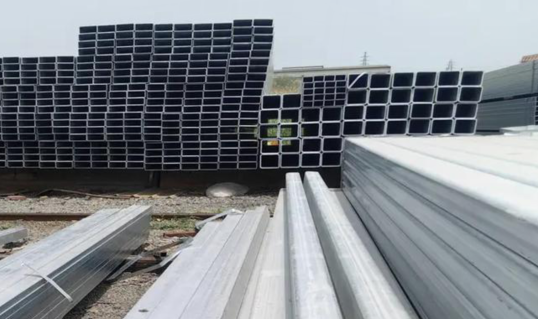
Advantages of Square Tubes:
1. Extremely High Directional Bending Efficiency
Core Principle: For a given cross-sectional area, by arranging the material as far away from the neutral axis as possible, the moment of inertia and section modulus of the section can be greatly improved. Square tubes (especially rectangular tubes) perfectly achieve this.
Quantitative Comparison: If the strong axis of a square tube is aligned with the bending moment direction, its bending section modulus can be 20%-50% higher, or even more, than that of a round tube of the same weight.
Engineering Implications: This is the fundamental reason why square tubes are the preferred choice for building beams, purlins, and equipment racks; they achieve maximum bending load-bearing capacity with minimal material, resulting in excellent economic efficiency.
2. Tensile Strength
The tensile strength of a material is independent of its cross-sectional shape. Under pure tension, both have the same performance; however, under combined tension and bending stress, square tubes exhibit superior overall load-bearing capacity due to their higher bending efficiency.
3. Excellent Space Utilization and Connection Convenience
Space Efficiency: The flat surface of square tubes allows for seamless splicing, maximizing space utilization and reducing enclosed volume in shelving, curtain wall framing, and frame structures.
Connection Convenience: Its right-angled edges facilitate welding, bolting, or direct fixing to panels, resulting in simple joint construction and convenient installation—advantages that round tubes cannot match.
Read more:
Square Tube Strength Calculation and Load-bearing Calculation
Square Tubes vs. Round Tubes: Which is Right for Your Needs?