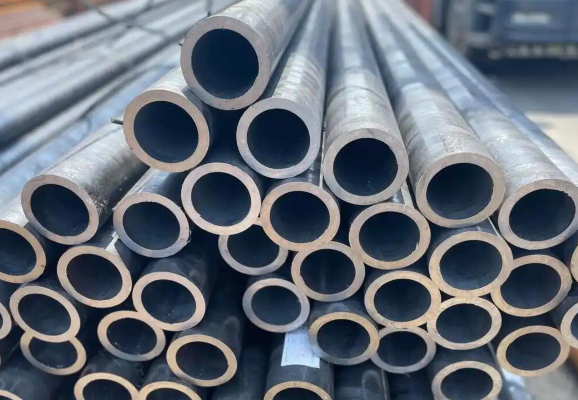
Seamless pipes (SMLS) are widely used in many fields, and their bending forming process is crucial for meeting diverse engineering needs. Common bending forming processes for SMLS pipes are mainly divided into two categories: cold bending and hot bending.
1. Cold Bending Process
Cold bending is a process of bending SMLS pipes at room temperature. This process has many advantages. First, it better maintains the surface quality of the seamless steel pipe because the absence of high temperatures prevents defects such as oxide scale from appearing on the surface. Second, the cold bending process allows for precise control of the bending angle and radius, meeting high-precision engineering requirements. Common cold bending methods include the following:
- Roll Bending: Roll bending uses three rollers to bend the SMLS pipe. Two are active rollers, and one is passive roller. The steel pipe moves forward under the rotation of the rollers, while the passive roller applies pressure to bend the pipe. This method is suitable for seamless steel pipes with large bending radii, enabling continuous bending and offering high production efficiency.
- Press Bending: Press bending uses a press and dies to bend the seamless steel pipe. The steel pipe is placed in a mold, and pressure is applied by a press, causing the pipe to bend under the mold's force. Pressure bending can achieve various shapes, such as U-shapes and V-shapes, but it can only bend one angle at a time, resulting in relatively low production efficiency and suitability for small-batch production.
- Tension Bending: Tension bending involves bending the SMLS pipe under the combined action of tension and bending moment. One end of the steel pipe is fixed, tension is applied to the other end, and a bending moment is applied to the middle of the pipe, causing it to bend. Tension bending effectively reduces springback during bending, improving bending accuracy and making it suitable for applications requiring high precision.
- Circuit Bending: This is the most common pipe bending machine process. The SMLS steel pipe is clamped onto the bending die, rotating with it, while pressure blocks hold the pipe firmly in the die's groove. A guide die controls the feeding direction. Its advantages include high flexibility, adapting to different radii by changing the bending die. It can be further divided into hydraulic bending and CNC bending (the mainstream).
2. Hot Bending Process
Hot bending is a process of bending SMLS pipes after heating them to a certain temperature. The purpose of heating is to reduce the hardness of the steel pipe and increase its plasticity, making it easier to bend. Hot bending is suitable for seamless steel pipes with small bending radii and large wall thicknesses. Common hot bending methods include:
- Medium Frequency Induction Heating Bending: Medium frequency induction heating bending uses an induced magnetic field generated by a medium frequency current to locally heat the steel pipe. The steel pipe is passed through an induction coil; when current passes through the coil, an induced current is generated inside the steel pipe, rapidly heating it to the required temperature. Then, a mechanical device bends the heated steel pipe. This method offers fast heating, concentrated heating area, precise control of heating temperature and bending angle, and high bending quality.
- Flame Heating Bending: Flame heating bending uses a flame to heat the steel pipe. Typically, a flame generated by the combustion of a mixture of gases such as oxygen and acetylene is used to heat the steel pipe. After heating to a certain temperature, the steel pipe is bent manually or mechanically. Flame-heated pipe bending equipment is simple and low-cost, but it heats slowly and unevenly, resulting in relatively poor bending quality. It is suitable for applications where bending quality requirements are not high.
Conclusion:
Different SMLS pipe bending processes have their own advantages and disadvantages. In practical applications, it is necessary to select the appropriate bending process based on factors such as the material, specifications, and bending requirements of the SMLS pipe to ensure bending quality and production efficiency.
Read more: Seamless Carbon Steel Pipe vs. Seamless Alloy Steel Pipe