Choosing between seamless and welded pipe is an important decision for any industrial, construction, or piping project. Although both types of steel pipe are widely used, they differ in manufacturing process, strength, pressure resistance, cost, and ideal applications. Understanding these differences can help improve system performance, reduce unnecessary costs, and ensure compliance with project requirements.
In this guide, you'll learn the key differences between seamless vs welded pipe, the factors to consider when selecting each type, and how to choose the right solution for your specific application. Let's first compare their key differences at a glance.
1. Seamless vs Welded Pipe: Quick Comparison
Feature
|
Seamless Pipe
|
Welded Pipe
|
Manufacturing
|
Solid billet
|
Steel plate/coil welded
|
Weld Seam
|
No
|
Yes
|
Pressure Resistance
|
Excellent
|
Good
|
Strength
|
Higher
|
Moderate
|
Dimensional Accuracy
|
Good
|
Excellent
|
Cost
|
Higher
|
Lower
|
Large Diameter
|
Limited
|
Better availability
|
Best For
|
High-pressure service
|
General industrial applications
|
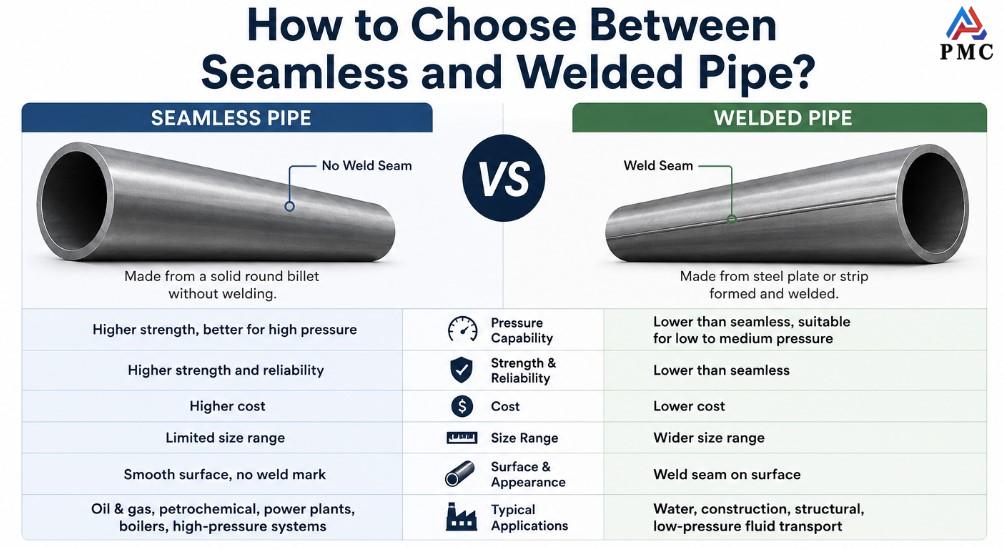
Seamless pipe is generally preferred for high-pressure and high-temperature applications, while welded pipe is a more economical choice for structural and low- to medium-pressure systems.
2. How to Choose Between Seamless and Welded Pipe
There is no universal answer to how to choose between seamless and welded pipe. The right option depends on how the pipe will perform under real operating conditions rather than simply comparing prices or manufacturing methods. Engineers typically evaluate factors such as pressure, temperature, pipe size, project budget, industry standards, and the intended application before selecting a seamless steel pipe or welded steel pipe. Understanding these factors will help you choose a solution that delivers the right balance of safety, performance, and cost.
2.1 Consider Operating Pressure
In most industrial piping systems, operating pressure is the first factor engineers evaluate. Seamless steel pipe is manufactured from a solid billet without a longitudinal weld, giving it more uniform mechanical properties and reducing potential stress concentrations. For this reason, it is commonly specified for high-pressure applications such as steam systems, refinery process lines, and power generation facilities.
For low- to medium-pressure services, however, welded steel pipe often provides more than enough performance. Water distribution networks, fire protection systems, HVAC installations, and many construction projects successfully use welded pipe because it combines reliable strength with lower manufacturing costs. The key is to match the pipe's pressure rating to the actual operating conditions instead of assuming that the strongest option is always the best.
2.2 Consider Operating Temperature
Temperature can have a significant impact on the long-term performance of steel pipe. High operating temperatures increase thermal stress and may reduce material strength over time, making seamless steel pipe the preferred choice for boilers, heat exchangers, and high-temperature process piping.
In contrast, welded steel pipe performs well in normal-temperature environments where thermal loading is relatively low. Many commercial buildings, municipal infrastructure projects, and general industrial facilities use welded pipe because it meets performance requirements without the additional cost associated with seamless products. Selecting a pipe that matches both the pressure and temperature of the system is essential for long service life.
2.3 Consider Pipe Size
Pipe diameter also influences how to choose between seamless and welded pipe. Seamless pipe is widely available in small and medium sizes and is often selected where mechanical performance is the primary concern.
As pipe diameters increase, welded steel pipe usually becomes the more practical solution. Manufacturing large-diameter seamless pipe is more complex and expensive, while welded pipe can be produced efficiently in a wider range of sizes with excellent dimensional consistency. This is why large water transmission lines, oil and gas pipelines, bridge structures, and other infrastructure projects frequently rely on welded pipe.
2.4 Consider Project Budget
Although seamless steel pipe offers higher pressure capability and greater resistance to demanding service conditions, it also requires a more complex manufacturing process, resulting in a higher purchase price.
That does not necessarily mean it is the most economical choice. If your project operates under moderate pressure and temperature, welded steel pipe can deliver comparable performance at a significantly lower cost. Instead of focusing only on the initial material price, consider the total lifecycle cost, including installation, inspection, maintenance, and expected service life. A balanced evaluation often leads to the most cost-effective decision.
2.5 Consider Industry Standards
Industry standards should always be reviewed before selecting a pipe because they define the minimum performance and testing requirements for specific applications. For example,
ASTM A53 is available in both seamless and welded forms for general industrial and structural service.
ASTM A106 is commonly specified for seamless pipe in high-temperature applications, while API 5L covers both manufacturing types for oil and gas pipeline transportation.
Rather than choosing a pipe solely based on its manufacturing method, verify that it complies with the standards required by your project. This approach helps ensure regulatory compliance, product quality, and long-term operational reliability.
2.6 Consider the Application
Ultimately, the intended application is the deciding factor in how to choose between seamless and welded pipe. If the piping system will operate under high pressure, elevated temperatures, or critical process conditions, seamless pipe is generally the safer and more reliable choice because of its consistent mechanical properties.
For structural steel fabrication, municipal water systems, fire protection, HVAC, and many commercial or industrial facilities, welded steel pipe provides an excellent combination of performance, availability, and cost efficiency. The best choice is not the pipe with the highest strength, but the one that meets your project's technical requirements while delivering the greatest long-term value.
3. Advantages of Seamless and Welded Pipe
3.1 Advantages of Seamless Pipe
No weld seam: Eliminates the potential weak point found in welded pipes, making seamless pipe a preferred choice for high-pressure and critical applications.
Higher strength and pressure resistance: The uniform structure provides more consistent mechanical properties under demanding operating conditions.
Lower risk of weld-related defects: Without a longitudinal weld, seamless pipe avoids issues such as incomplete fusion or weld discontinuities.
Better corrosion performance: The absence of a weld seam reduces areas that may be more susceptible to localized corrosion in certain service environments.
Suitable for critical industries: Commonly used in oil and gas, power generation, chemical processing, boilers, and other applications where safety and reliability are essential.
3.2 Advantages of Welded Pipe
More cost-effective: Welded pipe is generally less expensive than seamless pipe, making it an economical choice for large-scale construction and industrial projects.
Shorter production lead times: The manufacturing process is highly efficient, allowing faster delivery for projects with tight schedules.
Available in larger diameters: Welded pipe can be produced in a wider range of sizes, making it ideal for water transmission, oil and gas pipelines, and structural applications.
Excellent dimensional accuracy: Modern welding and forming processes provide consistent wall thickness and precise dimensions, simplifying installation and fabrication.
Suitable for most general applications: For low- to medium-pressure service, welded pipe offers reliable performance while reducing overall project costs.
4. FAQs
Q: How do I choose between seamless and welded pipe?
Choose seamless pipe for high-pressure, high-temperature, and critical service applications. Choose welded pipe for structural, low- to medium-pressure, and cost-sensitive projects.
The right choice depends on operating conditions, pipe size, project budget, and applicable industry standards.
Q: Is seamless pipe stronger than welded pipe?
Generally, yes. Because seamless pipe has no longitudinal weld, it provides more uniform strength and is better suited for high-pressure and high-temperature applications.
However, modern welded pipe also delivers reliable performance for many general industrial and construction projects.
Q: Is welded pipe suitable for high-pressure applications?
Yes, provided it meets the required standards and pressure rating.
Modern welded pipe performs well in many industrial applications, but seamless pipe is typically preferred for critical systems involving extreme pressure, high temperatures, or demanding service conditions.
5. Conclusion
When deciding how to choose between seamless and welded pipe, focus on your project's actual operating requirements rather than a single factor such as price.
By considering pressure, temperature, application, and industry standards, you can select the most suitable pipe for reliable performance, safety, and long-term cost efficiency.
Related articles:
ERW Pipe VS Seamless Pipe: What's the Difference?
ERW Pipe vs Seamless Cost