


This guide breaks down what actually drives the price gap between ERW and seamless pipe, and — more importantly — helps you figure out when paying more for seamless pipe is worth it, and when it isn't.
Manufacturing process is the single biggest driver of the price gap between ERW and seamless pipe — but the size of that gap isn't fixed. It shifts depending on diameter, wall thickness, and steel grade. Based on general industry pricing patterns, here's how it typically breaks down:
|
Specification Range |
ERW Pipe (relative cost) |
Seamless Pipe (relative cost) |
Typical Price Gap |
|
Small diameter (≤ 4") |
Baseline |
15%–25% higher |
Narrower — less material and processing difference at small sizes |
|
Medium diameter (4"–12") |
Baseline |
20%–30% higher |
Moderate |
|
Large diameter (> 12") |
Baseline |
30%–40% higher |
Widest — piercing and rolling costs scale up faster than ERW forming costs |
Manufacturing process explains most of the price gap between ERW and seamless pipe, but it's not the only variable. These five factors also shape the final price of either pipe type:
Higher-grade materials cost more, regardless of manufacturing method. ASTM A106 seamless pipe, for example, is typically priced above ASTM A53 ERW pipe — not just because of the seamless process, but because A106 is formulated and tested for higher-temperature service, which adds material and certification cost on top of the manufacturing difference.
Related: ASTM A53 Steel Pipe Specifications & ASTM A53 Pipe Price: ERW vs Seamless & Cost Factors
Larger diameters and thicker walls simply require more steel, which raises cost for both ERW and seamless pipe. But the increase isn't proportional between the two — as covered in the price comparison above, seamless pipe's cost climbs faster than ERW's as size increases, because more of the seamless process (piercing, elongating, rolling) becomes material- and time-intensive at scale.
Coatings such as galvanizing, painting, or anti-corrosion systems add cost on top of the base pipe price — and this applies equally to ERW and seamless pipe. For offshore or buried applications, the coating system can end up adding more to the total cost than the ERW-vs-seamless choice itself.
Unit price drops with volume for both pipe types, since larger orders let mills run longer, more efficient production batches. Custom specifications or small orders — again, for either pipe type — typically carry a premium because they interrupt standard production runs.
Steel coil and billet prices, energy costs, and freight rates fluctuate throughout the year, and these swings affect ERW and seamless pricing independently of the manufacturing process itself. This is why the price gap between the two can widen or narrow somewhat even when specifications stay the same — it's worth checking current market pricing rather than assuming a fixed percentage always applies.
The short version — "seamless requires more complex manufacturing" — is true, but it's worth breaking down exactly where that complexity turns into cost, since the details are what actually help you evaluate a quote.
Material loss. Piercing a solid billet displaces more material than rolling a flat strip into shape — seamless production starts with a lower material yield.
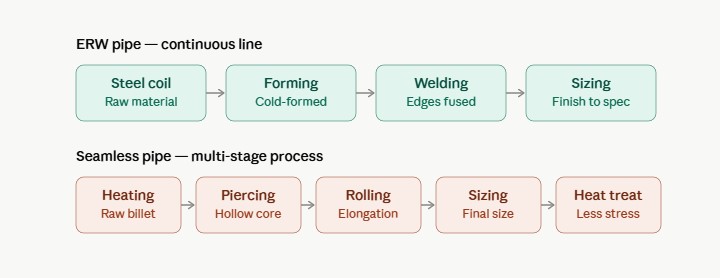
More production stages. ERW runs through one continuous line (uncoiling, forming, welding, sizing). Seamless requires several discrete steps — billet heating, piercing, elongating, rolling, sizing, and often heat treatment — each adding time and labor.
Higher energy use. Heating a solid billet to piercing temperature takes far more energy than ERW's room-temperature cold-forming process.
Stricter testing. Seamless pipe's typical use in higher-pressure service means more extensive testing — ultrasonic and hydrostatic testing, tighter dimensional checks — on top of ERW's own weld-seam inspection requirements.
These factors compound rather than add up separately, which is why the total price gap is often larger than any single factor alone would suggest — and why the premium is easiest to justify when the application genuinely needs that performance, not as a default safety margin.
5. Cost and Value by Application
The manufacturing cost gap matters less than whether an application actually needs what seamless pipe's premium buys you.
|
Application |
Better Value |
Why |
|
Water supply and drainage |
ERW |
Low pressure — no need to pay for performance margin you won't use |
|
Structural construction |
ERW |
Strength requirements met without seamless-grade pressure tolerance |
|
Fire protection systems |
ERW |
Standard-pressure service; ERW meets code at lower cost |
|
Low- to medium-pressure pipelines |
ERW |
Cost savings scale with volume, with no performance trade-off |
|
Large-volume industrial projects |
ERW |
Unit cost matters most; ERW's lower price compounds across large orders |
|
High-pressure piping |
Seamless |
No weld seam means fewer potential failure points under pressure |
|
High-temperature service |
Seamless |
Better structural integrity under thermal stress |
|
Boilers and heat exchangers |
Seamless |
Safety-critical; failure cost far exceeds the price premium |
|
Oil and gas production |
Seamless (mostly) |
High-pressure segments need it — but see note below |
|
Power plants and chemical processing |
Seamless |
Stringent safety and reliability requirements |
Seamless pipe vs ERW pipe in oil and gas: even within oil and gas — often treated as a blanket "seamless" application — lower-pressure segments of a pipeline system can often use ERW pipe meeting the appropriate API 5L specification, without compromising safety. Treating "oil and gas" as automatically requiring seamless pipe across the board can mean paying the premium in places where it isn't actually earning its cost.
6. Cost-Saving Tips for Pipe Buyers
Specify by actual requirement, not by habit. Before defaulting to seamless pipe, check whether your real pressure and temperature requirements can be met by ERW pipe under the relevant API or ASTM specification.
Stick to standard sizes. Custom diameters and wall thicknesses interrupt standard production runs and carry a cost premium — for either pipe type.
Consolidate order volume. Larger single orders reduce per-ton cost by letting mills run longer, more efficient batches.
Ask for a cost breakdown, not just a total price. A transparent supplier can explain how much of the price comes from raw material, processing, and testing — which helps you see where adjusting specs could save money without compromising the application.
Weigh total cost of ownership, not just purchase price. For genuinely high-pressure or safety-critical applications, a cheaper ERW pipe that leads to more frequent inspection or premature replacement can end up costing more overall.
Q: Does a lower ERW price mean lower quality?
No — it reflects a more efficient manufacturing process, not a quality shortfall. Issues only arise from using ERW pipe outside its intended pressure range.
Q: Can I switch from seamless to ERW mid-project to save cost?
Only if your engineer confirms ERW meeting an equivalent standard can still meet the original pressure/safety requirement — it's not a straight swap.
Q: Does the price gap vary by region?
Yes — regional steel, energy, and freight costs shift the exact gap, though the underlying reasons stay the same. Get current quotes rather than relying on a fixed percentage.
Q: How much does ERW pipe cost compared to seamless pipe?
Typically 20%–40% less for the same specification, with the gap widening at larger diameters — see the price comparison table above for a size-based breakdown.
The right choice isn't "always pick the cheaper option" or "always pick seamless to be safe" — it's matching the pipe to what your application actually requires. Specify by real pressure and service conditions, and the cost comparison takes care of itself.
Related Articles:
ERW Pipe VS Seamless Pipe: What's the Difference?
Seamless Pipe vs MS Pipe: Key Differences, Uses & How to Choose
Seamless Pipe vs Welded Pipe: What's the Difference?
Difference between Seamless Steel Pipe and Galvanized Steel Pipe
What is the Difference between ERW and CDW Pipes?
Seamless Steel Pipe Sizes Chart (NPS, DN, OD & Wall Thickness)
