


ERW (Electric Resistant Weld) steel pipe refers to a straight seam welded pipe manufactured through a high-frequency resistance welding process. The raw material steel plate (coil) of ERW welded pipe is made of low-carbon microalloy steel rolled by TMCP (Thermo-Mechanical Control Process).
The main differences between seamless casing and ERW casing come down to manufacturing process, dimensional accuracy, weld seam, mechanical performance, and cost. Which one to choose usually depends on the required steel grade, wall thickness control, budget, and the well conditions the casing will serve. Neither type is universally "better" — the right choice depends on the application.
|
Factor |
Seamless Casing |
ERW Casing |
|
Manufacturing |
Hot rolling, hot drawing, or cold drawing from a solid billet |
Cold-formed from hot-rolled steel coil, joined by high-frequency electric resistance welding |
|
Weld Seam |
No weld seam on the pipe body |
Straight longitudinal weld seam |
|
Dimensional Accuracy (OD) |
Hot-forming process; OD control is more sensitive to raw material and rolling conditions, so tolerance range tends to be wider |
Cold-sizing at near room temperature; OD control is generally more accurate and consistent |
|
Wall Thickness Uniformity |
Formed by piercing round billets; wall thickness deviation is larger, even on advanced mills |
Made from hot-rolled coil with tighter, more uniform thickness tolerance |
|
Mechanical Performance |
Strength tends toward the upper end of API requirements, with plasticity toward the lower end |
Strength and plasticity are reported to be more evenly matched, aided by microalloying and controlled rolling of the coil |
|
Cost / Material Efficiency |
Extra wall thickness margin is often needed to meet minimum requirements, which can increase steel consumption |
More uniform wall thickness can allow somewhat lower steel consumption for the same length and weight, which may reduce cost per meter |
|
Typical Applications |
Used across a wider range of steel grades, including higher grades such as P110 |
Currently more limited in maximum achievable steel grade, so more often used for surface casing |
This table is a quick reference — the sections below go into the technical detail behind each factor.
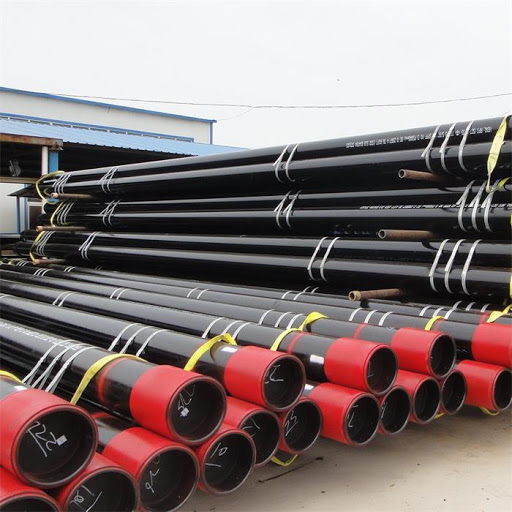
Seamless casing is formed by hot rolling, with sizing completed at roughly 800°C. Because raw material composition and the cooling condition of the rolls both influence outer diameter, wall thickness, and roundness, seamless casing generally has a wider tolerance range for OD, wall thickness, and ovality. Wall thickness deviation is typically controlled to around ±5–10%t even on advanced mills, though actual figures vary by mill, grade, and specification. Because seamless casing is formed in a plastic (hot) state, end straightness is also relatively harder to control with single-pass straightening equipment.
ERW casing is cold-formed and sized close to room temperature, typically with about a 0.6% reduction, and is straightened in-line during sizing. This generally allows tighter, more consistent control of OD, wall thickness, and roundness, and better straightness compared with seamless casing. Modern hot-rolled coil used as ERW casing raw material can often hold wall-thickness tolerance to around 0.05 mm. Tighter OD control also helps reduce black-leather-coupling issues. Actual tolerances for both casing types should be confirmed against the applicable API 5CT dimensional requirements for a specific order.
The outer surface defects on the billets used for seamless casing are not fully removed by the hot-rolling process; they can only be polished out after the pipe is finished, and the spiral trace left by piercing can only be partially removed during wall reduction.
ERW casing uses hot-rolled coil as raw material, so the surface quality of the coil largely determines the surface quality of the finished casing. Since coil surface quality is easier to control, ERW casing generally shows better surface quality than seamless casing.
Both seamless and ERW casing are manufactured to meet API tensile requirements. In practice, seamless casing strength is often reported toward the upper end of the standard range, with plasticity toward the lower end, since strength is more often achieved by raising carbon content. ERW casing's raw material (hot-rolled coil) is typically produced using microalloying, secondary refining, and controlled rolling/cooling, which can support a more balanced strength-to-plasticity ratio; ERW casing plasticity is often reported above the minimum standard requirement, though the actual margin depends on the specific grade, mill, and coil source.
The same controlled-rolling process that supports this mechanical balance also tends to give more uniform hardness across the coil, along with a finer, more uniform grain structure and fewer casting-related defects such as porosity or columnar-crystal regions. The degree of uniformity in practice depends on the producer's process control and the steel grade involved.
Because ERW casing generally has more uniform wall thickness and roundness than seamless casing, it is often reported to perform well in collapse-resistance and burst (hydrostatic) testing relative to standard requirements. Actual collapse and burst performance, however, depends on steel grade, pipe dimensions (including D/t ratio), manufacturing quality, and the specific standard and test method used, so results should not be assumed to apply uniformly across all sizes and grades.
Impact toughness is a particular focus for ERW casing, since the weld seam — rather than the base material — is typically the limiting factor; base-material impact toughness for ERW casing is often reported as notably higher than for seamless casing. Weld-seam impact toughness is managed through process control of raw material impurity content, slitting-burr geometry, forming-edge shape, welding angle and speed, heating power and frequency, weld upset, intermediate-frequency withdrawal temperature and depth, and air-cooling section length. With good process control, weld impact energy is typically targeted at 60% or more of base-metal impact energy, and can approach base-metal performance with further optimization — though results vary by manufacturer and should be verified against the applicable standard's impact requirements.
Because ERW casing generally has more uniform wall thickness, less extra margin is typically needed to guarantee the minimum wall thickness meets standard and performance requirements. Seamless casing, by contrast, may need a somewhat thicker wall to compensate for its wider thickness tolerance (commonly cited in the range of about ±5–10%t).
As a result, for casing of the same specification and weight, ERW casing can sometimes yield more usable length than seamless casing — commonly cited figures suggest a difference in the range of roughly 5–10%, though the actual figure depends on the specification, grade, and mill involved. Where this holds, it can translate into a similar reduction in steel consumption per length of casing and, at comparable unit pricing, a potential cost advantage. This should be verified against the specific product data sheet and order requirements rather than assumed as a fixed rule.
Steel grade availability for ERW casing has historically been more limited than for seamless casing. Industry sources commonly cite ERW casing as most readily available up to around K55, with some production lines — for example, certain lines using Japanese equipment — reaching roughly N80. Producing higher grades such as P110 via ERW has generally been considered difficult with widely available current production technology, which is one reason ERW casing has often been used primarily for surface casing rather than higher-grade or higher-pressure applications.
These figures reflect commonly reported industry practice rather than a fixed, universal limit — the casing grades a given manufacturer or production line can supply may vary, and can change as production technology develops. For any specific project, the available steel grade, dimensions, and performance should be confirmed directly against API 5CT requirements and the supplier's current production capability, rather than assumed from general industry figures.
Note: Straight-seam steel pipe is pipe whose weld runs parallel to the pipe's longitudinal axis. Straight-seam pipe is generally divided into high-frequency straight-seam pipe (ERW) and submerged-arc-welded straight-seam pipe (LSAW). Straight-seam welded pipe generally has a simpler production process, higher production efficiency, and lower cost than seamless pipe.
ASTM A53 Grade B and API 5L Gr.B are both American steel pipe standards. A53 GR.B ERW refers to electric-resistance-welded pipe made to A53 GR.B; API 5L GR.B Welded refers to welded pipe made to API 5L GR.B.
Related articles:
ASTM A53 Grade A vs Grade B Pipes
ASTM A53 Grade B vs ASTM A106 Grade B Pipe
The right casing type depends on the project, not on a single "better" option. Seamless casing is generally preferred where a weld-free pipe body, a broader range of available steel grades, or specific broader well conditions call for it. ERW casing can offer potential advantages in dimensional consistency, wall thickness uniformity, and material efficiency, which may translate into cost savings — provided the product meets the required standards and specifications for the application.
In practice, the decision should weigh: API 5CT requirements, casing grade, size and wall thickness, well depth, collapse and pressure requirements, and overall project specifications. Reviewing these factors against a manufacturer's actual mill test certificates and production capability, rather than general industry comparisons alone, is the most reliable way to choose between seamless casing and ERW casing for a specific job.
Seamless casing has no weld seam on the pipe body and is produced by hot or cold forming of a solid billet. ERW casing is made from hot-rolled steel coil formed into a tube and joined with a high-frequency electric resistance weld. The two also differ in typical dimensional tolerances, wall thickness uniformity, and the steel grades commonly available for each type.
Is seamless casing better than ERW casing?
Neither type is universally better. Seamless casing typically offers a wider range of available steel grades and no weld seam, making it a common choice for higher-grade or more demanding well conditions. ERW casing can offer more consistent dimensions and potential material savings. The better option depends on the required steel grade, size, wall thickness, and well conditions for a specific project.
Can ERW casing be used in oil and gas wells?
Yes, ERW casing is used in oil and gas wells, particularly for surface casing where its available steel grades and wall thickness uniformity meet the well's requirements. Suitability should be confirmed against the specific well's grade, pressure, and depth requirements, per API 5CT.
Which is more cost-effective, seamless or ERW casing?
ERW casing can offer a potential cost advantage because its more uniform wall thickness may reduce the extra material margin needed to meet minimum thickness requirements, sometimes yielding more usable length per unit weight. However, actual cost-effectiveness depends on steel grade, specification, and supplier pricing, so it should be compared using actual quotes and mill certificates rather than general assumptions.
Read more:
ERW Pipe VS Seamless Pipe: What's the Difference?
ERW Pipe vs Seamless Pipe Cost: Price Comparison & Buying Guide
Difference Between Seamless and ERW Stainless Steel Pipe
ERW Pipe, DOM Pipe, Seamless Pipe, What are the Differences?
