


DOM tube and CEW tube are both precision tubes produced from ERW (Electric Resistance Welded) tubes through different cold working processes. They are widely used in applications requiring better dimensional control and surface quality compared with standard welded tube.
CEW tube refers to Cold Drawn Electric Welded tube, produced by cold drawing an ERW tube through a die to improve dimensional precision and mechanical performance.
DOM tube (Drawn Over Mandrel tube) describes a specific cold drawing method in which a mandrel is used during the drawing process, along with removal of internal and external weld flash beforehand. This method provides tighter control of the inside diameter, wall thickness, and overall tube consistency.
Although both products start from ERW tube, their drawing methods, applicable standards, and typical applications are different.
|
Item |
DOM Tube |
CEW Tube |
|
Full Name |
Drawn Over Mandrel Tube |
Cold Drawn Electric Welded Tube |
|
Starting Material |
ERW welded tube |
ERW welded tube |
|
Drawing Method |
Cold drawn with internal mandrel |
Cold drawn through a die |
|
Precision & Surface Finish |
Excellent ID control and smooth internal surface |
Good dimensional accuracy and improved surface finish |
|
Material Grades |
SAE 1020 / SAE 1026 carbon steel |
E235 / E355 carbon steel |
|
Common Standards |
ASTM A513 Type 5 |
EN 10305-2 |
|
Typical Applications |
Automotive components, hydraulic parts, precision mechanical components |
Hydraulic cylinders, pneumatic systems, precision machinery |
Related: ERW Pipe VS. CEW Pipe
DOM tube and CEW tube are both precision tubes produced from ERW tubes through cold working processes. However, the two terms describe different drawing methods used to achieve that precision.
DOM tube stands for Drawn Over Mandrel tube. The term refers to a specific cold drawing method in which an ERW tube is drawn through a die with an internal mandrel. The mandrel supports the inside of the tube during drawing, helping achieve better control of the inner diameter, wall thickness, and tube consistency.
CEW tube stands for Cold Drawn Electric Welded Tube. It refers to an ERW tube that has been cold drawn through a die without an internal mandrel, improving dimensional accuracy, surface quality, and mechanical performance compared with standard ERW tube.
The key difference comes down to the drawing method itself: DOM uses a mandrel to control the inside diameter directly, while CEW relies on die drawing alone. This is why DOM typically achieves tighter ID tolerances and a smoother bore, while CEW offers a broader range of material grades and standards at a lower cost.
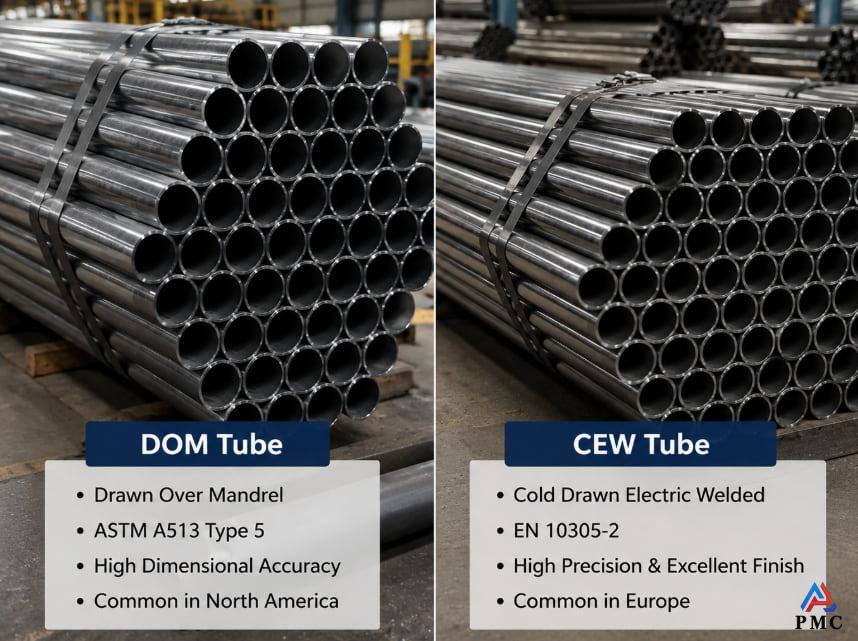
DOM tube and CEW tube share a similar production route. Both typically start from ERW welded tube, followed by weld seam treatment, cleaning, cold drawing, heat treatment (if required), straightening, and inspection.
The main difference between the two products lies in the cold drawing method. This difference has a major influence on their dimensional control, surface quality, and overall performance.
The key difference — mandrel support during cold drawing — leads to different performance characteristics:
|
Property |
CEW Tube |
DOM Tube |
|
Inside diameter control |
Very good |
Excellent — superior ID control |
|
Wall thickness uniformity |
Good consistency |
Improved uniformity due to mandrel support |
|
Internal surface finish |
Improved compared with standard ERW |
Smoother internal surface with better bore consistency |
|
Outside dimensional accuracy |
High |
Very high |
|
Mechanical performance |
Improved through cold drawing |
Improved with better dimensional consistency |
|
Common material grades |
E235, E355; other grades depend on supplier capability |
SAE 1020, SAE 1026 carbon steel |
|
Relative cost |
Generally lower |
Generally higher |
CEW tube and DOM tube are commonly associated with different standards due to their manufacturing methods and typical applications.
CEW tube is commonly manufactured according to EN 10305-2, the European standard for cold-drawn welded precision steel tubes, with diameters ranging from 6.35 mm to 127 mm. Non-standard sizes can also be supplied according to customer requirements.
DOM tube is typically manufactured according to ASTM A513 Type 5, the U.S. specification for high-precision mechanical tubing produced through the drawing-over-mandrel process.
This terminology difference roughly follows market usage. DOM tube is more commonly used in North American sourcing, while CEW tube terminology is frequently seen in European precision tubing applications. However, these standards are not strictly limited by region, and suppliers may produce tubes according to customer-specific specifications.
|
Item |
CEW Tube |
DOM Tube |
|
Common Standard |
EN 10305-2 |
ASTM A513 Type 5 |
|
Diameter Range |
6.35 mm – 127 mm |
Depends on supplier capability |
|
Delivery Condition |
BK / GBK / NBK |
As-drawn, stress-relieved, or annealed |
|
Common Material Grades |
E235, E355 carbon steel |
SAE 1020 / SAE 1026 carbon steel |
When different standards are requested, the exact grade, delivery condition, and application requirements should be reviewed before confirming equivalency.
Where DOM tube is used
Roll cages and chassis structures — consistent wall thickness matters for predictable bending and crush behavior
Driveshafts and torque tubes — concentricity and ID finish affect balance at speed
Hydraulic cylinder barrels where the piston seal rides directly on the bore, and ID surface finish and tolerance are critical to seal life
Where CEW tube is used
Multi-stage hydraulic cylinders — the application the official CEW product page identifies as a primary use case, where dimensional accuracy and surface finish are critical
Pneumatic cylinders, where operating pressures are lower and DOM's extra bore precision is often more than the application needs
Structural and mechanical components in construction and agricultural equipment, where 4130/4140 alloy strength or 304/316 corrosion resistance is required — grades DOM doesn't cover
General precision machinery components where dimensional accuracy matters but the part isn't a sealing surface
A note on standard hydraulic cylinder barrels
For single-stage cylinders specifically, either tube type can be a valid choice — this isn't a case where "hydraulic = DOM" or "hydraulic = CEW" as a fixed rule. The deciding factor is the actual bore tolerance and surface finish called out in the cylinder spec, along with the material grade required. If the spec falls within CEW's capability, it's typically the lower-cost option; if it calls for tighter ID control than CEW can deliver, DOM is the better fit. Buyers should check the spec against the tolerances in Section 3.2 rather than defaulting to either tube by habit.
Section 2.4 covered where each tube is typically used. This section turns that into a decision order — work through these in sequence, since each one can settle the decision on its own.
What material grade does the application call for?
Check this first — it's the hardest constraint. As covered in Section 2.4, DOM tube is available only in 1020/1026 carbon steel, so any requirement for alloy (4130/4140) or stainless (304/316) grades settles the decision immediately in CEW's favor.
What does the ID tolerance and bore finish need to be?
If material doesn't rule either tube out, check the bore requirement next — particularly for moving seals against the ID. If it's tighter than CEW can reliably hold, DOM is generally the better fit (confirm exact figures against your supplier's data sheet rather than assuming). If CEW's tolerances satisfy the spec, there's no mechanical reason to pay more for DOM.
Is the tube part of a multi-stage or single-stage assembly?
Section 2.4 covers this in detail — multi-stage cylinders lean CEW, single-stage can go either way. Either way, stage count is a starting point, not an override: the tolerance check in question 2 still decides it.
What's the standard your customer or project is specified against?
If the project calls out EN 10305-2, source CEW. If it calls out ASTM A513 Type 5, source DOM. Don't substitute one for the other unless the exact Type/grade equivalence has been confirmed with your supplier's technical team — see the open question flagged in Section 2.3.
A common misjudgment worth watching for
Choosing CEW purely on cost, without checking whether its ID tolerance actually covers the seal requirement in the spec, is one of the more common ways this decision goes wrong — it looks like a straightforward saving until it fails on bore finish during testing, at which point reordering in DOM costs more in time than the original saving. Running question 2 before question 4 or cost is what avoids this.
Q: What's the main difference between DOM tube and CEW tube?
Both start from ERW tube and are cold drawn, but DOM drawing uses an internal mandrel to support the bore, while CEW drawing uses a die alone. That's why DOM holds tighter inside diameter tolerances and a smoother bore, while CEW offers a wider range of material grades and a lower cost.
Q: Is DOM tube always more expensive than CEW tube?
Generally yes, because of the added mandrel-drawing step. But that premium only matters if the application actually needs what DOM offers — tighter ID tolerance and bore finish. If CEW's tolerances and material options already meet the spec, there's no mechanical reason to pay more for DOM.
Q: Can I use CEW tube instead of DOM tube for a hydraulic cylinder?
Often, yes — if CEW's bore tolerance and surface finish are sufficient for the seal design. It's not a safe swap by default, though: check the actual ID tolerance and finish requirement in the spec first, since that's what determines whether CEW can hold the seal properly, not the tube type alone.
Q: Which one should I use for a hydraulic cylinder?
For multi-stage (telescopic) cylinders, CEW is the more common choice due to its tolerance range, material flexibility, and lower cost. For single-stage cylinders, either can work — the deciding factor is the bore tolerance and surface finish your seal design requires, not the cylinder type itself.
Q: Which standard applies to each — EN or ASTM?
CEW tube is manufactured to EN 10305-2; DOM tube is manufactured to ASTM A513 Type 5. CEW can also be supplied to ASTM A513 on request, though the exact Type number for that cross-reference should be confirmed with your supplier before treating the two as directly equivalent.
DOM tube and CEW tube both start from the same base material — ERW tube — and both go through cold drawing to improve on it. The key manufacturing difference is whether an internal mandrel supports the bore during drawing: DOM uses one, CEW doesn't. That difference alone accounts for DOM's tighter ID tolerance and smoother bore, and for CEW's lower cost, since it skips the extra mandrel-drawing step.
The wider material grade range available in CEW (including 4130/4140 alloy and 304/316 stainless) and its broader standard flexibility (EN 10305-2, with ASTM A513 available on request) reflect the current product lines each process is typically offered under, rather than a direct consequence of the drawing method itself — DOM is available almost exclusively in 1020/1026 carbon steel.
Neither tube is the better choice in general — the right one depends on what the spec actually requires. If the application needs alloy or stainless steel, that alone settles it in CEW's favor. If it needs the tightest possible bore tolerance and finish, particularly for a moving seal, that points to DOM. For everything in between — including most single-stage hydraulic cylinders — the decision comes down to checking the actual numbers in the spec against what each tube can deliver.
Where a cross-reference between EN 10305-2 and ASTM A513 is needed, that equivalence should be confirmed directly with the supplier rather than assumed.
