


Carbon steel seamless pipe is a type of long steel product. Steel pipes have a hollow cross-section and are widely used as pipelines for transporting fluids, such as oil, natural gas, coal gas, water, and certain solid materials. This article will systematically analyze the standards, grades, classification methods, features of carbon steel seamless pipes.
| ASTM A53 Gr.B | Black and hot-dipped zinc-coated steel pipes welded and seamless |
| ASTM A106 Gr.B | Seamless carbon steel for high temperature service |
| ASTM SA179 | Seamless cold-drawn low-carbon steel heat exchanger and condenser tubes |
| ASTM SA192 | Seamless carbon steel boiler tubes for high pressure |
| ASTM SA210 | Seamless Medium-carbon boiler and superheater tubes |
| ASTM A213 |
Seamless alloy-steel boiler, superheater, and heat-exchanger tubes |
| ASTM A333 GR.6 |
seamless and welded carbon and alloy steel pipe intended for use at low temperatures. |
|
ASTM A335 P9,P11,T22,T91 |
Seamless ferritic alloy-steel pipe for high-temperature service |
|
ASTM A336 |
Alloy steel forgings for pressure and high-temperature parts |
| ASTM SA519 4140/4130 | Seamless carbon for mechanical tubing |
| API Spec 5CT J55/K55/N80/L80/P110/K55 | Seamless steel pipe for casing |
| API Spec 5L PSL1/PSL2 Gr.b, X42/46/52/56/65/70 | Seamless steel pipe for line pipe |
| DIN 17175 | Seamless steel tube for elevated temperture |
| DN2391 | Cold drawn seamless prevision pipe |
| DIN 1629 | Seamless circular unalloyed steel tubes subject to special requirements |
Chemical Components & Mechanical Properties
| Standard | Grade |
Chemical Components (%) |
Mechanical Properties |
||||||
| ASTM A53 |
C |
Si |
Mn |
P |
S |
Tensile STrength(Mpa) |
Yield STrength(Mpa) |
||
| A |
≤0.25 |
- |
≤0.95 |
≤0.05 |
≤0.06 |
≥330 |
≥205 |
||
| B |
≤0.30 |
- |
≤1.2 |
≤0.05 |
≤0.06 |
≥415 |
≥240 |
||
| ASTM A106 |
A |
≤0.30 |
≥0.10 |
0.29-1.06 |
≤0.035 |
≤0.035 |
≥415 |
≥240 |
|
|
B |
≤0.35 |
≥0.10 |
0.29-1.06 |
≤0.035 |
≤0.035 |
≥485 |
≥275 |
||
| ASTM SA179 | A179 |
0.06-0.18 |
- |
0.27-0.63 |
≤0.035 |
≤0.035 |
≥325 |
≥180 |
|
| ASTM SA192 | A192 |
0.06-0.18 |
≤0.25 |
0.27-0.63 |
≤0.035 |
≤0.035 |
≥325 |
≥180 |
|
| API 5L PSL1 | A |
0.22 |
- |
0.90 |
0.030 |
0.030 |
≥331 |
≥207 |
|
|
B |
0.28 |
- | 1.20 |
0.030 |
0.030 |
≥414 |
≥241 |
||
|
X42 |
0.28 |
- | 1.30 |
0.030 |
0.030 |
≥414 |
≥290 |
||
|
X46 |
0.28 |
- | 1.40 |
0.030 |
0.030 |
≥434 |
≥317 |
||
|
X52 |
0.28 |
- |
1.40 |
0.030 |
0.030 |
≥455 |
≥359 |
||
|
X56 |
0.28 |
- |
1.40 |
0.030 |
0.030 |
≥490 |
≥386 | ||
|
X60 |
0.28 |
- |
1.40 |
0.030 |
0.030 |
≥517 |
≥448 | ||
|
X65 |
0.28 |
- |
1.40 |
0.030 |
0.030 |
≥531 |
≥448 | ||
|
X70 |
0.28 |
- |
1.40 |
0.030 |
0.030 |
≥565 |
≥483 |
||
| API 5L PSL2 |
B |
0.24 |
- |
1.20 |
0.025 |
0.015 |
≥414 |
≥241 |
|
|
X42 |
0.24 |
- |
1.30 |
0.025 |
0.015 |
≥414 |
≥290 |
||
|
X46 |
0.24 |
- |
1.40 |
0.025 |
0.015 |
≥434 |
≥317 |
||
|
X52 |
0.24 |
- |
1.40 |
0.025 |
0.015 |
≥455 |
≥359 |
||
|
X56 |
0.24 |
- |
1.40 |
0.025 |
0.015 |
≥490 |
≥386 |
||
|
X60 |
0.24 |
- |
1.40 |
0.025 |
0.015 |
≥517 |
≥414 |
||
|
X65 |
0.24 |
- |
1.40 |
0.025 |
0.015 |
≥531 |
≥448 |
||
|
X70 |
0.24 |
- |
1.40 |
0.025 |
0.015 |
≥565 |
≥483 |
||
|
X80 |
0.24 |
- |
1.40 |
0.025 |
0.015 |
≥621 |
≥552 |
||
Classfication of Carbon Steel Seamless Pipes
| Types | Application |
|
Structure Purposes |
General structure and mechanical |
|
Liquid Services |
Petroleum, gas and other fluids conveying |
|
Low and Medium Pressure Boiler Tube |
Steam and boiler manufacturing |
|
Hydraulic Pillar Service |
Hydraulic support |
|
Auto Semi-shaft Casing |
Auto sem-shaft casing |
|
Line Pipe |
Oil and gas conveying |
|
Tubing and Casing |
Oil and gas conveying |
|
Drill Pipes |
Well drilling |
|
Geological Drilling Pipe |
Geological drilling |
|
Furnace tubes, heat exchangers tubes |
Furnace tubes, heat exchangers |
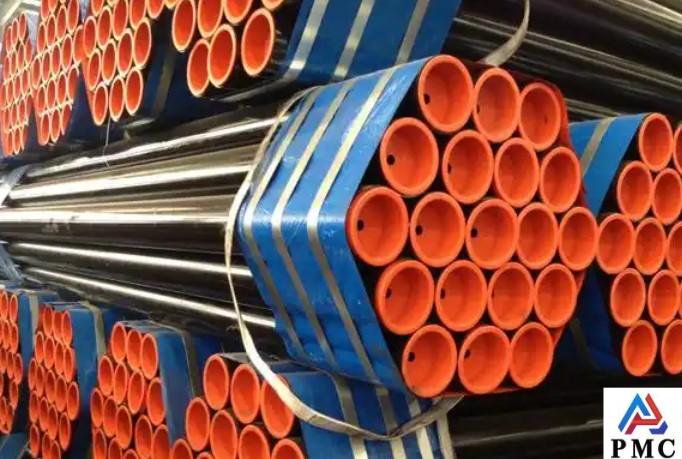
1. High strength and durability: Carbon steel itself has good strength and hardness. Combined with the seamless manufacturing process, the potential weak point of the weld is eliminated, which allows carbon steel seamless pipes to withstand higher internal pressure and external loads. They are not easy to deform or break, thus having excellent durability.
2. Cost-effectiveness: Carbon steel is one of the most produced and widely used metal materials, and its raw material costs are relatively low, making seamless carbon steel pipes an economical choice for many engineering projects.
Good processing performance: Carbon steel has good plasticity and weldability. Although seamless steel pipes do not require welding during the manufacturing process, carbon steel seamless steel pipes exhibit good processing convenience during subsequent installation, connection and processing (such as cutting and bending).
3. Wide temperature adaptability: Depending on the specific carbon steel grade and heat treatment, carbon steel seamless pipes can maintain their performance in certain high and low temperature environments. For example, some grades of carbon steel seamless pipes are specifically designed for high-temperature services (such as boiler tubes), while others are designed for low-temperature environments.
Structural uniformity: The seamless manufacturing process ensures the uniformity of steel pipe wall thickness and material properties, avoiding potential differences in metallographic structure and stress concentration in the welding area.
The standards, grades, and classifications of carbon steel seamless pipes are the core basis for their adaptability to different industrial conditions. Reasonably selecting pipes that meet the standards and corresponding grades can not only ensure project quality and operational safety, but also reduce procurement and maintenance costs.
