


Seamless pipe is widely used in oil & gas, power generation, chemical processing, and mechanical industries because it offers excellent strength under high-pressure and high-temperature conditions — the absence of a weld seam removes what is typically the weakest point in a comparable welded pipe.
However, seamless pipe is not always the best choice. Its higher cost and longer production cycle make welded pipe a better option for some low-pressure, non-corrosive applications, and carbon steel seamless pipe isn't the right grade for every corrosive environment either.
This guide explains the advantages and disadvantages of seamless steel pipe, the different types available, how to spot quality issues, typical industrial applications, and how to choose the right option for your project.
Light weight — for a given strength requirement, seamless steel pipe is significantly lighter than solid steel sections of comparable load capacity, giving it good weight-to-strength performance.
Corrosion and temperature resistance — resistant to acid, alkali, salt, and atmospheric corrosion; withstands high temperatures, impact, and fatigue without regular maintenance, which helps extend service life in demanding operating environments.
High mechanical strength — the absence of a weld seam removes what is typically the weakest point in a welded pipe, giving seamless pipe a strength and reliability advantage under high pressure and cyclic loading, along with strong creep resistance.
Easy to fabricate downstream — once formed, seamless pipe machines, cuts, bends, and threads predictably thanks to its uniform, continuous structure — this is a separate question from how difficult the initial seamless-forming process itself is (see Disadvantages below).
High dimensional stability — seamless pipes maintain consistent mechanical properties and dimensional accuracy along their length, with minimal deformation under load, making them suitable for precision applications.
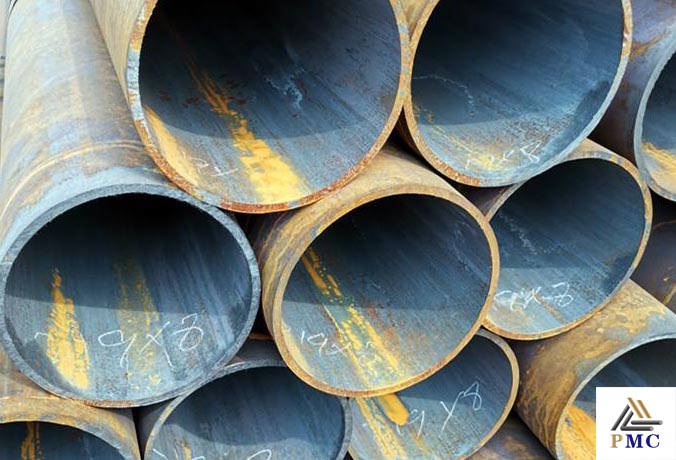
Higher cost and price — the production process requires specialized equipment and more complex processing steps than welded pipe, which pushes up both production cost and price. Projects with tighter budgets sometimes choose welded steel pipe instead for this reason.
Longer production cycle — seamless pipe goes through more processing stages than welded pipe, resulting in a longer lead time and lower production throughput.
Manufacturing (forming) difficulty — this is distinct from downstream fabrication ease (Advantage #4). Without a seam to work with, the initial seamless-forming process — piercing and rolling a solid billet into a hollow tube — requires higher pressure and temperature than forming a strip and welding it. That's what adds to manufacturing cost and complexity, even though the finished pipe itself is easy to cut, bend, and machine. Important distinction: manufacturing difficulty is different from downstream fabrication difficulty.
Quality can be inconsistent between suppliers — market demand for seamless pipe has driven a lot of new manufacturers into the market, and product quality varies significantly. Common quality issues include uneven wall thickness, low internal/external brightness, pitting, and black spots — see Section 4 below for how to spot these.
Environmental impact — seamless pipe production consumes significant energy and water and generates process waste, more so than some welded alternatives.
Seamless pipe isn't a single product — the right type depends on the working pressure, temperature, and corrosion environment of your application.
|
Type |
Material |
Key Advantage |
Typical Applications |
|
Carbon Steel Seamless Pipe |
Carbon steel |
Cost-effective, good general strength |
Heating, compressed air, oxygen/acetylene lines, general machinery |
|
Alloy Steel Seamless Pipe |
Alloy structural steel |
Higher strength at elevated temperature/pressure |
Boilers, power plants, high-pressure process piping |
|
Stainless Steel Seamless Pipe |
Chromium-nickel stainless steel |
Strong acid/corrosion resistance |
Chemical processing, food and beverage, marine environments |
Carbon steel seamless pipe — rolled from ordinary or high-quality carbon steel. The most widely used type, generally good for working pressures below 1.6 MPa: heating, refrigeration, compressed air, oxygen/acetylene lines, and most non-corrosive chemical pipelines.
Alloy steel seamless pipe — rolled from low-alloy or alloy structural steel. Handles higher temperature and pressure than carbon steel, which is why it's the standard choice for boiler tubing and high-pressure piping in power plants — for jobs too demanding for carbon steel but not corrosive enough to need stainless.
Stainless steel seamless pipe — made from chromium-nickel stainless steel. Stainless steel seamless pipe costs more but resists acid and corrosion well, making it the right call for chemical pipelines with aggressive media.
How to choose: start with the media. Corrosive (acidic, alkaline, marine, humid) → stainless. Non-corrosive and within carbon steel's pressure/temperature range → carbon, the cheapest option. Non-corrosive but too hot or high-pressure for carbon → alloy. And if the whole application sits at low pressure (roughly under 2.0–3.0 MPa) with non-corrosive media — think indoor heating or compressed air — plain welded pipe can skip the seamless-forming cost altogether and be the more economical pick.
End-face and cutting quality — on high-quality pipe, the cut end face is smooth and uniform; rough or uneven cut ends often indicate inferior base material.
Cross-section roundness — excessive ellipticity (an out-of-round cross-section) points to excessive reduction in the final rolling passes and generally means reduced strength.If several of these issues show up together, it's a strong signal to request mill test certificates and verify the supplier's production standards before ordering in volume.
Higher cost, longer lead times, and a more difficult manufacturing process than welded pipe — plus quality that can vary noticeably between suppliers.
Check for surface scars, fold lines, pitting, and a smooth cutting/end-face finish — see Section 4 above. If several issues show up together, request mill test certificates before ordering in volume.
Corrosive media → stainless. Non-corrosive, standard pressure/temperature → carbon, the cheapest option. Non-corrosive but too hot or high-pressure for carbon → alloy (boiler tubing is the classic example).
It's formed by piercing and rolling a solid billet rather than forming and welding a flat strip — a process that needs more specialized equipment and more production stages, which adds to cost.
Common standards include ASTM A106 and ASTM A53 (carbon steel), API 5L (oil and gas line pipe), and applicable EN standards for the European market. Confirm the required standard with your supplier before ordering.
At Permanent Steel Manufacturing Co., Ltd.(PMC), seamless pipes are supplied according to ASTM, API, and EN standards, with full inspection documentation including mill test certificates (MTC), chemical composition analysis, mechanical testing, and dimensional inspection — so buyers can verify compliance before the pipe ever leaves the mill.
Seamless steel pipes are widely used in key industries — oil and gas, power generation, chemical processing, and mechanical manufacturing — thanks to their strong resistance to high pressure and temperature, good corrosion resistance, and precise dimensional accuracy. Their main drawbacks are higher cost, longer production lead times, and processing complexity, along with quality variation across suppliers that buyers need to screen for. Choosing the right type — carbon seamless pipe, alloy seamless pipe, stainless seamless pipe, or welded pipe where the application allows it — along with basic quality checks before purchase, is usually enough to avoid the most common sourcing mistakes.
Related articles:
Heat Treatment Processes for Seamless Steel Pipes
Seamless Steel Pipe Manufacturing Process: How Are Seamless Pipes Made?
