After rolling and cold drawing, seamless steel pipe is left with internal stress and a coarse, uneven grain structure. Left untreated, that stress doesn't just sit there quietly — it can cause the pipe to warp or crack later, sometimes not until it's already in service. Heat treatment is how manufacturers deal with this: by carefully controlling how the pipe is heated, how long it's held at temperature, and how it's cooled, the internal structure of the steel can be reshaped to deliver the hardness, toughness, or wear resistance a particular application calls for.
There isn't one single "correct" heat treatment — the right choice depends on what the pipe will be used for. Below are the eight processes most commonly used for seamless steel pipe, along with some practical notes on when each one makes sense.
1. Quenching + High-Temperature Tempering
This is the go-to process when a pipe needs both strength and toughness at the same time — a combination that's hard to get any other way. The pipe is first heated until its internal structure turns into austenite, then rapidly cooled (quenched) so it transforms into martensite, a very hard but brittle structure. On its own, martensite would be too fragile to use, so it's followed by high-temperature tempering, which softens it slightly and converts it into a more balanced structure called tempered sorbite.
A real-world example helps illustrate why this matters. Pipeline steel like API 5L long-distance oil and gas pipelines that have to survive harsh winters and constant pressure cycling.
The tempering step isn't optional. Right after quenching, a steel pipe is carrying more than 300 MPa of internal stress and is dangerously brittle — a small impact could crack it. Tempering removes over 90% of that stress. Depending on how much hardness needs to be preserved versus how much toughness is required, tempering can be done at low, medium, or high temperature.
2. Normalizing
Normalizing looks similar to quenching at first glance — the pipe is heated to a high temperature (roughly 40–60°C above its upper critical point) until it fully turns into austenite — but the cooling step is different. Instead of a rapid quench, the pipe is simply left to cool in open air.
That slower, gentler cooling still refines the grain structure and relieves stress, but without pushing the steel all the way to martensite. Compared with annealing, normalized pipe generally ends up with 20–30% finer grain, 10–20% higher strength, and better machinability, while also avoiding a hot-rolling defect called Widmanstätten structure. It's also faster and cheaper — normalizing typically costs around 60% of what annealing does, mainly because there's no need for slow furnace cooling.
This makes normalizing a common default choice for general-purpose fluid transport pipe, pressure vessel shells, and structural components — anywhere a pipe needs decent strength without the extra cost of a full quench-and-temper cycle.
A simple rule of thumb: if the pipe still needs to go through cold bending or other cold-forming steps, anneal it first — you want it soft. If it's going straight into service, normalize it — you want the extra strength.
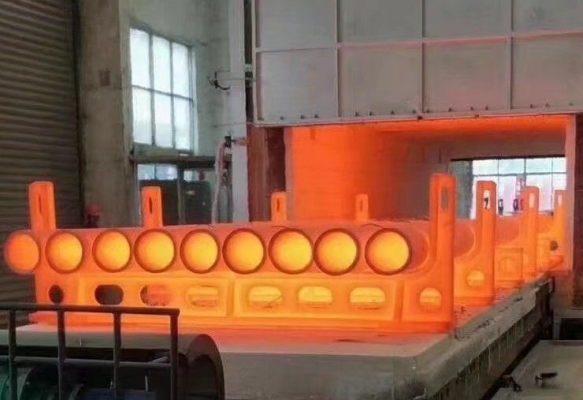
3. Normalizing + Tempering
Sometimes normalizing alone isn't quite enough — the pipe is strong, but a bit short on toughness for the application. Adding a tempering step after normalizing addresses that. The steel is heated and air-cooled as usual, then tempered, producing structures like tempered bainite or tempered sorbite depending on the steel grade.
Think of it as sitting between plain normalizing and full quench-and-temper: you give up a small amount of hardness in exchange for noticeably better toughness and dimensional stability, without paying the full cost of a quenching cycle.
4. Annealing
Annealing takes the opposite approach from quenching. The pipe is heated to a moderate temperature — about 30–50°C above its critical point — held there, and then cooled very slowly inside the furnace itself, often at a rate no faster than 50°C per hour. That slow cooling is the whole point: it lets the internal structure relax fully, which is why annealed steel is noticeably softer and easier to work with than normalized or quenched steel.
Because "annealing" covers a fairly wide range of outcomes, it's usually broken down into more specific types — full annealing, spheroidizing annealing, stress-relief annealing, isothermal annealing, and a few others — depending on exactly what the follow-up processing requires. In practical terms, annealing can lower hardness by more than 30%, which makes a real difference when a pipe still needs to be cold-bent, flared, or machined extensively. It's a common choice for precision hydraulic tubing, instrument pipe, and any component that needs a lot of downstream machining.
5. Solution Treatment
Solution treatment is really a stainless steel process, most often used for austenitic grades like 304. The pipe is heated until carbides and alloying elements fully dissolve into the austenite, then quenched quickly enough that those elements don't have time to precipitate back out. What you're left with is a clean, single-phase austenite structure.
This matters because in stainless steel, carbides that form along grain boundaries are exactly what makes the steel vulnerable to corrosion. Solution treatment — typically water quenching from around 1050–1100°C — dissolves those carbides and restores the pipe's corrosion resistance. So while the underlying idea is similar to annealing (heat, then cool to reset the structure), the goal here isn't softness — it's corrosion performance.
6. Surface Quenching
Not every application needs the whole pipe hardened — sometimes only the surface has to stand up to wear, while the core needs to stay tough so the pipe doesn't become brittle overall. Surface quenching does exactly that: only the outer layer is heated to quenching temperature and rapidly cooled, leaving the core structure untouched.
The two most common ways to do this are induction hardening, which uses electromagnetic heating and gives tight control over hardened-layer depth (typically 0.5–10mm) with very little distortion, and flame hardening, which is better suited to localized hardening on large-diameter pipe. A few less common but useful variants exist too — contact resistance heating, electrolytic heating, and laser hardening — each offering a different trade-off between precision, cost, and the size of pipe it can handle.
Done well, surface quenching pushes surface hardness up to HRC 55–60 while keeping the core tough, and can roughly double or triple fatigue strength. That combination is exactly what's needed for hydraulic cylinder barrels, drive shaft sleeves, and wear-resistant pipe used in mining equipment.
7. Chemical Heat Treatment
Chemical heat treatment changes the surface differently — instead of just altering the structure, it actually changes the chemical composition of the surface layer by diffusing other elements into it. Carburizing and nitriding are the two most common versions.
Nitriding in particular is worth calling out because of how little it disturbs the pipe: it causes almost no deformation and can hold tolerances as tight as 0.01mm, which means parts often don't need any further machining afterward. That's a meaningful advantage for precision components where re-machining after heat treatment would be expensive or risky.
8. Special Processes for Extreme Conditions
A couple of processes exist specifically for situations where the standard options aren't quite good enough:
Isothermal quenching holds the pipe at 200–400°C after quenching, allowing a structure called lower bainite to form gradually instead of transforming all at once. This greatly reduces the risk of cracking, which makes it well suited to thick-walled, high-pressure pipe where sudden transformation stresses would otherwise be a real problem.
Aging treatment is more about stability than strength. By holding the pipe at room temperature or a mild 100–200°C for an extended period, dimensions are locked in place so the part won't creep or distort later during service — something that matters a lot in precision applications like aerospace tubing, where even tiny dimensional drift isn't acceptable.
A Note on How Heat Treatment Is Classified by Purpose
Beyond the eight process types above, it's worth knowing that heat treatment is also sometimes grouped by why it's being done, rather than how:
Final heat treatment — done to bring the finished pipe up to the performance specs required for its end use
Delivery-state heat treatment — done because a standard or customer requires the pipe to be supplied already annealed or normalized, often to prevent cracking or deformation before the pipe is even put into service (common for high-alloy steels)
Inter-process heat treatment — done partway through manufacturing, not as a final step — for example, recrystallization or softening annealing between cold-drawing passes, just to undo work hardening so the pipe can be cold-worked again
This distinction matters mostly for spec-reading: when a purchase order calls for a pipe "delivered in the normalized condition," that's this second category, not necessarily the same normalizing described in Section 2 as a stand-alone treatment.
FAQs
Q: What is heat treatment of seamless steel pipe, exactly?
It's a controlled process of heating, holding, and cooling a steel pipe to change its internal structure — done to adjust properties like hardness, strength, toughness, or corrosion resistance without changing the pipe's shape or chemical composition.
Q: Why does seamless pipe need heat treatment at all?
Rolling and cold drawing leave the pipe with internal stress and uneven grain structure. Without heat treatment, that stress can cause cracking or deformation later — sometimes after the pipe is already installed.
Q: How do I know which heat treatment process is right for my application?
It comes down to what matters most for the job: normalizing or quenching + tempering for strength, annealing if the pipe still needs cold forming, surface quenching if only wear resistance on the outside matters, and solution treatment for stainless steel corrosion resistance. If you're not sure, it usually helps to start from the working conditions (pressure, temperature, corrosion exposure) rather than the process name.
Q: Why must tempering always follow quenching?
Because quenched steel is left extremely brittle and under heavy internal stress — often over 300 MPa. Tempering relieves more than 90% of that stress and makes the pipe usable rather than just hard.
Yes, though it's usually a different process. Austenitic grades like 304 typically go through solution treatment (water quenching from around 1050–1100°C) rather than quenching or annealing, since the goal is restoring corrosion resistance rather than adjusting hardness.
Q: Can heat treatment fix defects that happened earlier in manufacturing?
To a degree — it can relieve internal stress and refine grain structure, which helps with issues like uneven hardness or latent cracking risk. But it can't correct dimensional problems or surface defects like scratches; those need to be addressed separately.
Conclusion
Conclusion
There's no single "best" heat treatment — the right process depends on what the pipe needs to survive in service. Pressure and cold-weather impact call for quenching and tempering; pipe headed into further cold forming needs annealing; wear resistance on the surface alone points to surface quenching. All eight processes come down to the same idea — heat, hold, cool, and let the resulting structure do the work — so choosing the right one starts with the working conditions, not the process name. When in doubt, it's worth discussing those conditions with your supplier before finalizing the spec.
Related:
Test Method for Heat Treatment Hardness of Seamless Steel Pipe
The Difference between Bright Heat Treatment and Vacuum Heat Treatment of Seamless Tubes