


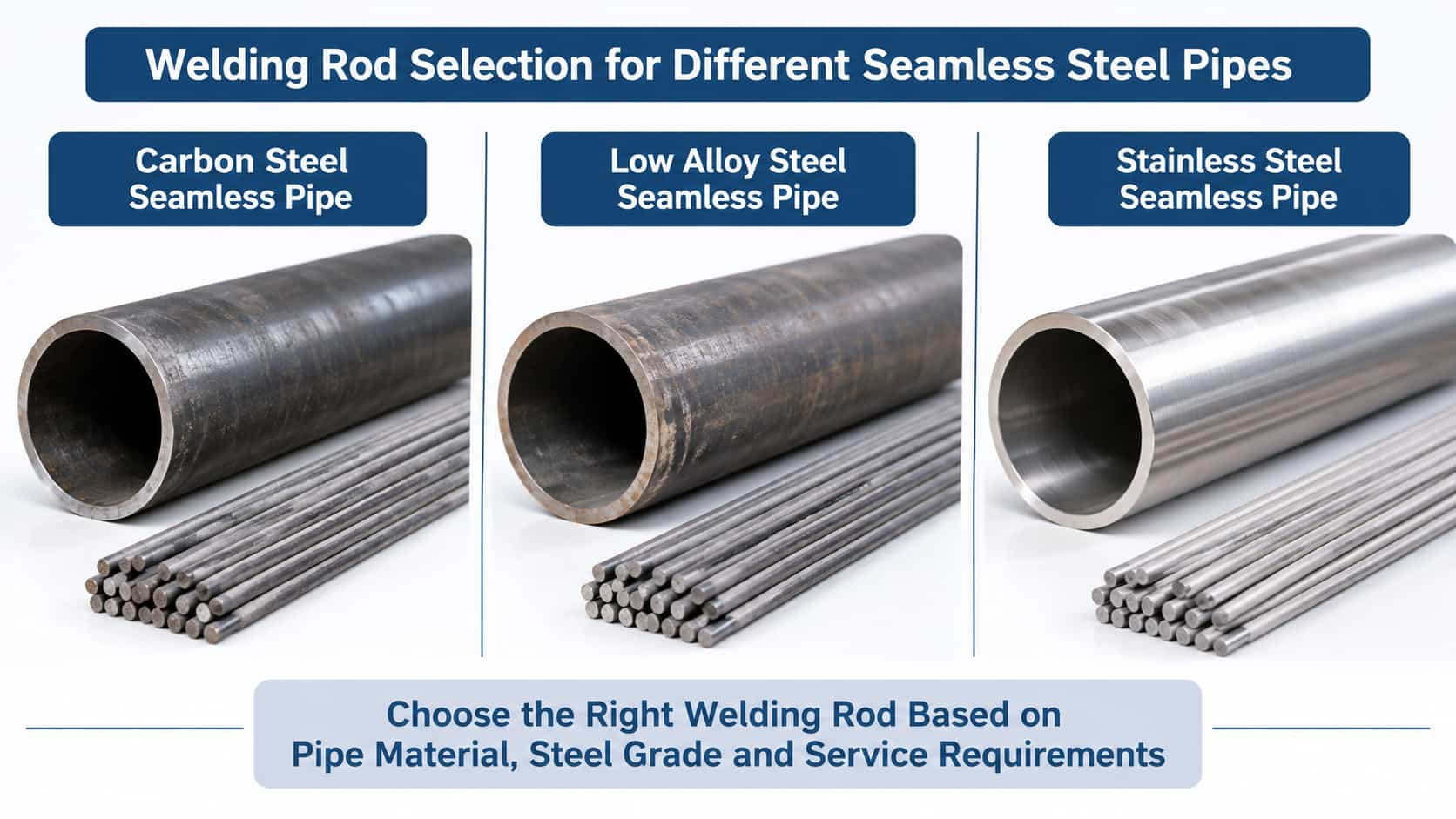
There is no single welding rod for all seamless steel pipe (SMLS Pipe). The right choice depends on the pipe material and grade, the welding process, wall thickness, welding position, service temperature and medium, and the welding procedure specification (WPS) for the project. For carbon steel seamless pipe, E6010 and E7018 are commonly used in some applications, while low alloy and stainless steel pipe need electrodes that match their chemistry.
This guide covers rod selection only. In shielded metal arc welding (SMAW), the coated welding rod is also called a stick electrode, and this guide uses “welding rod” and “welding electrode” interchangeably. GTAW and GMAW use bare filler wire or rods with separate classifications, so check the WPS if the project uses those processes.
|
Pipe material |
Common electrode classifications |
AWS specification |
Selection note |
|
Carbon steel seamless pipe |
E6010, E7018 |
A5.1 |
The role of each electrode and the final choice depend on grade, wall thickness and the WPS |
|
Low alloy steel seamless pipe |
Alloy-matched types, e.g. E8018-B2, E9018-B3 for Cr-Mo steels |
A5.5 |
The classification suffix indicates the weld metal alloy; match it to the pipe chemistry |
|
Stainless steel seamless pipe |
E308L, E316L, E309L (austenitic grades) |
A5.4 |
Match the filler to the pipe grade; E309L is commonly used for stainless-to-carbon steel joints |
When stick welding is used, carbon steel seamless pipe is welded with covered electrodes classified under AWS A5.1. E6010 and E7018 are two of the best-known welding rod types for carbon steel pipe, but they do different jobs.
|
Item |
E6010 |
E7018 |
|
AWS specification |
A5.1 |
A5.1 |
|
Coating |
High cellulose sodium |
Low-hydrogen, iron powder |
|
Minimum tensile strength class |
60 ksi |
70 ksi |
|
Welding current |
DCEP |
AC or DCEP |
|
Typical application on a pipe |
Root passes where deep penetration is needed |
Fill and cap passes where low hydrogen is needed |
|
Main limitation |
Not a low-hydrogen electrode; rougher bead |
Moisture-sensitive; generally not chosen for open-root passes |
When stick welding is used, low alloy pipe, such as chromium-molybdenum steel used in high-temperature service, is welded with low alloy electrodes classified under AWS A5.5. In E8018-B2, the first two digits (80) indicate the minimum tensile strength class in ksi, and the suffix indicates the weld metal alloy. E8018-B2 and E9018-B3 are chromium-molybdenum types with nominal 1¼Cr-½Mo and 2¼Cr-1Mo deposits. These are low-hydrogen electrodes, and preheat, interpass temperature and post-weld heat treatment are set by the WPS and the applicable code. Carbon steel electrodes such as E7018 are not a substitute for alloy-matched electrodes.
When stick welding is used, austenitic stainless steel seamless pipe is welded with stainless electrodes classified under AWS A5.4, and the filler is normally chosen to match the pipe grade. E308L is commonly used for 304 and 304L, and E316L for 316 and 316L. The “L” indicates low carbon, which reduces the risk of sensitization. Duplex and other grades need their own matched fillers per the WPS. For joining stainless steel to carbon steel, E309L is commonly used because of its higher chromium and nickel content. Carbon steel electrodes such as E6010 and E7018 are not suitable filler for stainless pipe.
|
Factor |
What to check |
|
Base metal grade |
Confirm the pipe material, grade and chemistry on the mill test certificate, then select the electrode type (A5.1, A5.5 or A5.4) for that material |
|
Strength matching |
Weld metal strength is normally selected to meet the base metal strength requirement in the WPS; a higher strength class is not automatically better |
|
Wall thickness |
Thicker walls generally mean more weld passes and closer hydrogen control; thick sections often call for low-hydrogen electrodes with preheat and interpass control per the WPS |
|
Welding position |
The electrode must be suitable for the positions in the WPS; electrode diameter is chosen for the wall thickness and position |
|
Service temperature |
Low-temperature service may require impact-tested electrodes (some classifications carry a suffix such as -1 for lower-temperature impact properties); high-temperature service may call for alloy-matched chromium-molybdenum electrodes |
|
Medium and environment |
Corrosive media may require filler metal that maintains the corrosion resistance of the pipe, as with stainless steel; the project specification may add further limits |
|
WPS, PQR and code |
The qualified WPS and procedure qualification record are the final authority; changing the electrode classification may require a new or revised qualification under the applicable code |
1. Keep welding rods in their original packaging in a dry place until use, and keep them dry on site.
2. Storage and drying needs differ by electrode type. Low-hydrogen electrodes such as E7018 absorb moisture and are usually kept in heated holding ovens or rebaked as the manufacturer instructs; cellulosic electrodes such as E6010 are handled differently. Do not apply one drying temperature or time to all electrodes. Follow the manufacturer’s data sheet and the WPS.
3. Do not use electrodes with peeling or cracked coatings, or with oil or other contamination on the rod.
4. Tack welds should use the same electrode type as the production weld, unless the WPS states otherwise.
Related articles: Seamless Steel Pipe Welding Methods and Techniques
