


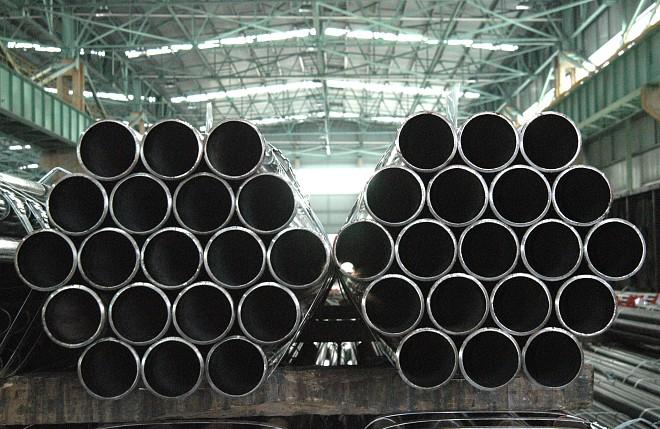
Seamless stainless steel pipe generally starts from a round billet, which is pierced and formed into a hollow section. ERW stainless steel pipe generally starts from stainless steel strip or coil, which is formed into a round shape and welded along its length. Although the starting materials are different, the quality of the finished pipe depends on both the initial condition of the raw material and the manufacturing quality control applied during production.
The two products are made in different ways. Seamless stainless steel pipe is produced by piercing a heated round billet and then rolling or drawing it to the required size. ERW stainless steel pipe is produced by forming stainless steel strip or coil into a round shape and joining the edges by electric resistance welding, followed by sizing.
The available size range for both seamless and ERW stainless steel pipe depends on the manufacturing process, the applicable standard, the stainless steel grade and the specific manufacturer's production capability. ERW is often an economical option for commonly produced sizes, while seamless stainless steel pipe is also available across a wide range of sizes. Buyers should confirm the exact size range available with the supplier for a specific project.
Seamless stainless steel pipe has no longitudinal weld seam, since it is formed from a solid billet. ERW stainless steel pipe has a longitudinal weld seam produced by electric resistance welding. The weld area of ERW pipe is subject to manufacturing quality control and the testing requirements of the applicable standard; it should not be assumed to be inherently weaker or stronger than seamless pipe without reference to the specific grade, standard and application.
Seamless stainless steel pipe may be selected for demanding pressure, temperature or critical-service applications when the applicable specification requires or permits seamless construction. ERW stainless steel pipe can be suitable for water systems, general industrial piping, structural applications and other services where welded stainless steel pipe meets the applicable requirements.
The selection depends on the applicable standard, stainless steel grade, pressure, temperature, corrosion environment and other project requirements — not on manufacturing method alone. For stainless steel pipe specifically, factors such as chemical composition, surface condition, service environment and testing requirements should all be considered alongside the manufacturing route.
Surface finish and dimensional quality depend on the manufacturing process, equipment, material condition and quality control applied by the manufacturer. Neither seamless nor ERW stainless steel pipe can be assumed to have a superior finish in every case; project specifications and inspection requirements should be checked for the pipe in question.
The decision between seamless and ERW stainless steel pipe should be based on project requirements rather than a general preference for one type.
Seamless stainless steel pipe may be the right choice when the project specification requires seamless construction, when the service involves demanding pressure or temperature, when the application is considered critical, or when the applicable standard calls for seamless pipe.
ERW stainless steel pipe may be a suitable choice when the applicable standard permits welded pipe, when the service conditions are appropriate for welded construction, when cost efficiency is a priority, and when the required grade and size are readily available in ERW form.
The right choice depends on the project requirements and applicable standards, rather than simply choosing seamless over ERW.
|
Factor |
Seamless Stainless Steel Pipe |
ERW Stainless Steel Pipe |
|
Starting Material |
Round billet |
Stainless steel strip/coil |
|
Weld Seam |
No longitudinal weld seam |
Longitudinal weld seam |
|
Manufacturing |
Piercing and forming |
Forming and resistance welding |
|
Typical Selection |
Selected for applications where seamless construction is specified |
Suitable where welded pipe meets project requirements |
|
Cost |
Generally higher |
Generally more economical |
To identify whether a stainless steel pipe is seamless or welded, check the pipe marking, the applicable product standard and the material certificate (MTC). The marking and accompanying documentation should indicate the applicable standard and product type.
For reference, under ASTM A53 — which is a carbon steel pipe specification, not a general stainless steel pipe specification — Type S denotes seamless, Type F denotes furnace welded, and Type E denotes electric resistance welded. For stainless steel pipe, the relevant stainless steel product standard and the mill certificate are the appropriate references for confirming whether a specific pipe is seamless or ERW.
What is the difference between seamless and ERW stainless steel pipe?
Seamless stainless steel pipe is formed from a round billet and has no longitudinal weld seam, while ERW stainless steel pipe is formed from strip or coil and joined by electric resistance welding along its length.
Is seamless stainless steel pipe more corrosion resistant than ERW pipe?
Not necessarily. Corrosion resistance depends mainly on the stainless steel grade, chemical composition, surface condition and service environment, rather than on whether the pipe is seamless or welded.
Which is better, seamless or ERW stainless steel pipe?
Neither type is universally better. The choice depends on the applicable standards, pressure, temperature, corrosion conditions, size, grade and project requirements.
Related articles:
