Seamless pipe generally offers advantages in strength and pressure resistance in many demanding applications because it has no longitudinal weld seam. This structural continuity can make seamless pipe a preferred choice for high-pressure and high-temperature service. However, the actual strength of a pipe depends on material grade, wall thickness, manufacturing quality, applicable standards, and operating conditions — not on whether the pipe is seamless or welded alone.
1. Is Seamless Pipe Stronger Than Welded Pipe?
Seamless pipe can provide higher or more uniform pressure-bearing performance in certain demanding applications, but the actual strength depends on pipe specifications, material, manufacturing quality, and applicable standards. Rather than treating strength as a fixed advantage of one pipe type, engineers evaluate each pipe against the requirements of the specific application.
1.1 No Longitudinal Weld Seam and More Uniform Structure
Seamless steel pipe is formed from a solid steel billet through a piercing process, without welding. As a result, it has no longitudinal welded joint, and this absence of a weld seam can provide more continuous structural characteristics around the pipe circumference, supporting even stress distribution under internal pressure. This structural continuity generally results in more uniform material properties around the pipe wall, which can support more consistent pressure-bearing performance, particularly in thick-wall or high-pressure designs.
By comparison,
ERW welded pipe and other welded pipe types include a longitudinal welded joint. The weld is an important part of welded pipe performance, and its quality depends on the welding process, manufacturing controls, and applicable requirements.
1.2 Factors That Determine Pipe Strength
Pipe strength does not depend only on whether the pipe is seamless or welded. Several factors determine the actual strength and pressure rating of a pipe, including:
Material grade
Wall thickness and outside diameter
Manufacturing quality and process control
Heat treatment, where applicable
Weld quality, for welded pipe
Applicable standard (such as ASTM, API, or EN specifications)
Operating pressure and operating temperature
A well-manufactured welded pipe that meets the required standard, material specification, and testing requirements can still deliver strong, reliable performance. A seamless pipe produced with inconsistent wall thickness or poor process control will not automatically outperform it.
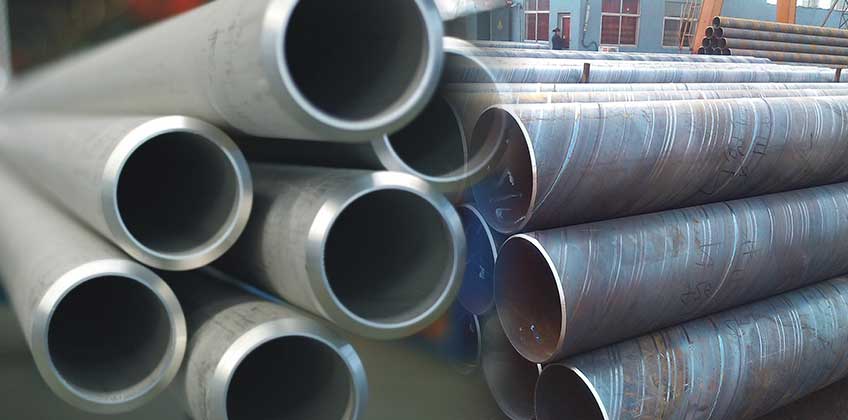
2. When Is Seamless Pipe Preferred for Strength and Pressure?
Seamless pipe is commonly specified for certain high-pressure applications, high-temperature service, boiler and heat exchanger applications, oil and gas service, and demanding mechanical applications, where structural continuity and consistent wall properties are important. This does not mean these applications always require seamless pipe — the applicable standard and project requirements determine the appropriate pipe type for each case.
3. Strength Comparison Table
Strength Factor
|
Seamless Pipe
|
Welded Pipe
|
Longitudinal weld
|
None
|
Present
|
Pipe structure
|
Continuous
|
Includes welded joint
|
Pressure performance
|
Generally suitable for demanding service
|
Depends on pipe type, weld quality, and specification
|
Strength consistency
|
Generally more uniform structure
|
Depends on manufacturing and weld quality
|
Key strength factors
|
Material, wall thickness, standard
|
Material, wall thickness, weld quality, standard
|
ASTM A53 covers both seamless and welded steel pipe with the same nominal wall thickness ranges, and is produced mainly for pressure and mechanical applications, including steam, water, and gas line service.
Cost is a separate consideration from strength. Seamless pipe is generally more expensive because of its manufacturing process — for a detailed breakdown, see why seamless pipe costs more.
The right pipe type for a given project also depends on pressure, temperature, standard, material, dimensions, and project requirements — for guidance on making that choice, see choose between seamless and welded pipe. For a broader look at how the two pipe types differ overall, see seamless and welded pipe differences.
4. FAQs
Is seamless pipe stronger than welded pipe?
Seamless pipe generally offers advantages in pressure-bearing performance in many demanding applications, but actual strength depends on material, wall thickness, manufacturing quality, and applicable standards.
Why is seamless pipe stronger than welded pipe?
Seamless pipe has no longitudinal weld seam and a continuous pipe structure, which results from its manufacturing process of piercing a solid billet rather than welding rolled plate or strip. This continuity supports more even stress distribution and consistent pressure-bearing performance.
Can welded pipe be used for high-pressure applications?
Yes. Welded pipe can be used in high-pressure applications when it meets the required standard, material, dimensions, weld quality, testing, and pressure-rating requirements. Seamless pipe may be preferred for certain demanding services.
5. Conclusion
Weld seam presence or absence is not the only factor that determines pipe strength. When welded pipe is manufactured and tested according to the applicable standard, with proper weld quality control, it can meet demanding strength and pressure requirements in many applications. Seamless pipe remains a common choice where structural continuity and consistent wall properties are especially important, such as high-pressure or high-temperature service. Ultimately, the applicable standard, material grade, wall thickness, and manufacturing quality — not the pipe type alone — determine whether a given pipe meets a project's strength and pressure requirements.