


A wellbore is the hole drilled into the earth to explore for and recover natural resources such as oil, gas or water. In oil and gas wells, it is the path that connects the surface to the reservoir, and it can be vertical, deviated or horizontal. Producing oil or gas is complex, time- and cost-intensive, but in principle most oil and gas wells go through three phases: drilling with drill pipes, lining with casing pipe and production with tubing.
A wellbore is the actual drilled hole that forms the well. In this article, the wellbore means the drilled hole itself; casing, cement and tubing are components installed in it. The hole is usually drilled to extract oil or gas over a long period of time.
A wellbore can be lined with steel casing and cement, or it can be left uncased (open hole).
The diagram below shows an oil wellbore lined with steel and cement. The wellbore wall is the rock face that bounds the drilled hole.
| Component |
Role |
|
Wellbore |
The drilled hole, bounded by the wellbore wall (rock face) |
|
Casing |
Steel pipe run into the wellbore to line it and improve stability. Wellbore casing is usually held in place with cement |
|
Cement |
Placed between the casing and the wellbore wall to hold the casing in place and help seal that space |
|
Tubing |
Pipe run inside the casing to carry oil or gas to the surface during production |
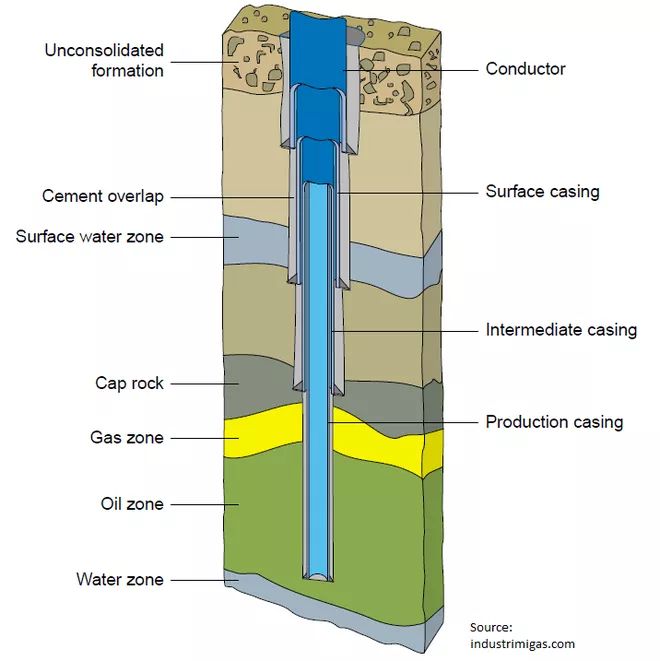
Access to the reservoir: it provides the path from the surface to the oil or gas formation.
Production path: it provides the route along which oil and gas flow to the surface.
Housing for well components: casing, cement and tubing are installed in it.
Wellbores should be cleaned before and after production, because mud or debris can increase operating costs and raise safety and environmental risks.
Drilling: drill pipes form most of the drill string that connects the surface rig to the drill bit and carries drilling fluid. They are connected through their tool joints.
Casing: once a section is drilled, casing pipe is run in and usually cemented in place to line the wellbore.
Tubing: production tubing is run inside the casing for production.
For a stage-by-stage breakdown, see The Three Phases of a Wellbore: Drilling, Casing, Tubing.
A borehole is any hole drilled into the ground. Boreholes are also used for mineral extraction, environmental assessment and temperature measurement. A wellbore is a borehole drilled for a well, typically an oil or gas well, so when comparing borehole vs wellbore, the main difference is scope: borehole is the broader term.
The two terms are often used interchangeably. Some sources use "borehole" for the open hole itself and "wellbore" for the hole together with its lining, but usage varies, so this is not a strict dividing line.
