


Square tube column buckling is a stability failure: a slender column under axial compression can bend sideways at a load below the one that would crush the steel. This article explains the basic square tube buckling calculation using the Euler buckling formula, with a worked example. For other load cases, see our guide to square tube strength and load capacity calculation.
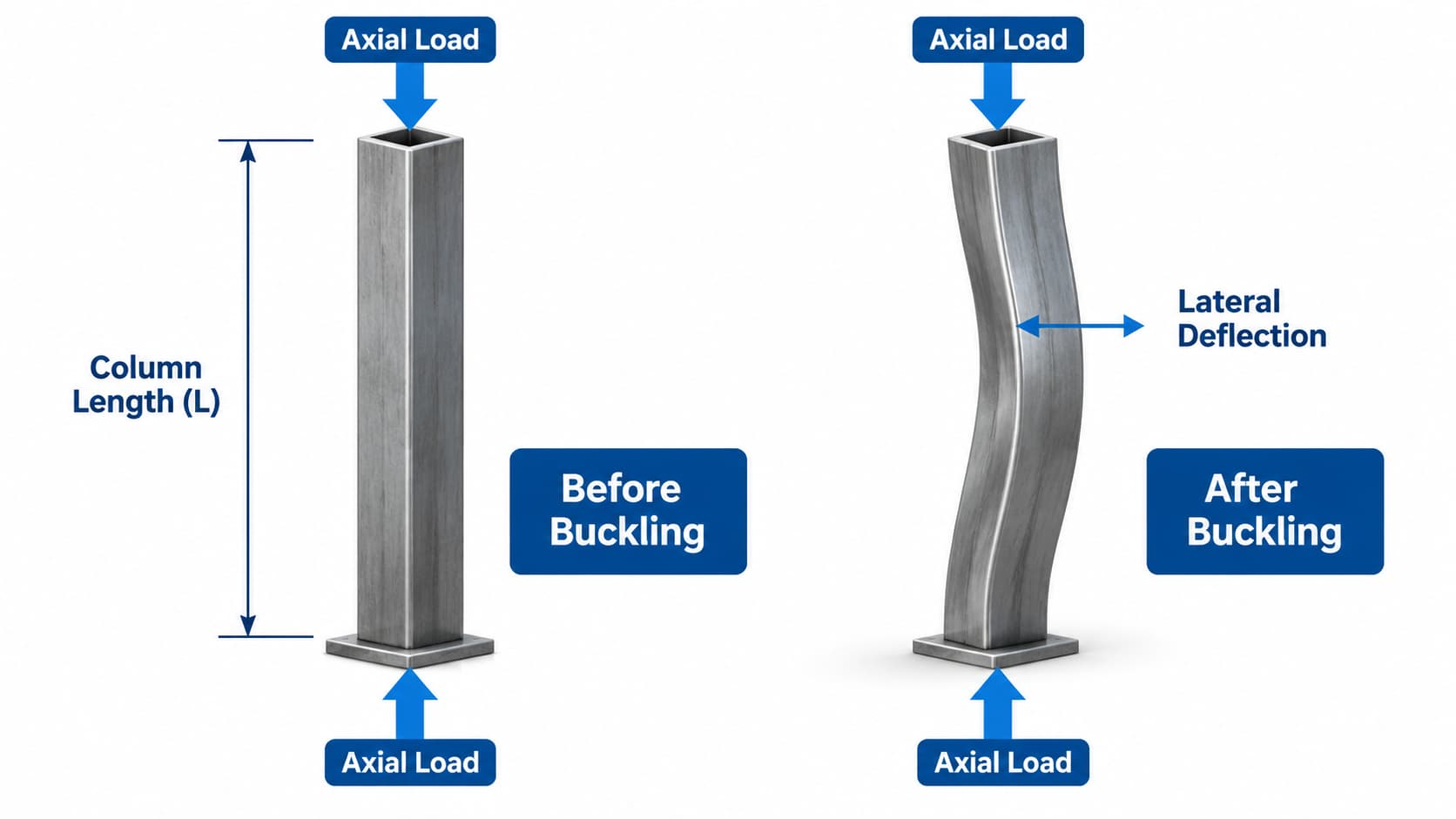
When a square steel tube column is loaded along its axis, it stays straight at low loads. At a critical load, it suddenly deflects sideways and loses much of its stiffness. This is global buckling of the whole member. Local wrinkling of the tube walls is not covered here.
Buckling is different from crushing. Crushing occurs when compressive stress reaches the steel's yield strength, so the material itself fails. Buckling is a loss of stability and can occur while the stress is still below yield. The more slender the column, the more likely buckling governs.
The Euler buckling formula gives the elastic critical load of an ideal column:
P<sub>cr</sub> = π²EI / (KL)²
KL is the effective length. Because it is squared, doubling it cuts P<sub>cr</sub> to one quarter. Idealized K values are 1.0 for pinned–pinned, 0.7 for fixed–pinned, 0.5 for fixed–fixed and 2.0 for fixed–free. Codes often use higher values because real supports are never perfectly rigid.
The formula assumes a straight column, a load applied at the centroid and purely elastic behavior, so it suits slender columns. Slenderness is checked with λ = KL / r, where r = √(I / A) is the radius of gyration. The limiting value is λ<sub>1</sub> = π√(E / f<sub>y</sub>), where f<sub>y</sub> is the yield strength. When λ is well above λ<sub>1</sub>, the Euler result is a useful reference. Near or below λ<sub>1</sub>, yielding, residual stresses and imperfections make it unreliable.
Tube dimensions and wall thickness: for outside width B and wall thickness t, the inner width is b = B − 2t. Area is A = B² − b² and I = (B⁴ − b⁴) / 12. These equations assume sharp corners. For real projects, use section properties from the product standard or manufacturer, because rounded corners change them slightly. A square tube has the same I about both axes.
Column length: the unsupported length between points restrained against sideways movement.
Elastic modulus: roughly 200,000–210,000 MPa for structural steel; use the value your design code specifies.
Moment of inertia: enters the formula directly, so a larger I gives a higher P<sub>cr</sub>.
End support conditions: these set K and should be stated with the result.
The inputs below are assumed for this example only. They are not general or standard engineering data.
Assumptions
Step 1: Section properties
b = 150 − 2(6) = 138 mm
A = 150² − 138² = 22,500 − 19,044 = 3,456 mm²
I = (150⁴ − 138⁴) / 12 = (506,250,000 − 362,673,936) / 12 ≈ 11,964,672 mm⁴
Step 2: Radius of gyration and slenderness
r = √(11,964,672 / 3,456) = √3,462 ≈ 58.8 mm
KL = 1.0 × 6,000 = 6,000 mm
λ = 6,000 / 58.8 ≈ 102
Step 3: Euler critical buckling load
P<sub>cr</sub> = π²EI / (KL)² = (9.8696 × 200,000 × 11,964,672) / 6,000²
P<sub>cr</sub> = 2.3617 × 10¹³ / 3.6 × 10⁷ ≈ 656,000 N ≈ 656 kN
Step 4: Validity check
σ<sub>cr</sub> = 656,000 / 3,456 ≈ 190 MPa, about half of f<sub>y</sub>.
λ<sub>1</sub> = π√(200,000 / 355) ≈ 74.6. Since λ ≈ 102 is well above this, the Euler result is a reasonable reference here.
Under these assumptions, an ideal, perfectly straight column would buckle elastically at about 656 kN. For comparison, yielding the whole section would take A × f<sub>y</sub> = 3,456 × 355 ≈ 1,227 kN, so buckling governs.
The 656 kN figure is a theoretical elastic limit. It is not an allowable load or a design capacity. Design must also consider yield, local buckling, initial imperfections, load eccentricity and the applicable code, which typically reduce usable capacity below the Euler value. With a 3 m length, λ falls to about 51, below λ<sub>1</sub>, and the formula no longer applies.
Column length. Long columns buckle at much lower loads. Intermediate bracing shortens the effective length and is often the most direct fix.
Tube size and wall thickness. For a given wall thickness, I rises roughly with the cube of the outside width, so widening the section helps more than thickening the wall. Very thin walls raise the risk of local buckling, which can occur before overall buckling.
Steel material properties. For slender columns, E governs and barely differs between grades. Yield strength matters more as columns get shorter.
End support conditions. Stiffer restraint lowers K and raises P<sub>cr</sub>. Assuming fixed ends where connections are only partly rigid overstates capacity.
Initial imperfections and load eccentricity. Out-of-straightness, residual stresses and off-center loading all lower the failure load below the Euler value. This is why design codes apply buckling curves or reduction factors.
Related articles:
