


There are two types of steel pipes: square tubes and round tubes. With different shapes and specifications, their performance parameters will also be different. In this article, we compare square tube vs round tube — and square tubing vs round tubing — across strength, bending performance, torsional resistance, applications, and fabrication, to help you choose the right option for your project.
|
Factor |
Square Tube |
Round Tube |
|
Shape |
Square/rectangular cross-section |
Circular cross-section |
|
Strength |
Higher bending strength in the axis direction; good rigidity |
Higher overall stress distribution; better under multi-directional loads |
|
Bending Performance |
Prone to deformation/cracking under bending |
Better suited to bending and forming |
|
Torsional Resistance |
Weaker torsional resistance |
Stronger, more even torsional resistance |
|
Applications |
Building structures, vehicle frames, guardrails, load-bearing supports |
Pipelines, pressure systems, furniture, machinery, oil field equipment |
|
Fabrication |
Flat surfaces simplify welding, bolting, and positioning |
Harder to fasten/align; may rotate during installation |
Round tube is a steel pipe with a circular cross-section. It has a regular structure and is more suitable for bending, folding and other processing methods. It is also relatively strong and not easily damaged. The pipe round has high pressure resistance, long service life, good corrosion resistance and waterproof performance. Therefore, round pipes are also widely used in fields such as building structures, mechanical processing, and oil field development.
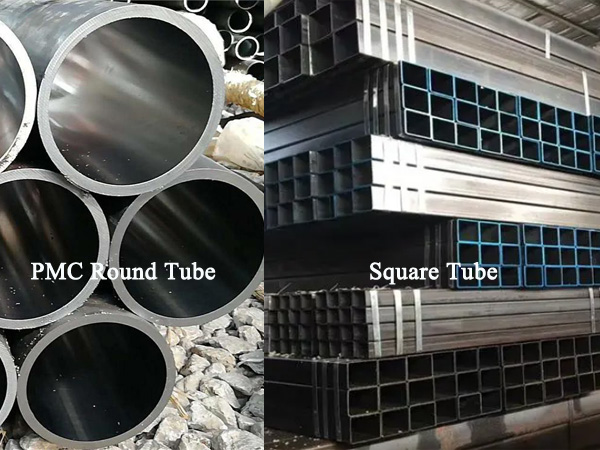
Square tubes generally have a higher section modulus in a given axis. Because the calculation formula for the pipe's resistance moment is based on the moment of inertia (cross-sectional area × pipe height), comparing square tube and round tube of the same cross-sectional area, thickness, and height shows the moment of inertia of the square tube is 86.68 cm to the fourth power, versus 51.05 cm to the fourth power for the round tube. In this specific comparison, the square tube's larger moment of inertia gives it greater bending strength in that axis.
That said, "stronger" depends on the loading direction and application:
Square tube tends to perform better in bending along a fixed axis, which is why it is favored for straight structural members, frames, and vertical load-bearing applications. See our square tube load capacity guide for detailed load calculations.
Round tube distributes stress more evenly around its circular cross-section, which gives it better torsional resistance and more consistent performance under multi-directional or rotating loads.
Neither profile is universally "stronger" — when comparing square tubing vs round tubing, the right choice depends on the direction and type of load your application involves.
Round tube delivers excellent internal pressure resistance, with stress evenly distributed around its circular cross-section. This makes it the optimal choice for fluid, gas, hydraulic systems, and high-pressure pipelines. By contrast, square tube is less resistant to internal pressure, as stress tends to concentrate at its four corners. For this reason, square tube is seldom used in pressure pipeline applications.
Round tube can be difficult to fasten and connect securely, and may rotate during installation. Square tube features flat, straight surfaces that provide stable contact, making welding, bolting, and positioning much simpler and more reliable.
For pipeline and long-distance delivery projects, round tube delivers superior cost effectiveness and lower overall material expenses, especially when using high-performance seamless pipe. Square tube involves slightly higher processing costs but greatly reduces installation difficulty and labor costs for on-site construction. Both profiles come with complete standard sizes and sufficient inventory for stable, fast delivery on bulk orders. Seamless round pipe is more readily available in the market than seamless square tube, making it easier for purchasers to secure stable supply. Round and square tubes commonly used in construction are produced to standards such as ASTM A500, which sets minimum requirements for strength and dimensional tolerance. In large-scale structural and frame projects, square tube provides better overall economic benefits and higher construction efficiency.
Advantages: The stress-bearing area of the round tube is relatively large, and it can evenly distribute the load and make bends. When subjected to large pressure and weight, round pipes have better resistance to deformation and are more suitable for bending processing.
Disadvantages: Due to the smaller connection area of round tubes, the bearing capacity can be attenuated over time, and connection points need to be strengthened. In addition, due to the curved surface at installation points, connections are more prone to cracking and are harder to align, and non-destructive testing is often required to ensure connection quality.
For a relatively large project, installation should strictly follow engineering design requirements, including the shape, size, and thickness of the steel pipe, to ensure project quality meets the standard. For a small project at home, it is generally recommended to choose slightly thicker materials.
If pipes are used as support materials, load-bearing requirements will be relatively high. In this case, square pipes are generally recommended for their better load-bearing performance, particularly at support points.
For vertical load-bearing structures, frames, and applications needing flat surfaces for connection, square tube is generally preferred. For pressure-bearing systems, bending applications, or components needing even stress distribution, round tube is usually the better fit.
Start with the load direction and installation method: if your project needs straight-line vertical support and flat surfaces for welding or bolting, square tube is usually the better fit. If it involves internal pressure, bending, or forming — or needs stress spread evenly around the section — round tube is the better fit. From there, confirm the choice against your project's design requirements and load-bearing specifications before finalizing the tube size and grade.
Structural square and round tubes are commonly to standards such as ASTM A500, which specifies mechanical properties and dimensional tolerances. Always confirm the applicable manufactured standard and grade with your supplier for your specific application.
Square tubes and round tubes are two different types of tubes, each with distinct strengths in bending performance, torsional resistance, and application suitability. When selecting tube materials, comprehensively consider square tube vs round tube based on your specific usage scenario and design requirements, and choose the tubing that best fits your use case. Also confirm that the selected pipes meet relevant standards and specifications to ensure proper performance.
Permanent Steel Manufacturing Co.,Ltd (PMC) is a supplier of square tube and round tube products with international quality certifications. For any inquiries or cooperation, please feel free to contact us.
How to Choose the Right Hollow Square Tube for your Project?
Square Tube Strength Calculation and Load-bearing Calculation
