


Quick Answer: A hot rolled 304 stainless steel tube is made by heating a solid round billet, piercing it into a hollow shell on a piercing mill, then hot rolling and sizing it to the target diameter and wall thickness. After heat treatment and surface cleaning, the tube goes through chemical, mechanical, dimensional, surface, pressure, and (where required) non-destructive testing before it is approved for shipment.
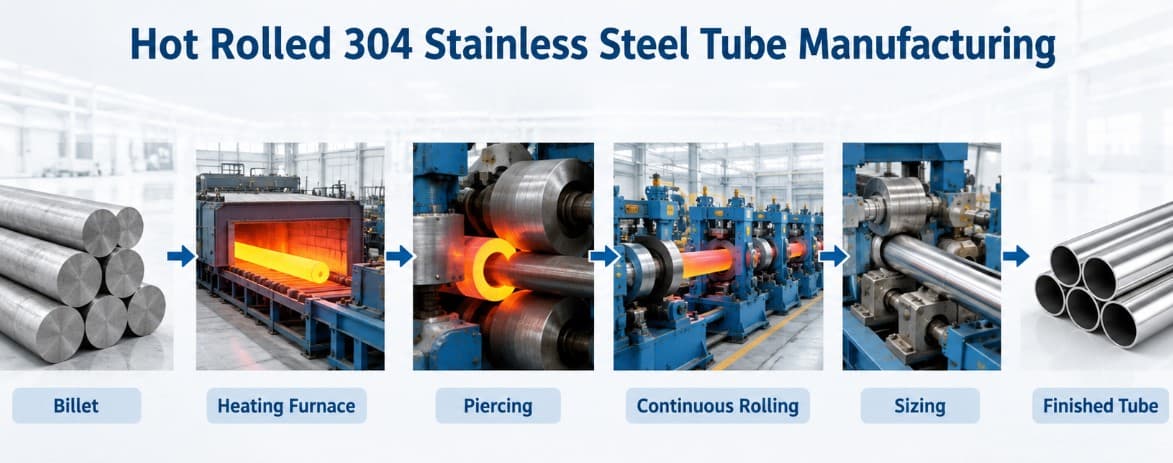
Hot rolled 304 stainless steel tube production follows a continuous sequence from solid billet to finished seamless steel pipe. Each stage affects the tube's final dimensions, surface condition, and mechanical properties, which is why manufacturers control the process closely rather than treating it as a single operation.
The process starts with a solid 304 stainless steel round billet. Before it enters the line, the billet surface is inspected for cracks, scale, or other visible defects, and it is cut to the length required for the piercing operation. The center of the end face is marked to guide the piercing point.
The prepared billet is charged into a heating furnace and brought to a uniform rolling temperature. Even heating throughout the billet is important — uneven temperature distribution can cause off-center piercing or wall thickness variation later in the process.
After hot rolling, 304 stainless steel tubes are heat treated (typically solution annealed) to restore corrosion resistance and ductility that hot working can otherwise reduce, and to produce a uniform, stable microstructure. Annealing leaves an oxide scale on the surface, so tubes are then pickled or otherwise surface-cleaned to remove it before moving on to inspection.
Outside diameter, wall thickness, length, and straightness are measured against the ordered tolerances. Dimensional checks are carried out at multiple points along the tube, not only at the ends, since hot rolling can introduce variation along the length.
Tubes are visually and, where needed, instrument-inspected for surface defects such as scale, pitting, cracks, or laps left over from the hot working process. Surface condition is checked both inside and outside the tube.
Tubes are pressure tested to confirm they can withstand a specified internal pressure without leakage, cracking, or deformation. This test is particularly important for tubes intended for fluid- or gas-carrying applications.
Depending on the intended application and customer requirements, non-destructive methods such as eddy current or ultrasonic testing may be used to detect internal or surface flaws that are not visible to the eye.
Before dispatch, tubes that pass the tests above are checked again for markings, packaging, and completeness of documentation. Each shipment is typically accompanied by a mill test certificate (MTC) recording the chemical and mechanical test results, so buyers can verify the tube matches what was ordered.
For smaller diameters or tighter tolerances, tubes may go through additional cold rolling or cold drawing after the hot rolled stage. These are secondary finishing operations rather than part of the core hot rolling process, and are only noted here for completeness.
Manufacturing a hot rolled 304 stainless steel tube is a sequence of controlled steps — heating, piercing, hot rolling, sizing, heat treatment, and surface cleaning — matched by an equally structured set of tests covering composition, mechanical properties, dimensions, surface quality, and pressure resistance. Together, these steps are what the documentation on an MTC is meant to confirm. If you're sourcing hot rolled 304 stainless steel tubes, our article on Steel Pipe MTC: What Is It and What Should Buyers Check? explains how to read and verify that certificate.
Related articles:
