


Welded and seamless steel pipes can sometimes be told apart at a glance, but that's not always the case. A welded pipe that has been ground, polished, or otherwise surface-treated can look almost identical to a seamless pipe. This is a common source of confusion in procurement and quality inspection.
In practice, identification usually relies on a combination of methods: visual inspection, pipe marking, the Mill Test Certificate (MTC), and — when needed — metallographic examination. For commercial transactions in particular, manufacturer markings and the MTC are generally more dependable than appearance alone. This guide walks through each method and when to rely on it.
|
Method |
What to Check |
Reliability |
|
Visual inspection |
Weld seam |
Basic |
|
Cross-section inspection |
Welded zone |
Moderate |
|
Pipe marking |
Product information |
High |
|
MTC |
Manufacturing method |
High |
|
Metallographic examination |
Weld zone and HAZ |
High |
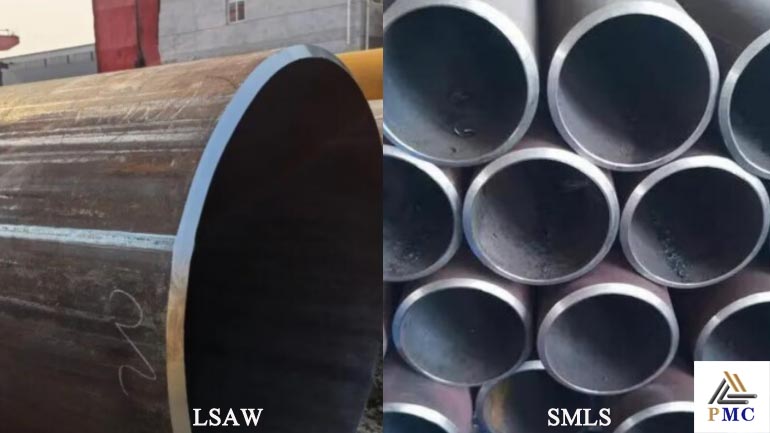
That said, weld seams on ERW pipe and other welded products are often ground, polished, or otherwise finished, and can become very difficult to see with the naked eye. Visual inspection alone is not always sufficient to reliably identify a welded pipe — the absence of a visible seam does not automatically confirm that a pipe is seamless.
Most pipes carry stenciled or stamped markings that can be checked against the order specification, including:
The MTC issued by the manufacturer typically confirms:
Metallographic examination looks at the pipe's microstructure to confirm its manufacturing method.
This method is generally reserved for cases where documentation is missing, disputed, or where a definitive answer is required, since it involves sample preparation and laboratory equipment rather than a quick check.
Because welded pipe is formed by joining the edges of plate or strip, it inherently has a weld seam. Seamless pipe is formed from a solid billet with no edges to join, so it has no longitudinal weld seam by nature of the process — not because of any finishing step.
Visual identification is useful for initial screening, but it is not always conclusive.
Check manufacturer documentation and the MTC first.
Check pipe marking for consistency with the order specification.
Perform an appropriate inspection when documentation is unavailable or disputed.
Use metallic examination when a definitive answer is required.
Treat visual inspection as an initial identification method rather than absolute proof.
How can I identify a welded steel pipe?
Look for a longitudinal or spiral weld seam, which may be visible on the outer or inner surface. If the seam has been ground or polished, confirm the manufacturing method through pipe marking, the MTC, or metallographic examination instead.
How can I identify a seamless steel pipe?
A seamless pipe has no longitudinal weld seam because it's formed from a solid billet rather than joined plate or strip. Since the absence of a visible seam isn't conclusive on its own, check the MTC and pipe marking to confirm.
Can a welded or seamless pipe be identified by appearance alone?
Sometimes, but not always. A visible weld seam is a reliable initial indicator of a welded pipe, but a smooth surface doesn't guarantee the pipe is seamless — finished ERW pipe can look very similar to seamless pipe.
What inspection methods can confirm the pipe type?
Pipe marking and the MTC are generally the most reliable for commercial verification. Metallographic examination, which reveals the weld zone and HAZ in welded pipe, provides a definitive answer when documentation is unavailable or disputed.
Does the absence of a weld seam mean a pipe is seamless?
Not necessarily. Welded pipe that has been ground or finished can have a weld seam that's very hard to detect visually, so a smooth appearance should be verified with pipe marking, the MTC, or further inspection.
Related articles:
