ERW pipe and LSAW pipe are both straight-seam welded steel pipe, but they are made from different raw material and different welding methods, which puts them in different size ranges, pressure classes, and price brackets. Buyers comparing ERW Pipe vs LSAW Pipe for a project usually need to settle three questions before requesting quotes: what diameter and wall thickness the job calls for, what pressure rating it needs to hold, and what budget it has to work within. This page covers the full difference between ERW and LSAW pipe — definitions, specs, manufacturing, sizing, applications, and cost — so you can shortlist the right pipe type before you get on the phone with a mill.
1. ERW Pipe Definition
ERW steel pipe (Electric Resistance Welded pipe) is made from hot-rolled steel coil. The coil is uncoiled and fed continuously through a forming machine, which cold-forms it into a round tube. The seam is then closed using high-frequency electric resistance welding: high-frequency current heats and melts the strip edges via the skin and proximity effect, and squeeze rollers press them together — no filler wire or flux is used. Depending on the equipment, this is done by either induction welding or contact welding.
ERW pipe is the standard choice for small-to-medium diameter pipeline work where production volume and cost matter as much as spec:
High production efficiency
Good dimensional accuracy
Smooth, uniform surface finish
2. LSAW Pipe Definition
LSAW steel pipe (Longitudinal Submerged Arc Welded pipe) is made from a single steel plate rather than coil. The plate is pressed or rolled into a tube-shaped blank, then welded along both the inner and outer surface of the seam using submerged arc welding, and finally expanded mechanically to bring it to final diameter and roundness.
Because it starts from flat plate instead of coil, LSAW pipe covers a size and pressure range that ERW cannot reach:
Large diameter capability
High weld strength
Suitable for high-pressure pipelines
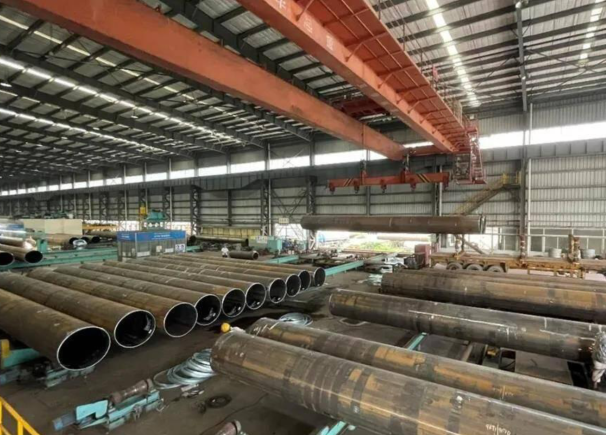
3. ERW vs LSAW Steel Pipe: Comparison Table
Item
|
Typical cost
|
LSAW Pipe
|
Raw material
|
Steel coil
|
Steel plate
|
Welding method
|
High-frequency electric resistance welding
|
Submerged arc welding (double-sided)
|
Diameter range
|
Small to medium (typically up to ~610mm)
|
Large diameter (typically 1422mm and up)
|
Wall thickness
|
Thin to medium
|
Medium to heavy
|
Pressure rating
|
Medium to low pressure
|
Medium to high pressure
|
Weld toughness
|
Slightly below parent material
|
Close to parent material after heat treatment
|
Production efficiency
|
High — continuous line production
|
Lower — pipe-by-pipe production
|
Typical cost
|
Lower
|
Higher
|
4. Manufacturing Process Difference
ERW: Steel Coil → Forming → High Frequency Welding → Sizing → Inspection. The line runs continuously, which is what makes ERW pipe efficient to produce in volume and competitively priced.
LSAW: Steel Plate → Edge Milling → JCOE/UOE Forming → Internal & External Welding → Inspection. Each pipe is formed and welded individually from plate, which takes longer per pipe but is what allows LSAW to reach diameters and wall thicknesses that a coil-fed ERW line physically cannot form.
The takeaway for procurement: ERW's continuous, coil-fed process favors speed and cost on standard sizes; LSAW's plate-based process favors size flexibility and weld strength on large or high-pressure specs.
5. Size Difference
ERW pipe:
Small and medium diameter
Thin to medium wall thickness
LSAW pipe:
Large diameter
Thick wall thickness
If your spec calls for large-diameter, heavy-wall pipe, LSAW is generally the only option of the two — ERW's coil-based process caps out well below LSAW's range.
6. Application Difference
ERW Applications:
Gas pipelines
Water pipelines
Structural applications
LSAW Applications:
Oil and gas transmission pipelines
Offshore projects
Large pipeline systems
7. Cost Difference
ERW pipe:
Lower manufacturing cost
Higher production efficiency
LSAW pipe:
Higher production cost
More complex manufacturing process
Stricter inspection requirements
(For a project-specific quote, contact our sales team.)
8. ERW or LSAW Pipe: How to Choose?
For urban gas distribution, water lines, and general structural work at standard diameters, ERW pipe is usually the more cost-effective spec. For long-distance transmission pipelines, offshore projects, or any application requiring large diameter and high pressure rating, LSAW pipe is the safer spec.
A quick decision checklist:
Diameter and wall thickness — small/medium favors ERW, large/heavy-wall favors LSAW.
Pressure rating — high-pressure service favors LSAW.
Project environment — harsh or critical environments (offshore, high-population areas, extreme climates) typically call for LSAW.
Budget and volume — standard sizes in volume favor ERW on cost; custom large-diameter runs go to LSAW regardless of the price premium.
9. FAQs
Q: What is the difference between ERW and LSAW pipe?
ERW pipe is made from steel coil using high-frequency resistance welding; LSAW pipe is made from steel plate using submerged arc welding. ERW covers small-to-medium diameters at lower cost; LSAW covers large diameters and higher pressure ratings at a higher cost.
Q: Which is stronger, ERW or LSAW pipe?
Within their respective size ranges, both meet standard mechanical strength requirements. LSAW pipe typically achieves weld toughness closer to the parent material after heat treatment, which is why it's specified for high-pressure, large-diameter pipelines.
Q: Can ERW pipe be used for high-pressure pipelines?
ERW pipe is generally rated for medium-to-low pressure service. For higher-pressure, large-diameter transmission lines, LSAW pipe is the more suitable choice.
Q: What size ranges are available for ERW vs LSAW pipe?
ERW pipe is typically produced up to around 610mm in diameter. LSAW pipe is typically produced from around 1422mm and up, with a wider range of wall thicknesses.
Q: Is LSAW pipe more expensive than ERW pipe?
Yes, LSAW pipe generally costs more per ton due to its plate-based raw material, slower pipe-by-pipe production, and stricter inspection requirements. ERW remains the lower-cost option wherever its size and pressure range meets the spec.
Related articles:
Comparing ERW and LSAW Steel Pipe Welding Processes
ERW Pipe VS Seamless Pipe: What's the Difference?
What is LSAW and SSAW Pipe?