


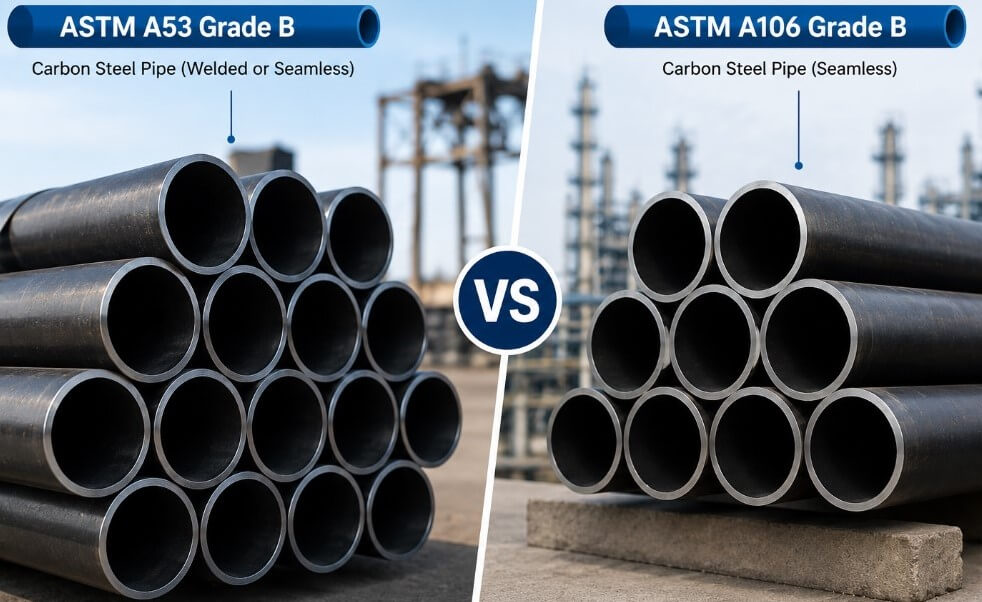
ASTM A53 Grade B and ASTM A106 Grade B are two of the most commonly used carbon steel pipes in industrial applications. While they may appear similar in terms of mechanical properties, they are designed for different purposes.
The main difference between ASTM A53 Grade B and ASTM A106 Grade B (ASTM A53 vs ASTM A106)lies in their manufacturing process, performance under temperature and pressure, and typical applications. ASTM A53 is widely used for general-purpose and low-pressure applications, whereas ASTM A106 is specifically designed for high-temperature and high-pressure service conditions.
|
Feature |
ASTM A53 Grade B |
ASTM A106 Grade B |
|
Manufacturing Type |
Seamless Only |
|
|
Application |
General, low-pressure systems |
High-pressure & high-temperature |
|
Temperature Resistance |
Moderate |
High |
|
Strength |
Standard |
More stringent quality control |
|
Surface Options |
Black, galvanized, coated |
Typically black |
|
Cost |
Lower |
Higher |
ASTM A53 steel pipes are available in a variety of manufacturing processes, including seamless, resistance welded (ERW), and furnace butt welded (F, E, and S types). This flexibility makes A53 steel pipes suitable for a wide range of general applications.
In contrast, ASTM A106 steel pipes are all seamless and are manufactured using hot rolling or cold drawing processes. This ensures greater structural integrity, especially under high pressure and high temperature conditions.
ASTM A53 Grade B has a maximum carbon content of 0.30% and relatively flexible limits on alloying elements.
ASTM A106 Grade B also has a maximum carbon content of 0.30%, but tighter control over composition improves its performance in high-temperature environments. This makes it more suitable for critical industrial systems.
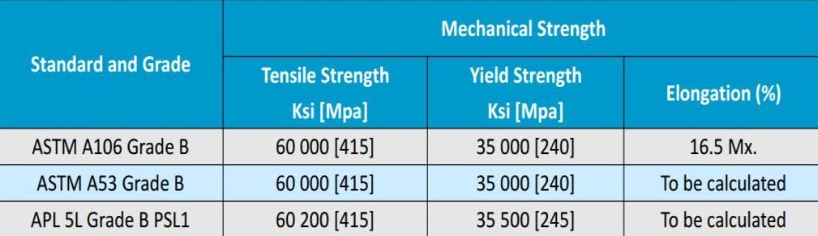
Tensile Strength:
A53 Grade B: Minimum 60,000 psi (415 MPa)
A106 Grade B: Minimum 60,000 psi (415 MPa)
Yield Strength:
A53 Grade B: Minimum 35,000 psi (240 MPa)
A106 Grade B: Minimum 35,000 psi (240 MPa)
Both grades have similar mechanical properties, but A106 is often used in applications where more stringent quality and performance are required.

ASTM A53 Grade B is generally used in low to medium pressure systems and standard temperature environments.
ASTM A106 Grade B is specifically designed for high-pressure and high-temperature service, making it ideal for industries such as oil and gas, power plants, and refineries.
ASTM A53 pipes are available in various surface finishes, including black, galvanized, and coated, making them versatile for construction and water systems.
ASTM A106 pipes are typically supplied in black finish and are rarely galvanized, as they are mainly used in high-temperature industrial environments.
A53 Grade B:
Typically used in applications with lower pressure and temperature requirements.
A106 Grade B:
Suitable for higher pressure and temperature applications, often used in environments where pipes are exposed to elevated temperatures and pressures.
A53 Grade B:
Generally used for low to medium pressure applications, such as water pipes, air pipes, steam, and structural applications.
Common in general construction, mechanical, and plumbing applications.
A106 Grade B:
Used in high-temperature services and high-pressure systems, particularly where seamless piping is preferred.
Common in oil refineries, gas plants, and power generation plants.
Choosing between ASTM A53 Grade B and ASTM A106 Grade B depends on your operating conditions, including pressure, temperature, cost, and application requirements.
Choose ASTM A53 Grade B if you need a cost-effective steel pipe for general construction, water supply systems, structural applications, or low-pressure service.
ASTM A53 is widely used in standard industrial and mechanical projects where extreme temperature or pressure is not required.
Choose ASTM A106 Grade B if your project involves high-temperature or high-pressure environments, such as oil and gas pipelines, refineries, power plants, or other critical industrial systems.
ASTM A106 provides better performance and reliability under demanding operating conditions due to its seamless manufacturing process and stricter quality control.
In summary, when comparing ASTM A53 vs ASTM A106, A53 is best suited for general and cost-sensitive applications, while A106 is the preferred choice for high-performance and high-risk industrial environments where safety and durability are critical.
Q1: What is the main difference between ASTM A53 and ASTM A106?
The primary difference is that ASTM A53 can be welded or seamless and is used for general applications, while ASTM A106 is seamless only and designed for high-temperature and high-pressure service.
Q2: Can ASTM A53 replace ASTM A106?
In low-pressure and non-critical applications, ASTM A53 may be used as a substitute. However, for high-temperature or high-pressure environments, ASTM A106 is the recommended choice.
Q3: Is ASTM A106 stronger than ASTM A53?
Both Grade B pipes have similar mechanical strength, but ASTM A106 is generally considered more reliable due to stricter manufacturing and testing standards.
ASTM A53 Class B pipe and ASTM A106 Class B pipe have similar strength properties, but significant differences exist in manufacturing processes, applications, and performance.
ASTM A53 is a versatile and cost-effective general-purpose pipe, while ASTM A106 is designed for high-performance environments such as high temperature and high pressure.
Choosing the appropriate pipe depends on your specific application requirements, operating conditions, and budget.
To better understand ASTM A53 pipe and related standards, you may also find these guides useful:
