


Carbon steel pipes are widely used in industries such as oil & gas, construction, and power generation due to their strength and cost efficiency. During production and handling, contaminants like oil, grease, rust, and mill scale can accumulate on the pipe surface, affecting performance and durability. Therefore, proper surface treatment is essential, particularly for high-spec seamless steel pipe. Degreasing removes oil and grease, while pickling eliminates rust and oxide layers. Passivation then forms a protective film to improve corrosion resistance. These processes ensure clean surfaces, longer service life, and reliable performance in demanding applications.
Common methods include solvent cleaning, alkaline cleaning, and emulsion cleaning. Proper degreasing prevents process interference, improves coating adhesion, enhances pickling and passivation results, and boosts pipe durability. It is an essential step for reliable carbon steel pipe performance.
A preliminary surface inspection is carried out to identify oil stains, rust spots, and mill scale on carbon steel pipes. The contamination level is recorded to determine appropriate soaking time for subsequent degreasing and pickling, ensuring effective cleaning while preventing over-corrosion of the base metal.
The pipes are immersed in an alkaline degreasing solution to remove surface oil, grease, and residual cutting fluids. The solution temperature and soaking duration are carefully controlled based on the level of contamination. Complete degreasing is verified through methods such as filter paper or camphor testing before proceeding to the next stage.
The pipes are rinsed with high-pressure clean water to remove any residual degreasing solution from both internal and external surfaces. This step prevents alkaline residues from interfering with the pickling process.
The cleaned pipes are immersed in a sulfuric or hydrochloric acid solution to dissolve rust and iron oxide scale. Acid concentration, temperature, and immersion time are strictly controlled until a uniform metallic surface is achieved. The pipes are then rinsed thoroughly after pickling.
The pickled pipes are transferred into a diluted ammonia solution to neutralize any residual acid on the surface and prevent further corrosion. A short immersion at room temperature is sufficient for effective neutralization.
The neutralized pipes are immersed in a specially formulated passivation solution to form a dense protective oxide film on the steel surface. This layer significantly reduces oxidation and enhances long-term corrosion resistance.
Finally, the pipes are rinsed with purified water to remove any remaining passivation chemicals. They are then thoroughly dried using oil-free compressed air or nitrogen. After final inspection, the pipe ends are sealed to ensure proper storage and protection.
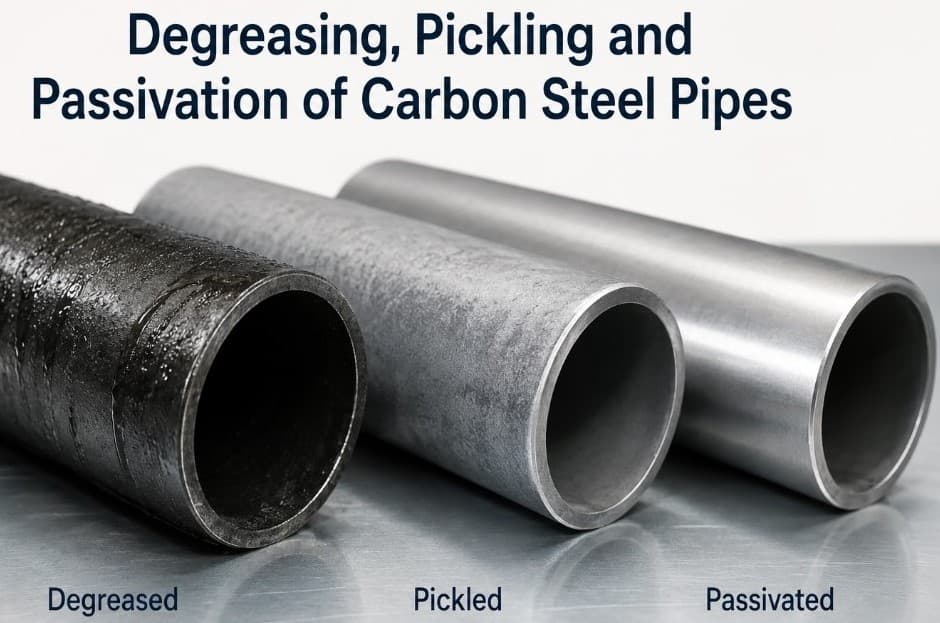
The combination of degreasing and pickling passivation provides significant advantages in improving the overall quality and performance of carbon steel pipes. By thoroughly removing oil, grease, rust, and mill scale, these processes ensure a clean and uniform metal surface that is essential for subsequent treatment and application.
One of the most important benefits is enhanced corrosion resistance. The passivation layer formed on the steel surface acts as a protective barrier, effectively slowing down oxidation and extending the material’s service life even in harsh environments.
In addition, these processes greatly improve surface cleanliness, eliminating contaminants that could otherwise affect welding, assembly, or further processing.
They also enhance coating adhesion, making it easier for paints, galvanizing layers, or other protective coatings to bond firmly to the pipe surface, ensuring long-term stability and performance.
Overall, degreasing and pickling passivation significantly increase the service life of carbon steel pipes, making them more reliable and durable for demanding industrial applications.
Treated carbon steel pipes are widely used across industries where strength, durability, and corrosion resistance are essential. Their performance after processes such as degreasing, pickling, and passivation makes them suitable for demanding operating environments.
In the oil and gas sector, these pipes are commonly used for transporting crude oil, natural gas, and refined products over long distances. The treatment process helps ensure internal cleanliness, reducing the risk of contamination and improving flow efficiency in critical pipeline systems.
Within the chemical industry, treated carbon steel pipes are valued for their ability to withstand aggressive media and fluctuating operating conditions. They are often applied in process pipelines, transfer lines, and auxiliary systems where surface purity and corrosion resistance are key requirements.
Power plants also rely on these pipes for steam lines, cooling water systems, and auxiliary piping networks. Their stability under high temperature and pressure conditions makes them a reliable choice for continuous operation in energy production facilities.
In water treatment systems, treated carbon steel pipes are used for raw water transmission, filtration units, and distribution networks. The improved surface condition helps minimize scaling and biological contamination, supporting long-term system efficiency.
Beyond industrial processing, these pipes are also used in structural applications. They serve as load-bearing components in construction, infrastructure projects, and mechanical frameworks where strength and service life are critical considerations.
Degreasing, pickling and passivation of carbon steel pipes is a critical surface treatment process to guarantee surface cleanliness, corrosion resistance and long-term performance. The process starts with surface inspection, followed by degreasing to remove grease and contaminants, acid pickling to remove rust and mill scale, neutralization to adjust surface pH, and passivation to form a dense protective anti-corrosion film. Final rinsing and drying leave pipe surfaces clean and dry for service.
Q1: What is degreasing of carbon steel pipes?
Degreasing is the process of removing oil, grease, and dirt from the pipe surface using an alkaline cleaning solution. It prepares the surface for further treatment.
Q2: What is pickling and passivation?
Pickling removes rust and scale from the pipe surface using acid solutions. Passivation forms a protective layer that improves corrosion resistance and surface stability.
Q3: What is the process of degreasing, pickling and passivation?
The main steps are:
Surface inspection → Degreasing → Rinsing → Pickling → Neutralization → Passivation → Final rinsing → Drying
Q4: What are the benefits of this process?
Removes oil, rust, and scale
Improves corrosion resistance
Extends pipe service life
Provides a clean, uniform surface
Suitable for oxygen and industrial piping systems
Q5: What are the applications?
Treated carbon steel pipes are widely used in:
Oxygen pipelines
Oil & gas industry
Petrochemical plants
Power plants
Industrial piping systems
Permanent Steel Manufacturing Co.,Ltd (PMC) is a professional and experienced supplier of carbon steel pipes with rich industry experience, strict quality control and complete international certifications. We provide high-quality products and professional services for global customers. For any inquiries or cooperation, please feel free to contact us.
Related articles:
