


Steel pipe is a relatively common pipe material. It can be divided into different types such as seamless pipe and welded pipe. So what is the difference between seamless pipe and welded pipe? Next, the carbon steel pipe supplier will briefly introduce to you.
Seamless pipes are manufactured from a solid steel billet with no weld seam, making them stronger and better suited for high-pressure and high-temperature applications — but at a higher cost. Welded pipes are made by rolling and welding steel plate or coil, offering a lower price point, wider size availability, and reliable performance for general industrial and structural use.
|
Feature |
Seamless pipe |
Welded pipe |
|
Manufacturing |
Solid billet, no seam |
Rolled plate, welded joint |
|
Weld seam |
None |
Present |
|
Pressure resistance |
Higher |
Moderate to high |
|
Structural strength |
Higher |
Good for general use |
|
Cost |
Higher |
Lower |
|
Size availability |
Limited range (see 2.9 for detail) |
Wider range(see 2.9 for detail) |
|
Best for |
High-pressure, high-temp service |
Water supply, construction, structural |
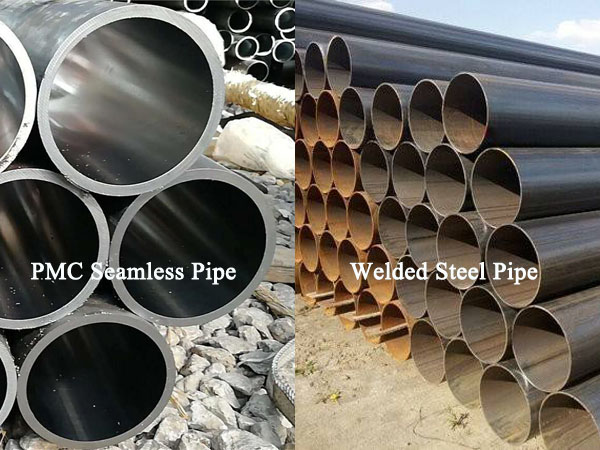
Seamless pipes are more expensive than welded pipes because the production process of seamless pipes is more complicated and its cost is higher.
Seamless steel pipes are often used in high-pressure equipment because of their better carrying capacity than ordinary steel pipes. Such as hydraulic equipment, pipe connections, etc. The welding position of ordinary steel pipe is the weak link, and the quality of the weld is the main factor affecting its comprehensive performance. The physical properties of seamless steel pipes are better than those of welded pipes, and their compression resistance is higher. The welded pipes are generally about 10 MPa, and in practice can withstand roughly 20% less working pressure than seamless pipe of the same specification. Now welded pipes are seamlessly treated, narrowing this gap for high-quality ERW products.
2.10 Different Uses
Seamless steel pipes are generally used in factories; welded steel pipes are generally used in construction.Welded pipes are used for liquid transportation: water supply and drainage. Used for gas transportation: coal gas, steam, liquefied petroleum gas; used for structure: used as piling pipes, pipes for bridges, piers, roads, building structures, etc.
Not sure if the pipe in your hands is seamless or welded? In most cases you don't need a lab — a flashlight, a caliper, and a few minutes are enough.
a: Start with the cut end of the pipe. Point a flashlight along the inner wall at a low angle and look for a raised line or slight discoloration running the length of the pipe — that's the weld seam. A genuine seamless steel pipe won't show this under any lighting angle, since there's no seam to catch the light in the first place.
b: Grinding can hide a seam from the eye, but it rarely hides it from your fingers. Run a fingertip slowly around the inside circumference near the cut end; a welded pipe often still has a faint ridge or a slightly rougher patch where the weld was ground down, even after the outside has been polished smooth.
c: Measuring helps too, and it's worth doing if the first two checks are inconclusive. Take a caliper reading at four points around the same cross-section. Welded pipe, rolled from strip or coil, tends to hold a tighter, more even wall thickness across those four points. Seamless pipe usually shows more variation from one side to the other — a byproduct of the hot-piercing process rather than a defect.
None of these tests is 100% conclusive on its own, especially with high-quality ERW pipe that's been heat-treated and finished to look seamless. When the seamless vs welded pipe question really matters — for a pressure-rated application, for example — mill certification and test reports remain the only fully reliable answer.
Choosing between seamless pipe vs welded pipe depends on your operating pressure, temperature, application, and budget. Here's a quick guide:
The key difference between seamless and welded pipe is not about which is universally better — it's about matching the right pipe to your project requirements. When safety and performance are critical, seamless steel pipe is the preferred choice. When cost efficiency and availability matter more, welded pipe is the smarter option.
Q1: What is the main difference between seamless and welded steel pipe?
Seamless steel pipe is made from a solid billet with no weld seam, giving it higher strength and pressure resistance. Welded pipe is made by rolling steel plate and welding the seam, making it more affordable but slightly lower in structural integrity at the joint.
Q2: Is seamless pipe stronger than welded pipe?
Yes. Because seamless steel pipe has no weld seam, it has uniform wall thickness and consistent mechanical properties throughout, making it stronger and more reliable under high pressure and temperature conditions.
Q3: When should I use seamless steel pipe instead of welded pipe?
Choose seamless steel pipe for applications involving high pressure, high temperature, corrosive fluids, or critical safety requirements — such as oil & gas, hydraulic systems, boilers, and chemical processing. Use welded pipe for general structural, water supply, or low-pressure applications.
Q4: Is welded pipe cheaper than seamless pipe?
Yes. Welded pipe is significantly more cost-effective due to simpler manufacturing processes and faster production speeds. For non-critical applications, welded pipe offers a practical and economical alternative.
In conclusion, seamless pipe and welded pipe differ greatly in manufacturing process, appearance, raw materials, wall thickness, physical properties and overall performance. They also vary in function, price and applicable usage scenarios, making each suited for distinct working conditions. Beyond clearly understanding these nine key differences, it is equally vital to follow professional guidelines when purchasing carbon steel seamless pipes. Taking standard specifications, material quality and actual project demands into account helps buyers make a rational, cost-effective choice, while ensuring long-term safety and stable operation of pipeline systems.
Explore More Seamless Pipe Comparison Guides:
ERW Pipe VS Seamless Pipe: What's the Difference?
Seamless Pipe vs MS Pipe: Key Differences, Uses & How to Choose
Learn more about seamless and welded pipes through the following related articles:
How to Choose Between Seamless and Welded Pipe
Why are Seamless Pipes more Expensive than Welded Pipes?
