


Welded steel pipe falls into two families by weld shape: straight seam (ERW, LSAW) and spiral seam (SSAW). ERW uses high-frequency resistance welding on coiled strip; LSAW uses submerged arc welding on single steel plates; SSAW also uses submerged arc welding but forms the weld in a spiral line. Each process gives the pipe a different diameter range, pressure rating, and ideal application. This guide gives you a quick side-by-side comparison — for a deeper dive into any single pairing, jump to our dedicated comparison pages linked below.
The table below summarizes how ERW, LSAW and SSAW differ across the factors that matter most when specifying pipe for a project — welding process, size range, pressure rating, cost and the standards each type typically meets. Use it as a quick reference, then check the sections and detailed guides below for the reasoning behind each figure.
|
|
ERW |
LSAW |
SSAW |
|
Full name |
Electric Resistance Welded Pipe |
Longitudinal Submerged Arc Welded Pipe |
Spiral Submerged Arc Welded Pipe |
|
Weld shape |
Straight seam |
Straight seam |
Spiral seam |
|
Welding process |
High-frequency induction/contact welding |
Double-sided submerged arc welding (UOE/JCOE/HME) |
Submerged arc welding, spiral forming |
|
Raw material |
Hot-rolled steel coil |
Single medium/thick steel plate |
Steel coil |
|
Typical diameter |
Small–medium |
Large |
Small–large (flexible) |
|
Typical wall thickness |
Thin |
Thick |
Medium |
|
Dimensional accuracy |
High |
High |
Moderate |
|
Pressure resistance |
Medium–high |
High |
Low–medium |
|
Cost |
Low |
Higher |
Lowest |
|
Typical use |
Urban gas, oil/product transport, structural |
Long-distance oil & gas trunk lines, offshore, high-pressure |
Water pipelines, piling, low-pressure/non-critical lines |
|
Common standard |
API 5L, ASTM A53 |
API 5L PSL2, DNV |
API 5L PSL1 |
ERW Steel Pipe
ERW (Electric Resistance Welded) pipe is made from hot-rolled steel coil through pre-bending, continuous forming, high-frequency welding, heat treatment, sizing and cutting. It offers short weld seams, high dimensional accuracy, uniform wall thickness and good surface finish. The limitation is that it's best suited to small and medium diameters with thinner walls. It's the standard choice for city gas networks and crude oil/refined product transport.
LSAW Steel Pipe
LSAW (Longitudinal Submerged Arc Welded) pipe is formed from a single steel plate, pressed into shape and welded on both sides using submerged arc welding, then expanded to final diameter. It delivers large diameters, thick walls, and strong performance under high pressure, high/low temperature and corrosive conditions. For long-distance oil and gas trunk lines — especially through alpine terrain, seabeds, or densely populated areas — LSAW is often the only pipe type that meets API requirements for Class 1/2 areas.
SSAW Steel Pipe
SSAW (Spiral Submerged Arc Welded) pipe is formed and welded simultaneously, with the weld seam running in a spiral line. A single strip width can produce multiple diameters, raw material use is more flexible, and the spiral weld can help distribute stress. The trade-off is lower dimensional precision and a longer total weld length, which increases the risk of porosity, slag inclusion and cracking. Most international codes restrict SSAW to Category 3/4 pipeline areas, though it remains widely used domestically for water transmission and lower-pressure lines.
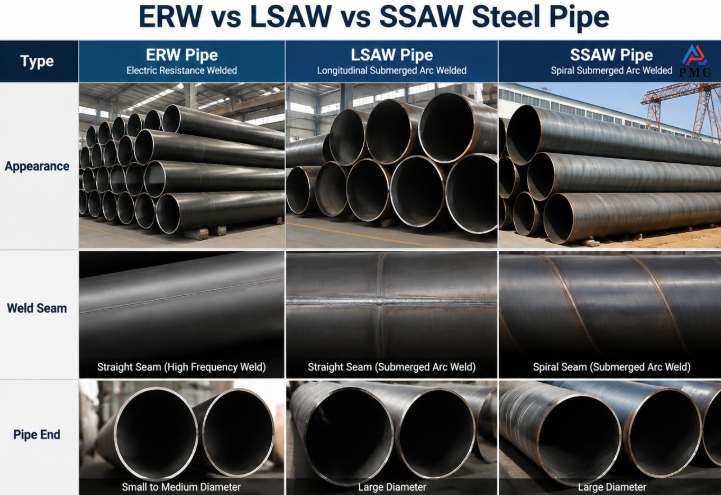
Need a large diameter, thick wall for high-pressure or long-distance oil/gas trunk lines → LSAW is the safer choice, and often the only compliant option for Class 1/2 pipeline areas.
Working with small-to-medium diameter, thinner-wall pipe for gas distribution or moderate-pressure service → ERW offers strong dimensional accuracy at a lower cost.
Prioritizing budget and need a wide range of diameters produced from the same coil → SSAW is the most economical, but limited to lower-pressure or non-critical applications (Class 3/4 areas).
Still unsure? Match your project's operating pressure, pipe diameter, and governing standard (e.g. API 5L PSL1 vs PSL2) against the comparison table above, or see the detailed pairwise comparisons below.
Where Can You Use Welded Steel Pipe? (ERW/LSAW/SSAW) — looking for pipe by application or standard instead of by process? See which national/industry standard applies to your project
A: SSAW is typically the lowest-cost option due to continuous coil production and flexible raw material use, followed by ERW. LSAW carries a cost premium justified by its higher pressure rating and dimensional precision.
Related articles:
