


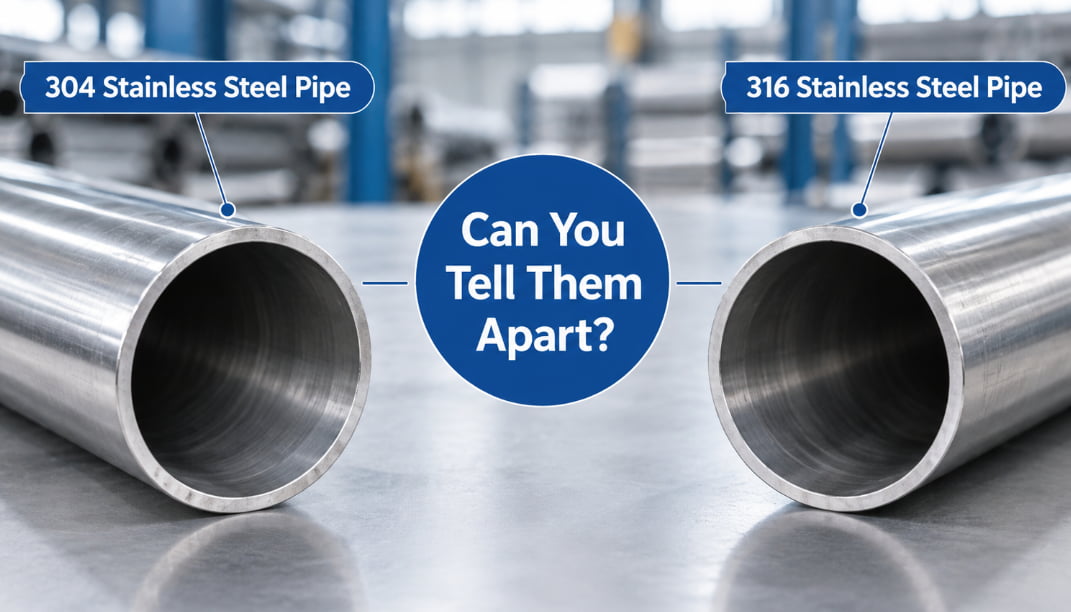
304 stainless steel pipe and 316 stainless steel pipes look very similar, so they cannot be reliably distinguished by appearance alone. Both grades share the same silver-grey finish, and differences in polish or surface texture come from manufacturing, not from the material grade itself.
Surface markings such as "304" or "316" can offer a useful reference point, but they should not be treated as final proof — markings can wear off, be mislabeled, or simply be absent on cut sections. When the grade needs to be confirmed with confidence, methods such as checking the material certificate, chemical testing, or XRF (X-ray fluorescence) analysis are used instead.
304 and 316 stainless steel pipes are visually almost identical. Color, surface finish, and polishing level do not correlate reliably with material grade — a mirror-polished 304 pipe can look identical to a mirror-polished 316 pipe, and neither shows any visible sign of the molybdenum content that separates the two grades. Visual inspection alone cannot reliably confirm whether a stainless steel pipe is 304 or 316.
Since appearance is not a dependable indicator, the following methods are used in practice to check the actual grade.
However, pipe markings should be treated as a reference rather than conclusive proof. Markings can be worn away during handling, cut off when a pipe is shortened, or — in rare cases — mislabeled during production or resale. For any application where grade confirmation matters, marking alone is not sufficient.
This method can help distinguish the two grades without lab equipment, but the result can be affected by the specific reagent used, surface condition, and how the test is carried out. It's a useful field check rather than a definitive certification, and results are best confirmed with a more precise method when accuracy is critical.
|
Method |
Can It Identify the Grade? |
Reliability |
|
Visual inspection |
No |
Low |
|
Surface markings |
Provides a clue |
Medium |
|
Chemical testing |
Yes |
Medium–High |
|
XRF analysis |
Yes |
High |
|
Material certificate |
Yes, if authentic |
High |
No. 304 and 316 stainless steel pipes have the same silver-grey appearance and can carry identical surface finishes, so appearance alone cannot reliably distinguish the two grades. Confirming the grade requires checking markings, testing, or documentation rather than visual inspection.
You can start by checking the pipe's surface marking, then confirm with chemical reagent testing or XRF analysis for greater accuracy. A material certificate from the supplier, if authentic, also confirms the grade. Combining more than one method gives the most reliable result.
XRF analysis is generally the most reliable method, as it directly measures elemental composition and detects the molybdenum present in 316 but not in 304. A valid material certificate is equally reliable when its authenticity can be verified against the supplied pipes.
Read more:
