


304 stainless steel and 316 stainless steel are among the most widely used austenitic stainless steel grades. Although they look very similar, sharing the same bright, corrosion-resistant surface finish, their chemical composition and corrosion resistance are different.
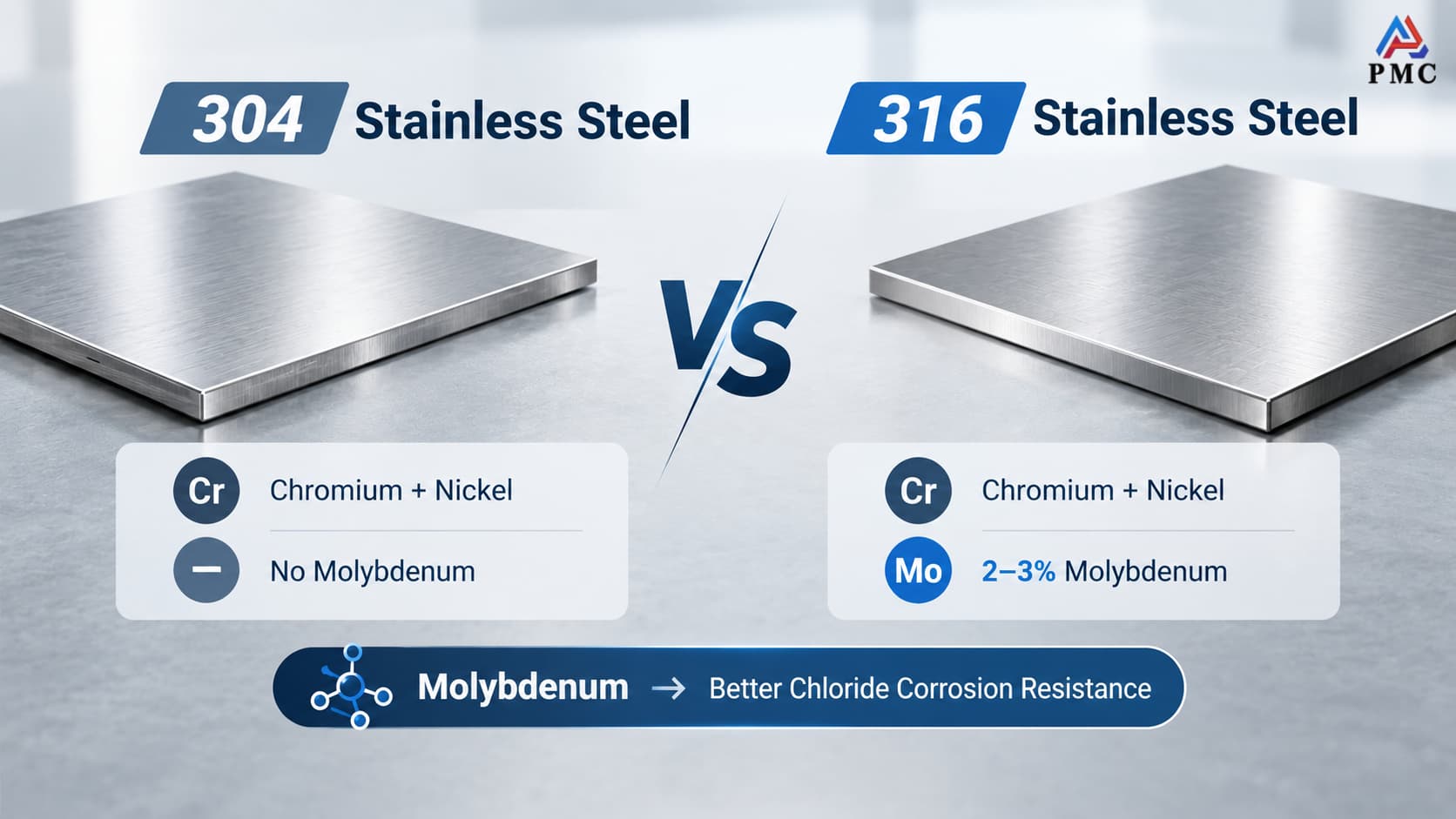
The main distinction is that 316 stainless steel contains molybdenum, an element that is not intentionally added to 304 stainless steel. This is the primary reason 316 offers better resistance to chloride-induced corrosion than 304, making it a more suitable choice for applications exposed to salts, seawater, or aggressive chemical environments.
|
Property |
304 Stainless Steel |
316 Stainless Steel |
|
Chromium |
18–20% |
16–18% |
|
Nickel |
8–10.5% |
10–14% |
|
Molybdenum |
None |
2–3% |
|
Corrosion Resistance |
Good |
Better |
|
Chloride Resistance |
Good |
Better |
|
Pitting Resistance |
Good |
Better |
|
Relative Cost |
Lower |
Higher |
Both 304 and 316 are chromium-nickel austenitic stainless steels, but their alloy content differs in a few key ways. 304 typically contains 18–20% chromium and 8–10.5% nickel, along with small, controlled amounts of carbon and manganese for structure and workability. 316 has a slightly lower chromium range (16–18%) but a higher nickel content (10–14%), and — most importantly — it includes approximately 2–3% molybdenum, an element that 304 does not contain.
This molybdenum addition is the defining chemical difference between the two grades. While chromium provides the base corrosion resistance common to all stainless steels, molybdenum improves resistance to localized corrosion, particularly pitting and crevice corrosion caused by chloride-containing environments. Carbon and manganese levels are similar between the two grades and have a comparatively minor effect on corrosion performance.
304 stainless steel offers excellent general corrosion resistance and performs well in most normal environments. It is suitable for common atmospheric conditions and mildly corrosive settings where exposure to chlorides is limited.
316 stainless steel provides better resistance to chloride-containing environments, along with improved resistance to pitting and crevice corrosion. Molybdenum is the key reason for this improvement, as it strengthens the passive oxide layer against localized attack.
It's important to note that 316 is not simply a "stronger" version of 304. Its main advantage is improved corrosion resistance, especially against chlorides — not higher mechanical strength or overall durability. Both grades will corrode under sufficiently aggressive conditions; 316 is simply better equipped to handle chloride exposure.
304 stainless steel is commonly used for food equipment, kitchen equipment, general industrial equipment, and general-purpose stainless steel products, where corrosion exposure is limited.
316 stainless steel is more often selected for chemical equipment, marine-related equipment, pharmaceutical equipment, and other applications exposed to chlorides, where its improved corrosion resistance provides a longer service life.
For a comparison focused specifically on stainless steel pipes, see our guide to 304 vs 316 stainless steel pipe, which covers pipe applications, cost, and selection in more detail.
316 contains molybdenum, which 304 does not, and this gives 316 better resistance to chloride-induced corrosion.
Yes, especially in chloride-containing environments such as seawater or de-icing salts, where the molybdenum in 316 provides added protection against pitting and crevice corrosion.
Both 304 and 316 can corrode under certain conditions. 316 generally provides better resistance to chloride-induced corrosion, but it is not completely corrosion-proof.
Read more:
