


304 stainless steel seamless pipe fractures during processing are most often traced to three stages: billet heating, hot piercing, and cold working. Getting the heating temperature, piercing parameters, and deformation control wrong at any of these stages is what typically produces cracking or layered defects in the finished tube. This article breaks down the main fracture causes based on macroscopic fracture morphology observed during pickling and cold working, and outlines practical measures to prevent processing fracture in 304 stainless steel seamless pipe production.
A seamless pipe is formed without welding, by piercing or extruding a solid billet over a mandrel to create a hollow tube. This process gives seamless pipe strong performance under high pressure, high temperature, and corrosive conditions — but it also means that any error in the heating, piercing, or cold-forming steps can show up directly as a fracture in the finished 304 stainless steel seamless pipe.
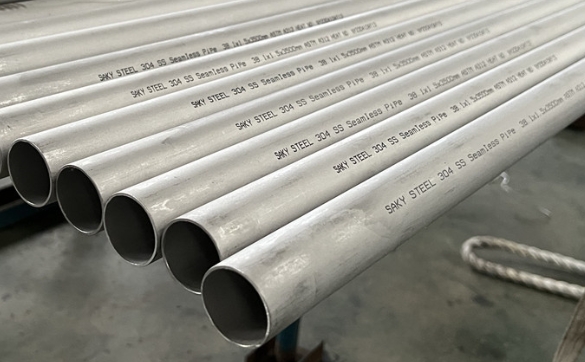
The fracture causes below cover the four stages where 304 stainless steel seamless pipe most commonly develops defects: billet heating, hot piercing, rolling, and cold working.
Hot piercing is one of the most critical steps in 304 stainless steel seamless pipe processing, and it starts with correct billet heating. If the heating temperature before piercing is not controlled within a reasonable range, it becomes much easier for folds to form on the inner and outer surfaces of the tube during piercing.
Along with heating temperature, the piercing parameters themselves — roll speed, penetration rate, and the sizing of the capillary (hollow shell) relative to the required specification — directly affect piercing quality. An unreasonable combination of these parameters is a common trigger for surface folding and for layered or collapsed (implosion-type) defects in the capillary.
Layered shortage in the tube is often associated with high heating temperature or with a piercing roll speed that is too fast. Under either condition, the capillary tends to stratify, and this layering will crack open during subsequent reaming. On the fracture surface, this shows up as a clear layered morphology.
A few concrete measures reduce processing fracture in 304 stainless steel seamless pipe production:
Control billet heating temperature within the process-specified range before piercing, avoiding both under-heating and overheating.
Match hot piercing roll speed and penetration rate to the actual billet condition and grade, rather than running a fixed speed regardless of conditions.
Check capillary size and specification against the target tube dimensions before reaming, to catch early signs of layering before it propagates.
Limit deformation during cold working, especially in secondary forming such as elbow bending, and inspect tubes with any suspected hot-piercing history for internal cracking before further processing.
Rational process selection at each of these stages is the most effective way to reduce 304 stainless steel seamless pipe processing fracture and improve yield.
Related articles:
